• HOME
  • NEWS
  • EXPLORE
    • CAREER
      • Companies
      • Jobs
    • EVENTS
    • iGEM
      • News
      • Team
    • PHOTOS
    • VIDEO
    • WIKI
  • BLOG
  • COMMUNITY
    • FACEBOOK
    • INSTAGRAM
    • TWITTER
Monday, November 23, 2026
BIOENGINEER.ORG
No Result
View All Result
  • Login
  • HOME
  • NEWS
  • EXPLORE
    • CAREER
      • Companies
      • Jobs
        • Lecturer
        • PhD Studentship
        • Postdoc
        • Research Assistant
    • EVENTS
    • iGEM
      • News
      • Team
    • PHOTOS
    • VIDEO
    • WIKI
  • BLOG
  • COMMUNITY
    • FACEBOOK
    • INSTAGRAM
    • TWITTER
No Result
View All Result
Bioengineer.org
No Result
View All Result
Home NEWS Science News Technology

Asynchronous Traffic Shaper Matches Synchronized In-Vehicle TSN Delay Without Clock Synchronization

by
November 23, 2026
in Technology
Reading Time: 2 mins read
0
Asynchronous Traffic Shaper Matches Synchronized In-Vehicle TSN Delay Without Clock Synchronization

Asynchronous Traffic Shaper Matches Synchronized In-Vehicle TSN Delay Without Clock Synchronization

Share on FacebookShare on TwitterShare on LinkedinShare on RedditShare on Telegram

An Asynchronous Traffic Shaper can achieve end-to-end communication delays within the same order of magnitude as the synchronized Credit-Based Shaper while operating without system-wide clock synchronization in zone-based in-vehicle networks.

The comparative analysis evaluated both shaping mechanisms under two primary network forwarding paradigms: store-and-forward switching and cut-through switching. Across realistic in-vehicle traffic profiles, cut-through switching delivered substantial reductions in device-level latency when compared against store-and-forward operation. Specifically, the evaluation revealed that cut-through switching reduced device-level delay by up to 53 percent under the Credit-Based Shaper and by up to 41 percent under the Asynchronous Traffic Shaper, underscoring the significant latency benefits of cut-through forwarding for in-vehicle data transmission.

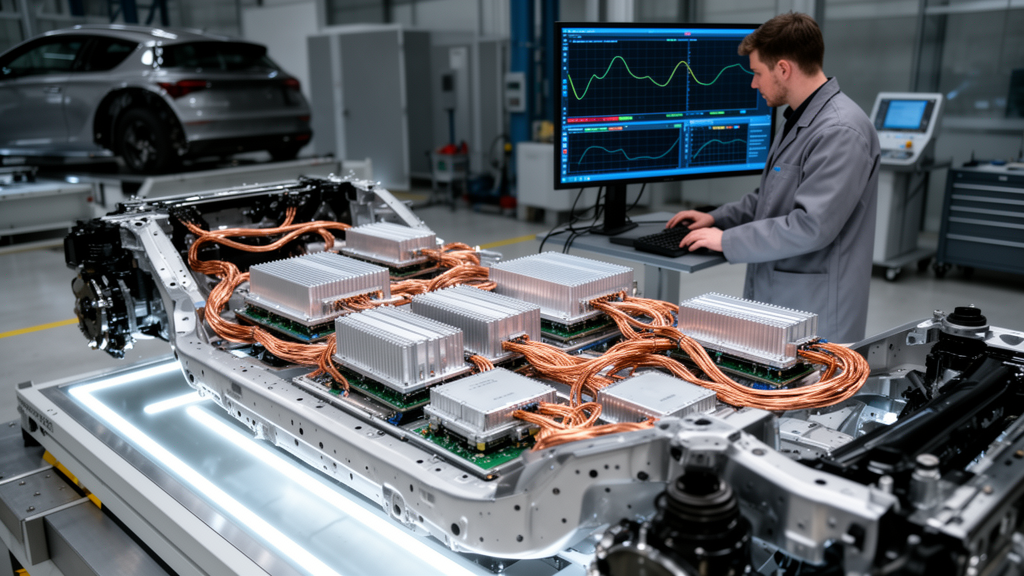
The research addresses pressing architectural challenges arising from the rapid evolution of modern automotive systems. The contemporary automotive industry faces mounting communication demands driven by an increasing density of Electronic Control Units required to support Advanced Driver Assistance Systems, in-vehicle infotainment, and autonomous driving capabilities.

Despite its capabilities, conventional Time-Sensitive Networking relies upon synchronous operation governed by system-wide clock synchronization, an operational requirement that encounters severe practical hurdles in modern vehicle architectures. As the total count of Electronic Control Units and distributed zone controllers multiplies across large-scale automotive environments, establishing and continuously sustaining synchronized clocks across every network node becomes increasingly difficult and impractical to maintain reliably during active vehicle operation.

To establish a rigorous and fair comparison between synchronized and asynchronous strategies, the research team evaluated both the Credit-Based Shaper and the Asynchronous Traffic Shaper under identical internal Electronic Control Unit traffic constraints. The authors developed a formal end-to-end delay model that systematically decomposed total network latency into distinct propagation delay components and device-level delay components encountered across the zone-based in-vehicle network architecture.

Using network calculus, the investigators derived analytical worst-case delay bounds to establish deterministic, per-stream quality-of-service guarantees for both shaping mechanisms. The resulting analytical and experimental findings show that the Asynchronous Traffic Shaper maintains tight delay boundaries matching the order of magnitude of Credit-Based Shaping without imposing any requirement for global clock synchronization, validating its readiness as a robust shaping solution for zone-based in-vehicle Time-Sensitive Networking deployments.

Subject of Research: Traffic shaping mechanisms in zone-based in-vehicle Time-Sensitive Networking

Article Title: Comparative Evaluation of CBS and ATS Traffic Shaping in Zone-Based In-Vehicle TSN: An End-to-End Delay and Network Calculus Analysis

Article References: Boulahdour, A., Bagaa, M., Ouameur, M. A., Ksentini, A., & Massicotte, D. (2027). Comparative Evaluation of CBS and ATS Traffic Shaping in Zone-Based In-Vehicle TSN: An End-to-End Delay and Network Calculus Analysis. Journal of Network and Systems Management, 35(1), Article 10. https://doi.org/10.1007/s10922-026-10119-5

Image Credits: AI Generated

DOI: 10.1007/s10922-026-10119-5

Keywords: Time-Sensitive Networking, Credit-Based Shaper, Asynchronous Traffic Shaper, in-vehicle networks, zone-based architecture, end-to-end delay, network calculus, cut-through switching, store-and-forward switching, Electronic Control Units, automotive Ethernet, worst-case delay bounds, clock synchronization, Advanced Driver Assistance Systems, autonomous driving, deterministic delay guarantees, traffic shaping

News Source: Denise Maddox. (November 23, 2026). Asynchronous Traffic Shaper Matches Synchronized In-Vehicle TSN Delay Without Clock Synchronization. Scienmag.


Tags: advanced driver assistance systemsAsynchronous Traffic Shaperautomotive EthernetAutonomous drivingclock synchronizationCredit-Based Shapercut-through switchingdeterministic delay guaranteesElectronic Control Unitsend-to-end delayin-vehicle networksnetwork calculusstore-and-forward switchingTime-Sensitive Networkingtraffic shapingworst-case delay boundszone-based architecture
Share12Tweet7Share2ShareShareShare1

Related Posts

Multifunctional Magnetic Soft Fibers Advance Wearable Bioelectronics and Untethered Soft Robotics

Multifunctional Magnetic Soft Fibers Advance Wearable Bioelectronics and Untethered Soft Robotics

November 23, 2026
Spectroscopy Uncovers Structural and Magnetic Shifts in Gallium-Substituted Honeycomb Battery Cathodes

Spectroscopy Uncovers Structural and Magnetic Shifts in Gallium-Substituted Honeycomb Battery Cathodes

November 23, 2026

Fluoride Fiber Laser Generates Record Millijoule Nanosecond Pulses Beyond Three Microns

November 23, 2026

Smart Meter Data Drives Personalised Shower Conservation System in Australian Households

November 23, 2026

POPULAR NEWS

  • Thoracoscopic Enucleation Removes Giant Esophageal Tumor While Preserving Critical Anatomy

    Thoracoscopic Enucleation Removes Giant Esophageal Tumor While Preserving Critical Anatomy

    29 shares
    Share 12 Tweet 7
  • Optimized mRNA Structure Boosts Recombinant Bacterial Asparaginase Yield for Cancer Therapy

    29 shares
    Share 12 Tweet 7
  • Threaded Wire Fixation Demonstrates High Tuberosity Healing in Humeral Head Fractures

    29 shares
    Share 12 Tweet 7
  • Molybdenum and Copper Alter Austenite Decomposition in Recycled Medium Manganese Steels

    29 shares
    Share 12 Tweet 7

About

We bring you the latest biotechnology news from best research centers and universities around the world. Check our website.

Follow us

Recent News

Bibliometric Study Maps Evolving Research Across Sudden Infant and Intrauterine Death

FSP27 Preserves Adipose Lipids but Drives Hepatic Steatosis in Liver Disease

Targeting G Protein-Coupled Receptors May Overcome Immunotherapy Resistance in Lung Cancer

Subscribe to Blog via Email

Enter your email address to subscribe to this blog and receive notifications of new posts by email.

Join 88 other subscribers
  • Contact Us

Bioengineer.org © Copyright 2023 All Rights Reserved.

Welcome Back!

Login to your account below

Forgotten Password?

Retrieve your password

Please enter your username or email address to reset your password.

Log In
No Result
View All Result
  • Homepages
    • Home Page 1
    • Home Page 2
  • News
  • National
  • Business
  • Health
  • Lifestyle
  • Science

Bioengineer.org © Copyright 2023 All Rights Reserved.