


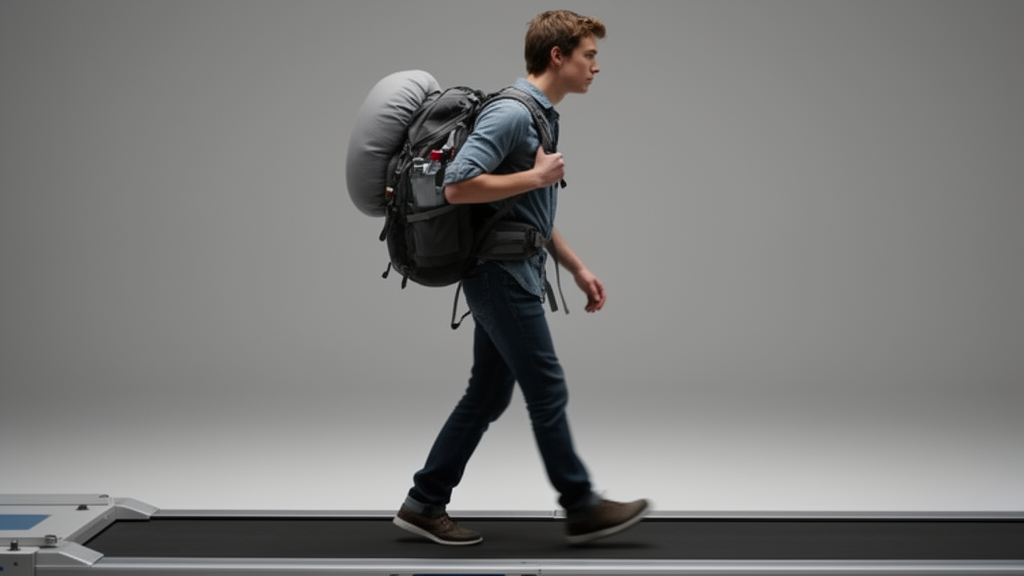
Carrying a bag on one side of the body changes how healthy young adults balance while standing still, according to a new laboratory study published in Chiropractic & Manual Therapies. Researchers at Miami University found that when participants carried a backpack loaded with 15% or 20% of their body mass, either in one hand or slung over one shoulder, several force-plate measures of postural control changed compared with standing unloaded. The average center of pressure shifted toward the side of the load, the area covered by postural sway grew larger, and the total path traveled by the center of pressure lengthened. The effects scaled with load magnitude for some measures but not others, and the two carrying configurations produced distinct patterns of change.
The study, led by Abdul Rafi with Dean L. Smith, William P. Berg and Mark S. Walsh, was a repeated-measures experiment conducted in November 2025 in the university’s Biomechanics Laboratory. Twenty-four healthy young adults, ten men and fourteen women, with a mean age of 21.13 years, completed all testing. All participants were right-hand dominant and free of neurological, musculoskeletal or vestibular disorders affecting balance. Anyone with current lower-extremity, back or shoulder pain, recent surgery, implanted medical devices or medications affecting balance was excluded. The protocol was approved by the Miami University Institutional Review Board, and all participants gave written informed consent.
Each participant stood quietly on a force plate under five conditions: no load, a handheld load at 15% body mass, a handheld load at 20%, a shoulder load at 15% and a shoulder load at 20%. The same model of backpack, a JanSport Odyssey 39-liter pack, was used for every loaded condition, which the authors say strengthened the design by letting load location vary while keeping the carrying equipment constant. Loads were built from weighted balls combined to reach the target within 0.1 kilogram, and the mean loads were 10.52 kilograms for the 15% condition and 14.02 kilograms for the 20% condition. The backpack’s own 1.3-kilogram mass was not counted toward the load. In the handheld conditions, participants carried the pack by its top grab handle in the dominant hand with the arm at the side; in the shoulder conditions, they carried it over the dominant shoulder with a single strap.
Participants completed two 30-second trials per condition, for ten recorded trials in total, with the order of conditions pseudorandomized across three sequences to limit order and carryover effects. They wore their usual athletic footwear, stood with feet shoulder-width apart in a standardized position on the plate, and fixed their gaze on a visual target at eye level 1.5 meters away. Force plate data from the Balance Tracking System were sampled at 25 hertz and filtered with a second-order Butterworth low-pass filter at a 4 hertz cutoff. Four outcome measures were analyzed: the average mediolateral location of the center of pressure (COP X), the average anteroposterior location (COP Y), the 95% ellipse area of postural sway, and total path length, the cumulative distance traveled by the center of pressure during the trial.
The statistical approach used one-way repeated-measures analyses of variance across the five conditions, with three planned contrasts tested at a Bonferroni-adjusted alpha of 0.017: load presence versus no load, 20% versus 15% load magnitude, and hand versus shoulder location. For COP X, the main effect of condition was significant after Greenhouse-Geisser correction, F(2.55, 58.60) = 145.00, p < 0.001, with load condition accounting for a substantial share of the variance (η² = 0.863). All three contrasts were significant: loading shifted the average center of pressure toward the side of the load, the 20% loads shifted it further than the 15% loads, and handheld loading produced a larger mediolateral shift than shoulder loading.
Total path length showed a similar dose-response pattern. The main effect of condition was significant, F(3.01, 69.30) = 22.60, p < 0.0001, η² = 0.495, and two of the three contrasts reached significance: loaded standing produced longer path lengths than unloaded standing, and the heavier 20% loads produced longer paths than the 15% loads. Carrying location, however, did not significantly affect path length. The authors interpret path length as reflecting the amount of postural corrective activity required to maintain balance, so the pattern suggests that heavier unilateral loads demanded more active postural regulation, while the total amount of corrective work was similar whether the pack was held in the hand or slung over a shoulder.
The 95% ellipse area told a different story. Because the normality assumption for the repeated-measures ANOVA was not met for this variable, the researchers used a Friedman test, which was significant (χ²(4) = 50.96, p < 0.0001), followed by Wilcoxon signed-rank contrasts. Sway area was greater with a 15% load than with no load (median 1.71 versus 0.63, p < 0.001), and shoulder carriage produced larger sway areas than hand carriage (median 2.05 versus 1.29, p < 0.001). Notably, there was no significant difference between the 15% and 20% load levels for sway area (p = 0.064). The authors suggest that heavier loads increased corrective activity and lateral displacement without expanding the overall spatial boundaries of sway, possibly because healthy young adults adopted compensatory strategies that limited sway area despite greater mechanical demands.
One measure remained essentially flat. The average anteroposterior center of pressure location showed no significant main effect of condition, F(2.43, 55.90) = 0.28, p = 0.798, indicating that lateral loading challenged balance primarily in the frontal plane rather than the sagittal plane. Because all loads were positioned lateral to the body’s midline, the handheld load directly to the side and the shoulder load posterolaterally, the main perturbation occurred in the mediolateral direction. The authors note this is consistent with previous work showing that the direction of external loading shapes the direction of postural adaptation, and that healthy young adults were able to maintain their anteroposterior center of pressure location despite the added demands.
The distinction between carrying configurations is central to the findings. A handheld load sits farther from the body’s center of mass and lower relative to the trunk, increasing frontal-plane torque and requiring larger lateral adjustments, which the authors offer as an explanation for the greater COP X shift in the hand condition. A shoulder bag places the load closer to the center of mass, potentially reducing the need for large lateral weight shifts, but its elevated position may require more complex postural adjustments involving the trunk, shoulders and cervical region, which could explain the larger sway areas seen with shoulder carriage. The authors conclude that load location influences balance control through multiple mechanisms and that no single postural measure fully captures the effects of asymmetrical loading.
The team frames the work as relevant to clinicians, chiropractors, manual therapists, rehabilitation professionals and ergonomists, since unilateral load carriage is routine in daily, occupational and educational settings. They caution, however, that the sample consisted exclusively of healthy young adults from a university population, limiting generalizability to older adults and clinical groups, that sway was assessed only during quiet standing rather than dynamic tasks such as walking, and that the study captured immediate responses rather than long-term consequences of repeated asymmetrical loading. The study was also not designed or powered to evaluate sex differences. Within those limits, the authors suggest that both load magnitude and carrying method deserve consideration when giving ergonomic advice, and that clinicians may find it useful to evaluate load carriage habits in patients who report balance difficulties or discomfort related to carrying bags, equipment or occupational tools.
Subject of Research: Effects of asymmetrical load magnitude and carrying location on postural sway in healthy young adults
Article Title: Impact of asymmetrical load magnitude and location on postural sway metrics in healthy young adults
Article References: Rafi, A., Smith, D. L., Berg, W. P., & Walsh, M. S. (2026). Impact of asymmetrical load magnitude and location on postural sway metrics in healthy young adults. Chiropractic & Manual Therapies, 34(1), Article 57. https://doi.org/10.1186/s12998-026-00682-8
Image Credits: AI Generated
DOI: 10.1186/s12998-026-00682-8
Keywords: postural sway, load carriage, center of pressure, force plate, backpack, balance, biomechanics, quiet standing, load magnitude, shoulder bag, ergonomics, young adults
News Source: Ophelia Keating. (October 28, 2026). Asymmetrical Backpack Loads Shift Balance in Healthy Young Adults. Scienmag.



