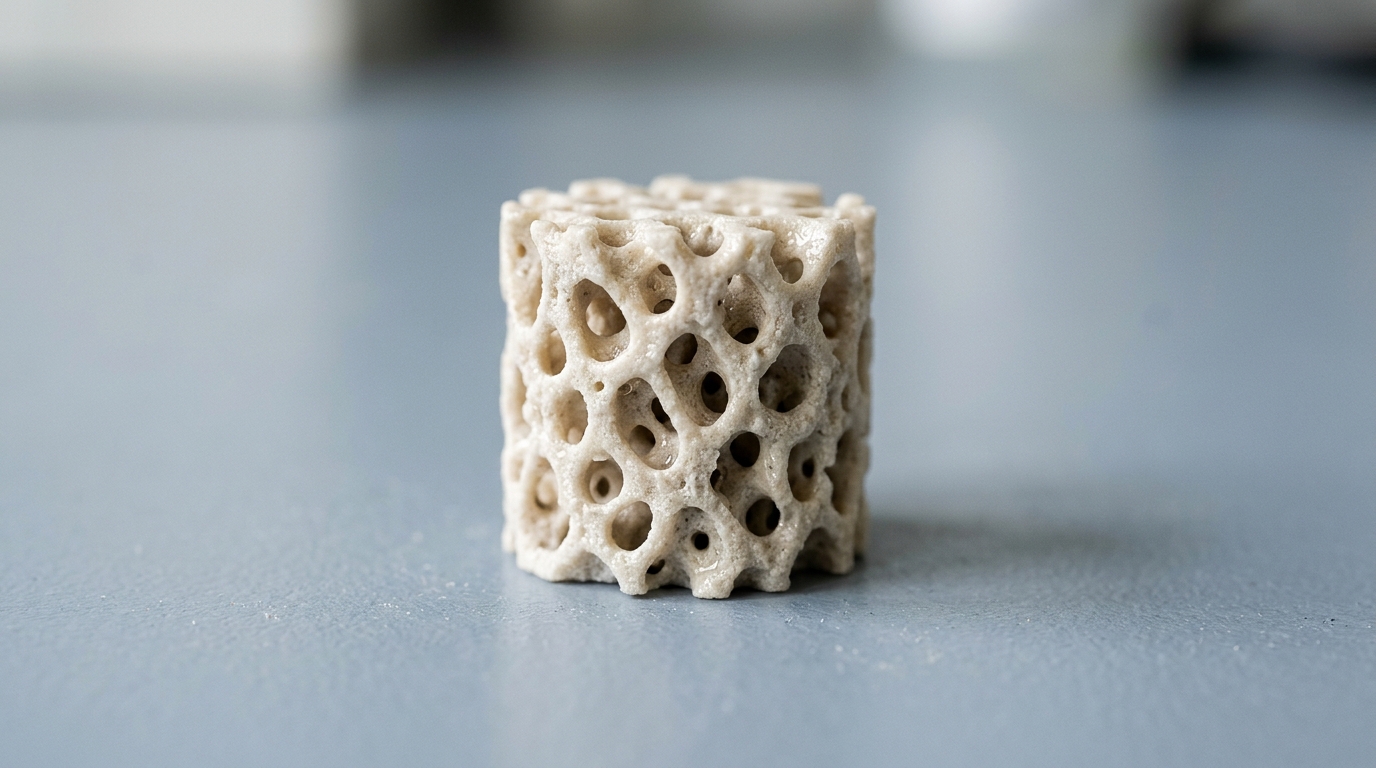
Materials scientists have developed a multifunctional biomaterial composite that pairs hydroxyapatite recovered from bovine bone waste with polyethylene glycol, zinc oxide nanoparticles, and ascorbic acid to improve cellular viability and antioxidant defence without compromising antibacterial efficacy. In an investigation published in the Journal of Materials Science: Materials in Medicine, a research team designed the composite scaffold, designated S2, to tackle the persistent clinical challenge of engineering orthopedic implants that concurrently resist bacterial colonization, reduce destructive local inflammation, and limit cytotoxic stress on host tissue. The formulation was benchmarked directly against an ascorbic acid-free counterpart, designated S1, as well as positive control compounds across a series of physical characterization tests and laboratory bioassays. By examining structural formation, radical scavenging, protein stabilization, microbial inhibition, and macrophage viability, the study demonstrates that incorporating trace quantities of vitamin C produces measurable biological improvements while maintaining structural stability.
The physical foundation of the composite relies on hydroxyapatite extracted from bovine bone fragments collected from a local butchery in Kollam, India. To isolate the bone mineral, the biological tissue underwent thermal and chemical processing beginning with boiling in water for twenty-four hours to eliminate soft organic components. The cleaned fragments were dried at one hundred degrees Celsius for forty-eight hours, during which rendered lipids were periodically drained. Subsequent immersion in a zero-point-one molar sodium hydroxide solution for twenty-four hours eliminated remaining organic residues prior to thorough rinsing with deionized water. The dried bone fragments were calcined in a furnace at nine hundred degrees Celsius for six hours, and the resulting brittle white material was milled into fine powder using a high-velocity ball mill. To adjust the calcium-to-phosphorus ratio to the theoretical stoichiometric ratio of approximately one-point-six-seven, the powder was blended with aqueous phosphoric acid, neutralized with ammonium hydroxide to reach a neutral pH of seven, aged overnight, dried, and calcined again at nine hundred degrees Celsius for four hours.
Spectroscopic and elemental analyses confirmed the purity and biomimetic properties of the bone-derived hydroxyapatite before scaffold assembly. Inductively coupled plasma mass spectrometry verified that calcium and phosphorus formed the primary elements, establishing a calcium-to-phosphorus ratio of approximately one-point-six-seven that matches natural apatite. Trace quantities of magnesium, along with parts-per-million levels of potassium, zinc, and barium, were also detected in the mineral lattice, mirroring the elemental complexity of natural bone. Fourier-transform infrared spectroscopy identified bending and stretching vibrations of phosphate groups at five hundred sixty to six hundred five reciprocal centimeters and nine hundred sixty to eleven hundred reciprocal centimeters, alongside hydroxyl stretching bands near thirty-five seventy reciprocal centimeters. X-ray diffraction peaks indexed cleanly to the standard hexagonal phase of hydroxyapatite without secondary calcium phosphate phases.
To fabricate the composite scaffolds, the researchers combined polyethylene glycol with a molecular weight of six thousand, the synthesized hydroxyapatite powder, zinc oxide powder, and L-ascorbic acid via sequential aqueous mixing and drying. In the experimental scaffold formulation, zero-point-four-five grams of polymer and one gram of mineral powder were stirred in deionized water at sixty degrees Celsius for three hours at four hundred revolutions per minute. Eighty milligrams of zinc oxide, pre-dispersed in water for fifteen minutes, were introduced and stirred for one hour, followed by the addition of eight milligrams of ascorbic acid stirred for one hour at sixty degrees Celsius. The resulting slurry was dried at one hundred degrees Celsius for twenty-four hours and crushed. The final S2 composite contained approximately sixty-five weight percent hydroxyapatite, twenty-nine weight percent polyethylene glycol, five weight percent zinc oxide, and zero-point-five weight percent ascorbic acid. The control composite S1 was synthesized under identical conditions without ascorbic acid, yielding sixty-five percent mineral, thirty percent polymer, and five percent zinc oxide. Highly porous scaffolds were fabricated by suspending the powders in water at five to ten weight percent solids, freezing the slurry at minus eighty degrees Celsius for twelve hours, and freeze-drying for twenty-four to forty-eight hours.
Structural and surface characterization confirmed that both composites retained phase-pure hexagonal hydroxyapatite while revealing subtle differences caused by ascorbic acid. X-ray diffraction patterns revealed characteristic hydroxyapatite reflections, but S2 consistently exhibited broader peaks than S1. Scherrer equation calculations indicated that coherent crystallite domains measured forty to forty-eight nanometers in S1, whereas S2 crystallites were constrained to thirty-four to thirty-six nanometers. The researchers attributed this reduction in crystallite size to ascorbic acid acting as a mild capping agent through transient surface chelation of calcium ions during composite synthesis, restricting crystal coalescence without altering lattice dimensions. Zinc oxide reflections were absent from diffraction patterns in both composites, which the authors attributed to the low five weight percent loading, fine nanoscale dispersion, and peak overlap with hydroxyapatite reflections. However, X-ray photoelectron spectroscopy and energy-dispersive X-ray spectroscopy confirmed the presence of zinc at approximately five to six atomic percent on composite surfaces, while high-resolution carbon and oxygen spectra documented increased oxygenated functional groups from ascorbic acid in S2.
Microscopic analysis through high-resolution transmission electron microscopy and selected-area electron diffraction provided visual confirmation of the composite architecture. In bright-field images of S1, irregular hydroxyapatite nanocrystals measuring tens of nanometers appeared embedded within cloudier regions of amorphous polyethylene glycol. In contrast, images of S2 revealed better contrast between the inorganic phase and the polymer matrix, showing more defined and separated crystallite outlines. The authors suggested that ascorbic acid acted as a mild dispersant that reduced inorganic agglomeration during mixing. Selected-area electron diffraction patterns from S1 showed diffuse rings characteristic of randomly oriented nanocrystals and substantial amorphous polymer content. In S2, the diffraction rings were sharper and displayed faint diffraction spots, indicating improved domain orientation and localized crystalline ordering. Energy-dispersive X-ray elemental mapping confirmed that zinc, calcium, phosphorus, oxygen, and carbon were uniformly distributed across composite particles without phase segregation or isolated zinc clustering.
Antibacterial performance was evaluated in vitro using an agar well diffusion assay against representative bacterial pathogens, specifically Gram-positive Staphylococcus aureus and Gram-negative Escherichia coli. Test samples of S1, S2, and pure zinc oxide powder were dry-heat sterilized at one hundred ten degrees Celsius for one hour prior to aqueous suspension and well loading. Pure zinc oxide powder produced the largest clear zones of microbial inhibition, measuring approximately seventeen millimeters against Escherichia coli and nineteen millimeters against Staphylococcus aureus. In comparison, composite S1 generated average inhibition zones of approximately nine millimeters against Escherichia coli and eight millimeters against Staphylococcus aureus. Composite S2 produced zones of approximately seven millimeters against Escherichia coli and eight millimeters against Staphylococcus aureus. Statistical analysis indicated that differences in antibacterial zone diameters between S1 and S2 were not statistically significant, demonstrating that incorporating zero-point-five weight percent ascorbic acid did not diminish the antibacterial action provided by zinc oxide nanoparticles embedded within the polymer matrix.
Anti-inflammatory efficacy was evaluated by measuring the inhibition of heat-induced protein denaturation using bovine serum albumin as a model protein across concentrations ranging from six-point-two-five to one hundred micrograms per milliliter. Both composite formulations exhibited a dose-dependent reduction in protein denaturation following heating at eighty degrees Celsius for ten minutes. Composite S2 consistently outperformed S1 across the tested concentration curve, achieving approximately sixty percent inhibition at one hundred micrograms per milliliter compared to approximately fifty percent for S1. The positive pharmaceutical control, diclofenac, produced approximately eighty-five percent inhibition at the same dose. At an intermediate concentration of twenty-five micrograms per milliliter, S2 achieved nearly forty percent inhibition, slightly surpassing diclofenac and composite S1, which produced thirty-five percent inhibition. Dose-response curves established a half-maximal inhibitory concentration of approximately seventy micrograms per milliliter for S2, compared to ninety-five micrograms per milliliter for S1 and fifty micrograms per milliliter for diclofenac, demonstrating a statistically significant twenty-five microgram per milliliter potency advantage for the ascorbic acid-enriched material.
Antioxidant capability was quantified through a standard DPPH free radical scavenging assay across sample concentrations from twelve-point-five to two hundred micrograms per milliliter in dimethyl sulfoxide. Spectrophotometric absorbance measurements at five hundred seventeen nanometers showed that radical scavenging increased with concentration for all tested materials. Composite S2 demonstrated significantly higher scavenging activity than S1 at all concentrations, reaching forty-five to fifty percent DPPH inhibition at two hundred micrograms per milliliter compared to approximately forty percent for S1. Pure ascorbic acid tested at equivalent solution concentrations served as a standard, achieving approximately sixty percent scavenging at twenty-five micrograms per milliliter. The authors highlighted that because S2 contains only zero-point-five weight percent ascorbic acid, a composite concentration of two hundred micrograms per milliliter delivers approximately one microgram per milliliter of embedded active antioxidant. The observation that this minute quantity supported nearly fifty percent radical scavenging indicates a substantial amplification of antioxidant efficiency, which the researchers attributed to hydrogen bonding with polyethylene glycol that retards aerobic oxidation alongside spatial co-localization near zinc oxide on the hydroxyapatite surface.
Cytocompatibility assessments using the MTT colorimetric viability assay in RAW 264.7 murine macrophage cells demonstrated that ascorbic acid significantly mitigated the cytotoxic effects of zinc oxide nanoparticles. Following twenty-four hours of exposure across concentrations from six-point-two-five to one hundred micrograms per milliliter, both composites displayed dose-dependent cytotoxicity, but S2 maintained higher macrophage viability at every evaluated concentration. At the lowest dose of six-point-two-five micrograms per milliliter, both materials were non-toxic, with S1 yielding approximately ninety-one percent viability and S2 yielding ninety-six percent viability. At twelve-point-five micrograms per milliliter, S2 maintained ninety percent viability while S1 dropped to eighty percent. At the highest dose of one hundred micrograms per milliliter, S1 viability fell to fifty-six percent, whereas S2 retained sixty-six percent. Evaluating the standard seventy percent viability threshold for cytocompatibility revealed that S1 breached acceptable levels between twenty-five and fifty micrograms per milliliter, whereas S2 maintained acceptable viability up to nearly one hundred micrograms per milliliter. Phase-contrast microscopy corroborated these findings, revealing that macrophages exposed to S2 exhibited fewer rounded, detached, or stressed cells than those treated with S1.
The study authors acknowledged several experimental limitations that frame their findings within an early proof-of-concept stage. The dry-heat sterilization protocol conducted at one hundred ten degrees Celsius for one hour prior to antibacterial assays likely caused partial thermal oxidation of ascorbic acid to dehydroascorbic acid and breakdown products, meaning observed bioactivity represents the combined influence of intact and partially oxidized species rather than pure ascorbic acid alone. The authors emphasized that future investigations must use chromatographic methods such as high-performance liquid chromatography or enzymatic assays to quantify intact ascorbate retention and explore gentler sterilization alternatives, including gamma irradiation or suspension filtration. Furthermore, comprehensive evaluations of sustained release kinetics for zinc ions and ascorbic acid over extended timeframes, mechanical testing under compressive and tensile loading, co-culture osteogenic differentiation assays, macrophage polarization profiling between M1 and M2 phenotypes, and in vivo animal bone defect models remain necessary to determine whether these laboratory performance gains translate into accelerated tissue healing and functional bone regeneration.
Subject of Research: Multifunctional bone tissue engineering composite scaffolds derived from bovine bone waste
Article Title: Synergistic antioxidant and anti-inflammatory scaffold based on ascorbic acid-enriched hydroxyapatite-PEG-ZnO composite from natural bone waste
Article References: Vijayan, A., Gopakumar, A., Nair, S. V., Shankar, B., Saravana Kumar, G., & Sambhudevan, S. (2026). Synergistic antioxidant and anti-inflammatory scaffold based on ascorbic acid-enriched hydroxyapatite-PEG-ZnO composite from natural bone waste. Journal of Materials Science: Materials in Medicine, 37(1), Article 111. https://doi.org/10.1007/s10856-026-07078-3
Image Credits: AI Generated
DOI: 10.1007/s10856-026-07078-3
Keywords: hydroxyapatite, polyethylene glycol, zinc oxide nanoparticles, ascorbic acid, bone tissue engineering, bovine bone waste, biocomposite scaffold, antibacterial activity, antioxidant properties, anti-inflammatory activity, protein denaturation inhibition, DPPH radical scavenging, MTT cytotoxicity assay, RAW 264.7 macrophages, X-ray diffraction, X-ray photoelectron spectroscopy, transmission electron microscopy, freeze drying, diclofenac comparison
News Source: Ophelia Keating. (November 19, 2026). Ascorbic Acid Enhances Bone Scaffold Biocompatibility Without Reducing Antibacterial Activity. Scienmag.