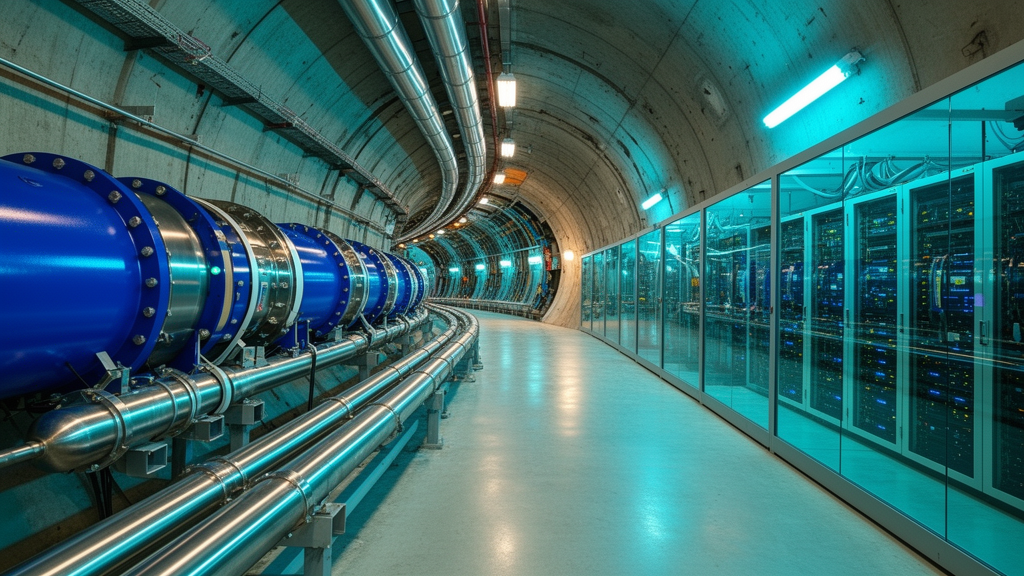
Although more than 50,000 particle accelerators currently operate across international scientific, medical, and industrial sectors, the implementation of artificial intelligence within these environments has historically remained fragmented. Individual laboratories frequently build specialized machine learning tools to address narrow facility-specific challenges, but differences in control architectures, data silos, and institutional boundaries have severely limited cross-facility reproducibility, method transfer, and long-term algorithmic sustainability. To overcome these persistent operational barriers, the ARTIFACT network has launched a comprehensive strategic framework uniting 41 partner institutions across 14 countries. Operating as an open-science collaborative network, ARTIFACT establishes a federated, FAIR-by-design ecosystem connecting research facilities, universities, and industrial partners to systematically coordinate the development, deployment, and governance of artificial intelligence across international accelerator science.
Modern accelerator performance depends on the exacting coordination of beam dynamics, electromagnetic hardware, high-bandwidth diagnostics, and complex operational software workflows. As facilities expand their experimental capabilities, the volume and heterogeneity of generated data continue to rise rapidly during design, commissioning, and routine operation. An assessment of technological maturity reveals that optimization algorithms have already achieved high operational readiness across most accelerator facilities, supporting routine parameter adjustments and automated tuning. In contrast, classification systems remain at intermediate developmental stages, while full-scale data-driven modeling represents an emerging field whose primary growth will occur within next-generation research infrastructures. However, data practices across participating sites diverge considerably, with records often trapped inside closed subsystems. Models are frequently constructed for localized use cases without systematic cross-validation or mechanisms for persistent maintenance. ARTIFACT resolves this operational division by treating accelerator datasets, models, and workflows as first-class, shareable research assets, enabling cross-facility comparative benchmarks, reproducible findings, and seamless technology exchange between diverse machine topologies.
To establish cohesion across varied institutional platforms, the network defines seven core strategic pillars integrated with a six-layer reference architecture. The strategic pillars encompass establishing a FAIR AI-enabled data store, embedding lifecycle sustainability, deploying state-of-the-art AI for facility optimization, executing frugal modeling for future infrastructures, structuring training, formulating AI policy, and building an interconnected AI science network. These thematic pillars map directly onto an architectural stack that bridges physical accelerator hardware with community-wide governance. Rather than imposing a monolithic central platform, the framework relies on three fundamental interoperability principles. Semantic interoperability is ensured through standardized naming conventions, shared parameter ontologies, and common coordinate frames. Technical interoperability is achieved using well-defined application programming interfaces, modular containerization, and abstraction layers that interface cleanly with established control systems like EPICS and TANGO. Finally, organizational interoperability establishes explicit governance protocols defining intellectual property, attribution rules, and data ownership, enabling independent institutions to collaborate securely without forfeiting control over their underlying facilities.
Translating architectural concepts into concrete operational capabilities requires coordinated work across six primary effort areas. These areas include integration into the evolving European Open Science Cloud AI ecosystem, constructing hybrid physics-informed digital twins for operational and planned facilities, developing domain-specific foundation models, embedding lifecycle sustainability, deploying agentic operational tools, and training the accelerator workforce. Foundation models represent an ambitious direction within the network, leveraging privacy-preserving federated learning across pooled operational archives, maintenance logs, and multi-channel diagnostic streams from participating laboratories. Because advanced language architectures can ingest unstructured log texts directly, rigid standardization of logging formats is not an absolute prerequisite, although lightweight metadata conventions remain valuable. These foundation models will act as scientific orchestrators, combining retrieval-augmented generation over technical documentation with direct programmatic access to simulation physics and digital twins. By fine-tuning generalized architectures locally using minimal facility-specific data, laboratories can rapidly adapt foundational capabilities to their unique machine lattices while ensuring sensitive telemetry remains protected on-premises.
The network grounds its reference architecture in concrete demonstrators across fourteen partner facilities, notably at CERN where machine learning supports active experimentation and design. The CERN Linear Electron Accelerator for Research linac provides electron beams between 30 and 220 mega-electronvolts, serving as an ideal testbed for benchmarking virtual diagnostics and automated beam tuning. For the proposed 91-kilometer Future Circular Collider, surrogate models evaluate beam-beam effects, impedance phenomena, dynamic aperture limits, and collective instabilities whose direct numerical simulation remains computationally prohibitive. In the Large Hadron Collider, machine learning already classifies beam loss patterns to automate collimator alignment, sharply reducing commissioning time. Experimental efforts like TWOCRYST demonstrated double-crystal channeling at 450 gigaelectronvolts in 2025, with reinforcement learning surrogates under active development for the proposed ALADDIN experiment. Concurrently, physics-informed neural surrogates developed by EPFL, CHART, SDSC, and CERN reproduce key nonlinear beam-dynamics indicators with millisecond-level inference, demonstrating how physics-aware models bridge simulation and operational control.
Major national research centers across Europe provide complementary testbeds demonstrating machine learning integration at production scale. At the Karlsruhe Institute of Technology Accelerator Technology Platform, the KARA storage ring operates microsecond-latency reinforcement learning feedback to stabilize nonequilibrium beam physics, while the KITTEN initiative demonstrated a 30 percent reduction in KARA’s energy footprint through AI-optimized load management. In France, synchrotron SOLEIL is implementing online reinforcement learning for lattice tuning and orbit stabilization during its SOLEIL II upgrade, using neural networks to compensate for magnetic crosstalk and hysteresis. At GANIL, the SPIRAL2 superconducting heavy-ion linac deploys machine learning anomaly detection to track radiofrequency cavity faults and classify radioisotopes. In Germany, FAIR at GSI utilizes the Generic Optimization Framework and Frontend alongside surrogate models to mitigate beam losses across the SIS100 synchrotron injector chain. Complementing these installations, convolutional neural networks deployed by IPHC reconstruct transverse phase-space distributions, improving sensitivity for low-intensity halo measurements.
Specialized spallation sources, compact radiation systems, and medical accelerators further illustrate the versatility of ARTIFACT’s shared methodology. The European Spallation Source in Sweden is incorporating a Synchronous Data Service to collect correlated waveform bursts alongside FPGA-based edge computing, testing Bayesian optimization to minimize beam loss along its multi-megawatt superconducting proton linac. At the ISIS pulsed spallation source in the United Kingdom, researchers deploy differentiable models and neural surrogates to manage beam loss within its 800-mega-electronvolt rapid-cycling synchrotron. For compact sources, the ThomX ring at IJCLab utilizes LINACNET for modular particle tracking and INODE neural differential equations to model beam transitions. Nuclear fusion materials testing at Spain’s IFMIF-DONES uses reinforcement learning for vacuum control alongside surrogate neutronics, while the TEX facility at INFN Frascati uses the Cheshire Cat artificial intelligence framework to govern autonomous radiofrequency conditioning across four operational modes.
To convert operational demonstrators into durable infrastructure, ARTIFACT connects with major funded European research programs. The European Union-funded TwinRISE initiative establishes a cross-disciplinary Virtual Distributed Facility deploying a Digital Twin Engine across accelerators, fusion facilities, and clinical oncology centers. Using the privacy-preserving FedBioMed framework, TwinRISE trains collaborative models while ensuring General Data Protection Regulation compliance. Within its medical cluster, TwinRISE develops three digital twins: a proton therapy dose-sensing twin inferring three-dimensional dose fields from detector telemetry, a neural translation model generating synthetic computed tomography scans from magnetic resonance imaging, and a clinical plan optimizer. The ecosystem is further enriched by Modularity’s three-tier generative agent hierarchy for facility control, and RL4AA’s international benchmarks advancing autonomous reinforcement learning across global particle accelerators.
Deploying automated intelligence into mission-critical accelerator operations requires robust governance frameworks that guarantee physical safety, interpretability, and legal compliance. Trustworthiness is established through comprehensive Uncertainty Quantification and Safety Of The Intended Functionality hazard evaluations, ensuring compliance with emerging European Union AI Act regulations. Furthermore, explainable artificial intelligence techniques provide facility operators with clear reasoning alongside algorithmic recommendations, guaranteeing meaningful human oversight over automated decisions. To reconcile collaborative training with institutional security and intellectual property protection, ARTIFACT introduces tiered data sharing protocols. Facilities can publish open benchmark datasets under permissive licenses, grant federated API access to internal data for approved research partnerships, or participate in federated learning where raw operational measurements remain strictly on-site and only parameter updates are shared. A non-binding governance committee coordinates these standards, ensuring institutional continuity beyond fixed grant lifecycles.
To steer this multi-institutional transformation systematically, ARTIFACT outlines a phased roadmap structured across three core development stages running from 2026 through 2031. Phase 1, spanning 2026 to 2027, establishes foundational data standards, releasing metadata schema version 1.0 endorsed by five facilities, launching an open catalog, and validating a federated learning proof-of-concept across three sites alongside the iRIS feature store. Phase 2, covering 2028 through 2029, centers on cross-facility validation, demonstrating the TwinRISE Digital Twin Engine across accelerator, medical, and energy domains, releasing an ARTIFACT copilot framework with agentic retrieval-augmented generation interfaces, and securing EuroHPC computing allocations. Phase 3, concluding between 2030 and 2031, targets operational consolidation, implementing production federated learning across five or more facilities, establishing an AI certification program, and handing core network services over to permanent host laboratories. Looking beyond 2031, the roadmap envisions training specialized foundation models on pooled datasets and establishing a thematic European Open Science Cloud node, securing an enduring ecosystem for accelerator intelligence.
Subject of Research: Federated artificial intelligence frameworks, collaborative architectures, and strategic roadmaps for particle accelerator research infrastructures.
Article Title: ARTIFACT Network: Federated Infrastructures, Collaboration, and Roadmap for AI in Accelerator Science
Article References: Ghribi, A., Appel, S., Bründermann, E., Bugiotti, F., Bustinduy, I., Caron, S., Cassou, K., Corroyer-Dulmont, A., Cros, B., Cruz-Miranda, J., Dalena, B., Gethmann, J., Gilardi, A., Gizzi, L. A., Gómez-Espinosa Martín, R., Guler, H., Gutleber, J., Hirländer, S., Keintzel, J., … Žagar, T. (2026). ARTIFACT Network: Federated Infrastructures, Collaboration, and Roadmap for AI in Accelerator Science. EPJ Research Infrastructures, 10(1), Article 46. https://doi.org/10.1007/s41781-026-00198-z
Image Credits: AI Generated
DOI: 10.1007/s41781-026-00198-z
Keywords: ARTIFACT network, particle accelerators, machine learning, surrogate modeling, digital twins, federated learning, beam dynamics, beam loss minimization, radiofrequency systems, Future Circular Collider, TwinRISE, iRIS project, FAIR data principles, European Open Science Cloud, anomaly detection, reinforcement learning, accelerator eco-design, beam collimation
News Source: Blake Davidson. (November 26, 2026). ARTIFACT Network Coordinates Federated Artificial Intelligence Strategy Across European Particle Accelerators. Scienmag.