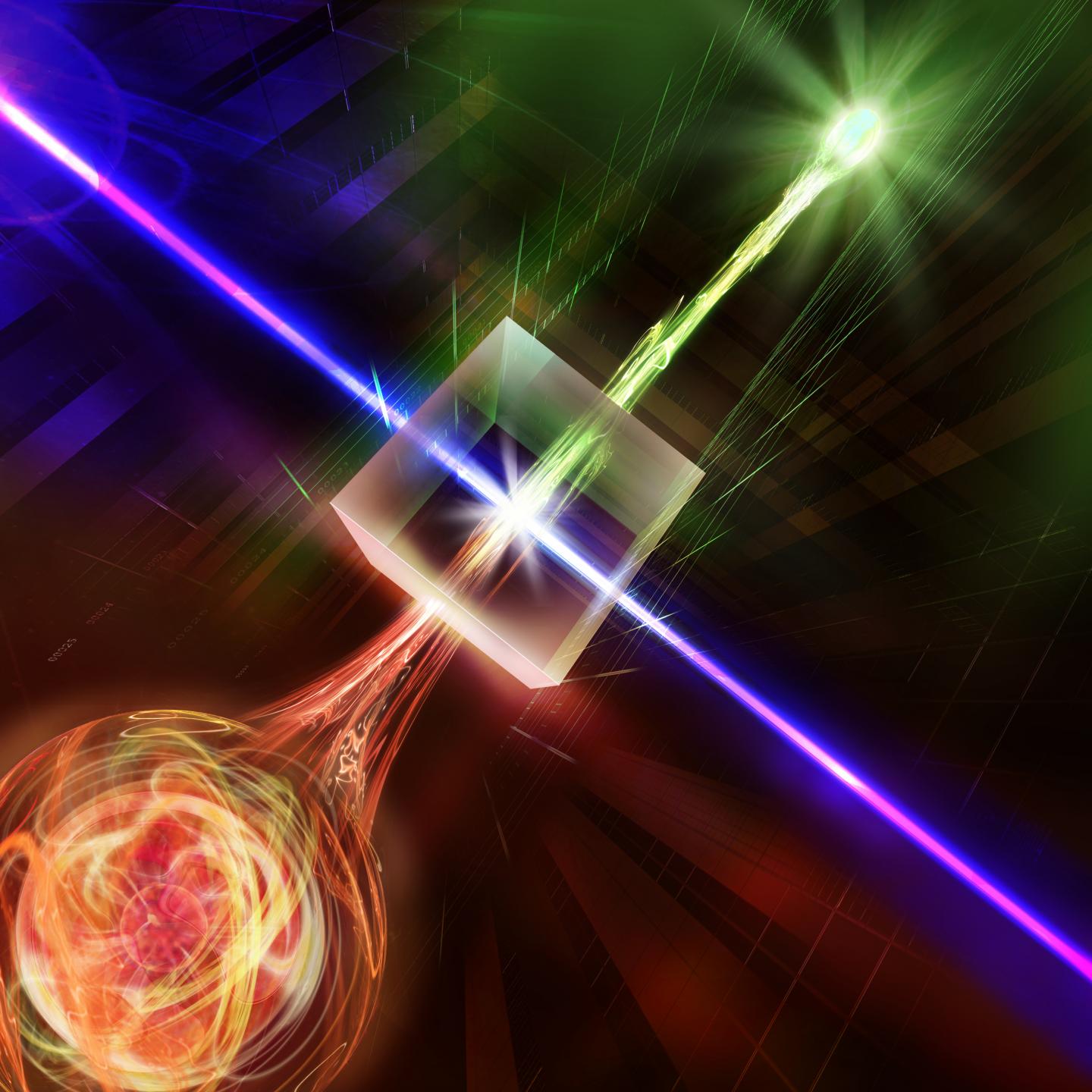
Credit: Courtesy IQOQI Innsbruck/Harald Ritsch
RESEARCH TRIANGLE PARK, N.C. — A U.S. Army research result brings the quantum internet a step closer. Such an internet could offer the military security, sensing and timekeeping capabilities not possible with traditional networking approaches.
The U.S. Army’s Combat Capability Development’s Army Research Laboratory’s Center for Distributed Quantum Information, funded and managed by the lab’s Army Research Office, saw researchers at the University of Innsbruck achieve a record for the transfer of quantum entanglement between matter and light — a distance of 50 kilometers using fiber optic cables.
Entanglement is a correlation that can be created between quantum entities such as qubits. When two qubits are entangled and a measurement is made on one, it will affect the outcome of a measurement made on the other, even if that second qubit is physically far away.
“This [50 kilometers] is two orders of magnitude further than was previously possible and is a practical distance to start building inter-city quantum networks,” said Dr. Ben Lanyon, experimental physicist at University of Innsbruck and the principal investigator for the project, whose findings are published in the Nature journal Quantum Information.
Intercity quantum networks would be composed of distant network nodes of physical qubits, which are, despite the large physical separation, nevertheless entangled. This distribution of entanglement is essential for establishing a quantum internet, researchers said.
“The demonstration is a major step forward for achieving large scale distributed entanglement,” said Dr. Sara Gamble, co-manager of the Army program supporting the research. “The quality of the entanglement after traveling through fiber is also high enough at the other end to meet some of the requirements for some of the most difficult quantum networking applications.”
The research team started the experiment with a calcium atom trapped in an ion trap. Using laser beams, the researchers wrote a quantum state onto the ion and simultaneously excited it to emit a photon in which quantum information is stored. As a result, the quantum states of the atom and the light particle were entangled.
The challenge is to transmit the photon over fiber optic cables.
“The photon emitted by the calcium ion has a wavelength of 854 nanometers and is quickly absorbed by the optical fiber,” Lanyon said.
His team therefore initially sent the light particle through a nonlinear crystal illuminated by a strong laser. The photon wavelength was converted to the optimal value for long-distance travel — the current telecommunications standard wavelength of 1,550 nanometers.
The researchers then sent this photon through the 50-kilometer-long optical fiber line. Their measurements show that atom and light particles were still entangled even after the wavelength conversion and the distance traveled.
“The choice to use calcium means these results also provide a direct path to realizing an entangled network of atomic clocks over a large physical distance, since calcium can be co-trapped with a high quality “clock” qubit. Large scale entangled clock networks are of great interest to the Army for precision position, navigation, and timing applications,” said Dr. Fredrik Fatemi, an Army researcher who also co-manages the program.
###
The CCDC Army Research Laboratory (ARL) is an element of the U.S. Army Combat Capabilities Development Command. As the Army’s corporate research laboratory, ARL discovers, innovates and transitions science and technology to ensure dominant strategic land power. Through collaboration across the command’s core technical competencies, CCDC leads in the discovery, development and delivery of the technology-based capabilities required to make Soldiers more effective to win our Nation’s wars and come home safely. CCDC is a major subordinate command of the U.S. Army Futures Command.
Media Contact
Lisa Bistreich-Wolfe
[email protected]
Original Source
https:/
Related Journal Article
http://dx.