• HOME
  • NEWS
  • EXPLORE
    • CAREER
      • Companies
      • Jobs
    • EVENTS
    • iGEM
      • News
      • Team
    • PHOTOS
    • VIDEO
    • WIKI
  • BLOG
  • COMMUNITY
    • FACEBOOK
    • INSTAGRAM
    • TWITTER
Thursday, April 9, 2026
BIOENGINEER.ORG
No Result
View All Result
  • Login
  • HOME
  • NEWS
  • EXPLORE
    • CAREER
      • Companies
      • Jobs
        • Lecturer
        • PhD Studentship
        • Postdoc
        • Research Assistant
    • EVENTS
    • iGEM
      • News
      • Team
    • PHOTOS
    • VIDEO
    • WIKI
  • BLOG
  • COMMUNITY
    • FACEBOOK
    • INSTAGRAM
    • TWITTER
  • HOME
  • NEWS
  • EXPLORE
    • CAREER
      • Companies
      • Jobs
        • Lecturer
        • PhD Studentship
        • Postdoc
        • Research Assistant
    • EVENTS
    • iGEM
      • News
      • Team
    • PHOTOS
    • VIDEO
    • WIKI
  • BLOG
  • COMMUNITY
    • FACEBOOK
    • INSTAGRAM
    • TWITTER
No Result
View All Result
Bioengineer.org
No Result
View All Result
Home NEWS Science News Chemistry

APS tip sheet: The new fate of the kaon

Bioengineer by Bioengineer
February 18, 2020
in Chemistry
Reading Time: 1 min read
0
IMAGE
Share on FacebookShare on TwitterShare on LinkedinShare on RedditShare on Telegram

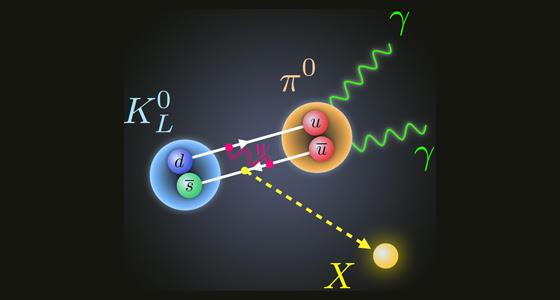
Preliminary reports of an extremely rare decay of a subatomic particle called the kaon could challenge the standard model of particle physics
IMAGE

Credit: Kitahara et al., Physical Review Letters (2020)


This past September, researchers at KOTO reported four incidents of rare decays from a type of subatomic particle called a kaon. However, the decays should be too rare to detect yet, according to the standard model of particle physics–a theory that describes how matter interacts through fundamental forces like electromagnetism. The decays’ presence also violates a well-known theoretical connection between charged and neutral kaon decays, so particle theorists will not accept the findings until this discrepancy is resolved. Recently, scientists Kitahara et al. have found a potential explanation as to why KOTO recognized those rare decays while larger experiments have missed them. They suggest that because KOTO is smaller than other detectors, it may not fully capture the subsequent decay of a new particle from a neutral kaon decay if the new particle flies a long distance before it decays. The presence of such rare decays of the kaon, if confirmed by further experiments, could force physicists to modify the standard model.

###

New physics implications of recent search for KL ? π 0νν¯ at KOTO

Teppei Kitahara, Takemichi Okui, Gilad Perez, Yotam Soreq, and Kohsaku Tobioka

Media Contact
APS Press Office
[email protected]
301-209-3090
Tags: Chemistry/Physics/Materials Sciences
Share12Tweet8Share2ShareShareShare2

Related Posts

Linker Histone H1 Functions as a Liquid-Like “Glue” Binding Chromatin

Linker Histone H1 Functions as a Liquid-Like “Glue” Binding Chromatin

April 8, 2026
UH Engineer Uncovers Structural Flaw Behind Lithium-Ion Battery Failures

UH Engineer Uncovers Structural Flaw Behind Lithium-Ion Battery Failures

April 8, 2026

Harnessing Light to Manipulate Nuclear Spins in Molecules Opens New Avenues for Quantum Technology

April 8, 2026

Innovative Method for Creating Branched Molecules Promises to Speed Up Future Drug Development

April 8, 2026
Please login to join discussion

POPULAR NEWS

  • blank

    Revolutionary AI Model Enhances Precision in Detecting Food Contamination

    98 shares
    Share 39 Tweet 25
  • Imagine a Social Media Feed That Challenges Your Views Instead of Reinforcing Them

    1011 shares
    Share 399 Tweet 250
  • Popular Anti-Aging Compound Linked to Damage in Corpus Callosum, Study Finds

    44 shares
    Share 18 Tweet 11
  • Revolutionary Theory Transforms Quantum Perspective on the Big Bang

    40 shares
    Share 16 Tweet 10

About

We bring you the latest biotechnology news from best research centers and universities around the world. Check our website.

Follow us

Recent News

“’Stemness Checkpoint’ Key to Regulating Stem Cell Identity”

Multi-Omics Uncover Diverse Rice lncRNA Effects

Multiomics, Deep Learning Decode Human Development

Subscribe to Blog via Email

Enter your email address to subscribe to this blog and receive notifications of new posts by email.

Join 78 other subscribers
  • Contact Us

Bioengineer.org © Copyright 2023 All Rights Reserved.

Welcome Back!

Login to your account below

Forgotten Password?

Retrieve your password

Please enter your username or email address to reset your password.

Log In
No Result
View All Result
  • Homepages
    • Home Page 1
    • Home Page 2
  • News
  • National
  • Business
  • Health
  • Lifestyle
  • Science

Bioengineer.org © Copyright 2023 All Rights Reserved.