

• HOME
  • NEWS
  • EXPLORE
    • CAREER
      • Companies
      • Jobs
    • EVENTS
    • iGEM
      • News
      • Team
    • PHOTOS
    • VIDEO
    • WIKI
  • BLOG
  • COMMUNITY
    • FACEBOOK
    • INSTAGRAM
    • TWITTER
Tuesday, July 14, 2026
BIOENGINEER.ORG
No Result
View All Result
  • Login
  • HOME
  • NEWS
  • EXPLORE
    • CAREER
      • Companies
      • Jobs
        • Lecturer
        • PhD Studentship
        • Postdoc
        • Research Assistant
    • EVENTS
    • iGEM
      • News
      • Team
    • PHOTOS
    • VIDEO
    • WIKI
  • BLOG
  • COMMUNITY
    • FACEBOOK
    • INSTAGRAM
    • TWITTER
  • HOME
  • NEWS
  • EXPLORE
    • CAREER
      • Companies
      • Jobs
        • Lecturer
        • PhD Studentship
        • Postdoc
        • Research Assistant
    • EVENTS
    • iGEM
      • News
      • Team
    • PHOTOS
    • VIDEO
    • WIKI
  • BLOG
  • COMMUNITY
    • FACEBOOK
    • INSTAGRAM
    • TWITTER
No Result
View All Result
Bioengineer.org
No Result
View All Result
Home NEWS Science News Health

Antifungal activity of a maleimide derivative: Disruption of cell membranes and interference with iron ion homoeostasis

Bioengineer by Bioengineer
March 26, 2024
in Health
Reading Time: 3 mins read
0
Schematic diagram of the proposed antifungal mechanism for the maleimide compound 5 (MPD)
Share on FacebookShare on TwitterShare on LinkedinShare on RedditShare on Telegram

This study is led by Prof. Ying Li (Xuzhou Medical University), Prof. Zuobin Zhu (Xuzhou Medical University), and Prof. Wenqiang Chang (Shandong University). A small molecule library consisting of 40 compounds, specifically N-substituted maleimide and its derivatives were initially screened in the study. Among them, twelve maleimides, each with a distinct N-protection group, were synthesized using ring-opening and ring-closing reactions involving various amines and maleic anhydride. Additionally, a set of twenty-eight new Lamellarin analogs containing a maleimide ring structure were synthesized using an oxidative [3 + 2] cycloaddition aromatization cascade strategy. The compounds were screened to detect a novel maleimide analogue (MPD) with antifungal activity.
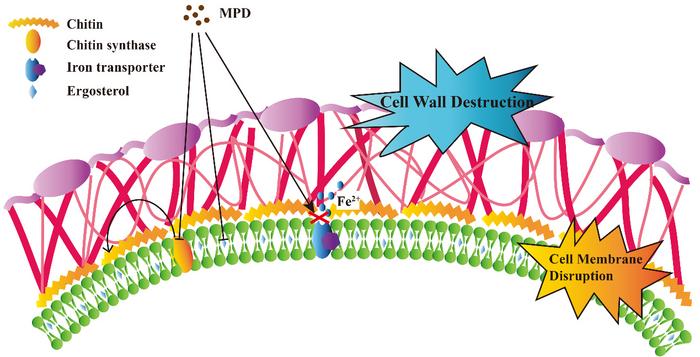
Schematic diagram of the proposed antifungal mechanism for the maleimide compound 5 (MPD)

Credit: Professor Ying Li, Xuzhou Medical University, Xuzhou, China

This study is led by Prof. Ying Li (Xuzhou Medical University), Prof. Zuobin Zhu (Xuzhou Medical University), and Prof. Wenqiang Chang (Shandong University). A small molecule library consisting of 40 compounds, specifically N-substituted maleimide and its derivatives were initially screened in the study. Among them, twelve maleimides, each with a distinct N-protection group, were synthesized using ring-opening and ring-closing reactions involving various amines and maleic anhydride. Additionally, a set of twenty-eight new Lamellarin analogs containing a maleimide ring structure were synthesized using an oxidative [3 + 2] cycloaddition aromatization cascade strategy. The compounds were screened to detect a novel maleimide analogue (MPD) with antifungal activity.


Subsequently, they analysed the safety of MPD, which has low toxicity to mammalian cell lines and is less likely to cause neurological damage and nephrotoxicity. The antifungal activity and safety of MPD supported further investigation of its antifungal mechanism.


They found that there may be an effect of MPD on the iron ion homeostasis of fungal cells by the fact that MPD was more sensitive to the wild-type Saccharomyces cerevisiae knockout strain (aft2Δ). MPD did reduce intracellular iron levels in Candida albicans cells, as analysed by iron ion probe staining.


The decrease in iron concentration leads to a decrease in the synthesis of ergosterol, an important component of fungal cell membranes, which results in increased permeability and reduced flow ordering of fungal cell membranes. In this case, along with the leakage of intracellular trehalose, the fungal cells eventually die. They also demonstrated the antifungal effect of MPD in vivo by using the Caenorhabditis elegans–Candida albicans infection model. The findings, therefore, demonstrate the efficacy of MPD as a novel antifungal compound, highlighting its potential as a promising option for the treatment of clinical candidiasis. The study also reveals the mechanism by which maleimide derivatives exert their antifungal effects.


See the article: Antifungal activity of a maleimide derivative: disruption of cell membranes and interference with iron ion homoeostasis


Journal

Mycology: An International Journal on Fungal Biology

DOI

10.1080/21501203.2024.2330403

Article Title

Antifungal activity of a maleimide derivative: disruption of cell membranes and interference with iron ion homoeostasi

Article Publication Date

19-Mar-2024

Share12Tweet8Share2ShareShareShare2

Related Posts

Groundbreaking Surgery Completed on Western Lowland Gorilla at San Diego Zoo

July 14, 2026

New Method Enables Spinal Cord Recording in Freely Moving Rodents

July 14, 2026

Biochar’s impact on soil carbon varies with soil type

July 13, 2026

Fallopian Tube T Cells May Prevent Ovarian Cancer Through Immune Surveillance

July 13, 2026

POPULAR NEWS

  • New Drug Candidate Developed at McMaster Shows Potential for Treating Brain Cancer

    58 shares
    Share 23 Tweet 15
  • Detection of EDCs in Breast Milk and Infant Urine Up to Six Months Highlights Early Exposure Risks

    77 shares
    Share 31 Tweet 19
  • Experimental Therapy Simultaneously Destroys Prostate Tumor Cells and Reactivates Antitumor Immunity

    46 shares
    Share 18 Tweet 12
  • 高齢者の骨粗鬆症治療の持続性比較

    51 shares
    Share 20 Tweet 13

About

We bring you the latest biotechnology news from best research centers and universities around the world. Check our website.

Follow us

Recent News

Groundbreaking Surgery Completed on Western Lowland Gorilla at San Diego Zoo

UMA Scientists Enhance Morphine’s Pain-Relief Effectiveness

New Method Enables Spinal Cord Recording in Freely Moving Rodents

Subscribe to Blog via Email

Enter your email address to subscribe to this blog and receive notifications of new posts by email.

Join 85 other subscribers
  • Contact Us

Bioengineer.org © Copyright 2023 All Rights Reserved.

Welcome Back!

Login to your account below

Forgotten Password?

Retrieve your password

Please enter your username or email address to reset your password.

Log In
No Result
View All Result
  • Homepages
    • Home Page 1
    • Home Page 2
  • News
  • National
  • Business
  • Health
  • Lifestyle
  • Science

Bioengineer.org © Copyright 2023 All Rights Reserved.
