


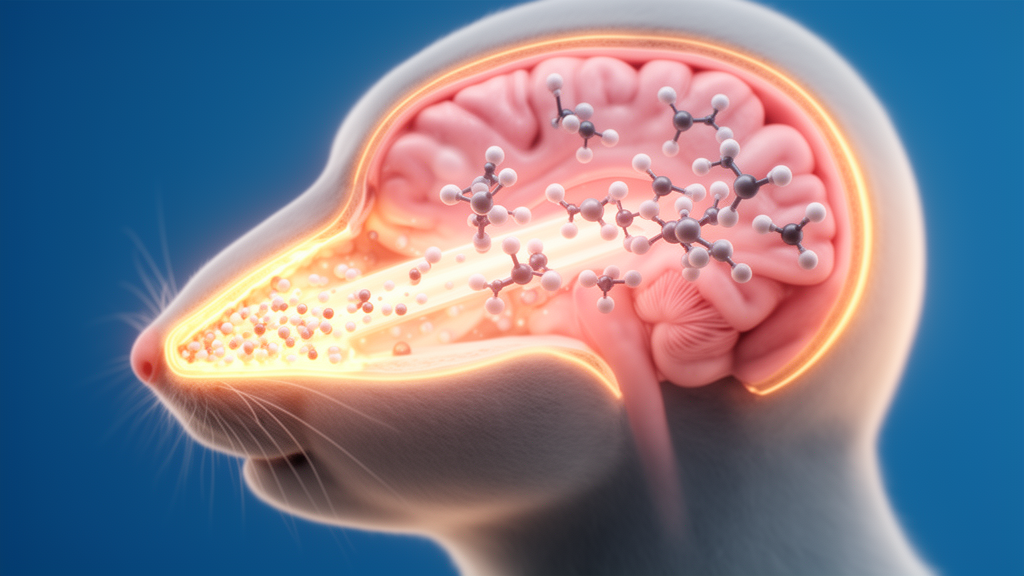
Scientists in Japan have shown that a monoclonal antibody directed against a cell-surface protein abundant in the olfactory epithelium can significantly increase the amount of an antitumor drug that reaches the brain after being administered through the nose. The study, published as an open-access original research article in the journal Cellular and Molecular Neurobiology on 9 October 2026, was led by Azusa Yoneshige and colleagues, including senior author Akihiko Ito. It offers the first evidence, according to the authors, that deliberately targeting a specific cell-surface protein in the olfactory epithelium can improve nose-to-brain drug delivery in mice.
The protein in question is cell adhesion molecule 1, or CADM1, an intercellular adhesion molecule belonging to the immunoglobulin superfamily. In previous work, the same research group had demonstrated efficient intracellular drug delivery to CADM1-expressing tumor cells using anti-CADM1 antibodies, which prompted them to explore whether the same targeting principle could be exploited for delivering therapeutic agents from the nasal cavity into the central nervous system.
Before testing drug delivery, the team confirmed the expression and distribution of CADM1 in the mouse olfactory epithelium using two complementary techniques: immunoblotting and immunohistochemistry. These analyses established that in the mouse nasal cavity, CADM1 is distributed in the olfactory epithelium and is particularly prominent in the sustentacular cell layer, the supporting cell layer of the olfactory epithelia.
The researchers then turned to antibodies that recognize the extracellular domain of CADM1. Two such antibodies, designated 3E1 and 9D2, were administered intranasally to mice. When the researchers compared their behavior with that of a non-targeting control antibody, 3E1 stood out: it exhibited both prolonged retention in the nasal tissue and greater accumulation specifically in the olfactory epithelium. This combination of persistence and selective enrichment made 3E1 the leading candidate for carrying a drug payload.
To test that idea quantitatively, the team selected monomethyl auristatin E, or MMAE, an antitumor agent. To address this, the researchers developed a simple and highly sensitive liquid chromatography–tandem mass spectrometry method capable of detecting MMAE in brain tissue at concentrations as low as 0.5 fmol per milligram of tissue. That level of sensitivity allowed them to quantify drug concentrations in the olfactory bulbs following intranasal administration of the antibody-drug conjugate 3E1-MMAE.
The results showed a clear advantage for the targeted approach over the non-targeting control antibody. On day 4 after administration, the MMAE concentration in the olfactory bulbs achieved with 3E1-mediated delivery was 22.8 fmol per milligram of tissue, compared with 13.4 fmol per milligram with the control antibody. On day 8, the difference persisted: 19.0 fmol per milligram for the 3E1 group versus 14.7 fmol per milligram for the control. In both cases the differences were statistically significant, indicating that coupling MMAE to the CADM1-targeting antibody produced consistently higher drug levels in the olfactory bulbs than the same payload delivered with a non-targeting antibody.
The authors describe these findings as the first evidence that targeting a specific cell-surface protein in the olfactory epithelium can improve nose-to-brain drug delivery, and they present the approach as a promising strategy for developing intranasal therapeutics. A graphical abstract accompanying the paper summarizes the concept: the anti-CADM1 antibody 3E1 enhances nose-to-brain delivery of MMAE by targeting the olfactory epithelium, with LC–MS/MS quantification revealing increased MMAE accumulation in the olfactory bulb.
It is worth emphasizing the scope of the study. The work was carried out in mice, and the measured outcome was drug concentration in the olfactory bulb, not a therapeutic effect against any disease. MMAE is an antitumor agent, but the reported findings concern delivery and quantification of the drug in brain tissue rather than therapeutic effects. The published version is also an early-release, peer-reviewed accepted manuscript that the journal notes is citable and carries a permanent DOI, subject to further edits before the final version of record appears. Within those boundaries, the study establishes a quantitative benchmark for a targeted nose-to-brain strategy: an antibody raised against a protein naturally abundant in the olfactory epithelium, carrying a measurable payload, delivered measurably more drug to the adjacent brain region than a non-targeting antibody at both time points examined.
Subject of Research: Targeting CADM1 in the mouse olfactory epithelium with antibodies to enhance nose-to-brain delivery of the antitumor agent MMAE
Article Title: Cell Adhesion Molecule 1-Targeting Antibodies Enhance Nose-to-Brain Delivery of Monomethyl Auristatin E
Article References: Yoneshige, A., Hagiyama, M., Ito, S., Takeuchi, F., Inoue, T., & Ito, A. (2026). Cell Adhesion Molecule 1-Targeting Antibodies Enhance Nose-to-Brain Delivery of Monomethyl Auristatin E. Cellular and Molecular Neurobiology. https://doi.org/10.1007/s10571-026-01842-3
Image Credits: AI Generated
DOI: 10.1007/s10571-026-01842-3
Keywords: CADM1, nose-to-brain delivery, olfactory epithelium, monomethyl auristatin E, antibody-drug conjugate, intranasal administration, LC-MS/MS, olfactory bulb, drug delivery, mice, Cellular and Molecular Neurobiology, sustentacular cells
News Source: Cassandra Pierce. (October 28, 2026). Antibody Targeting of Olfactory Epithelium Boosts Nose-to-Brain Drug Delivery in Mice. Scienmag.



