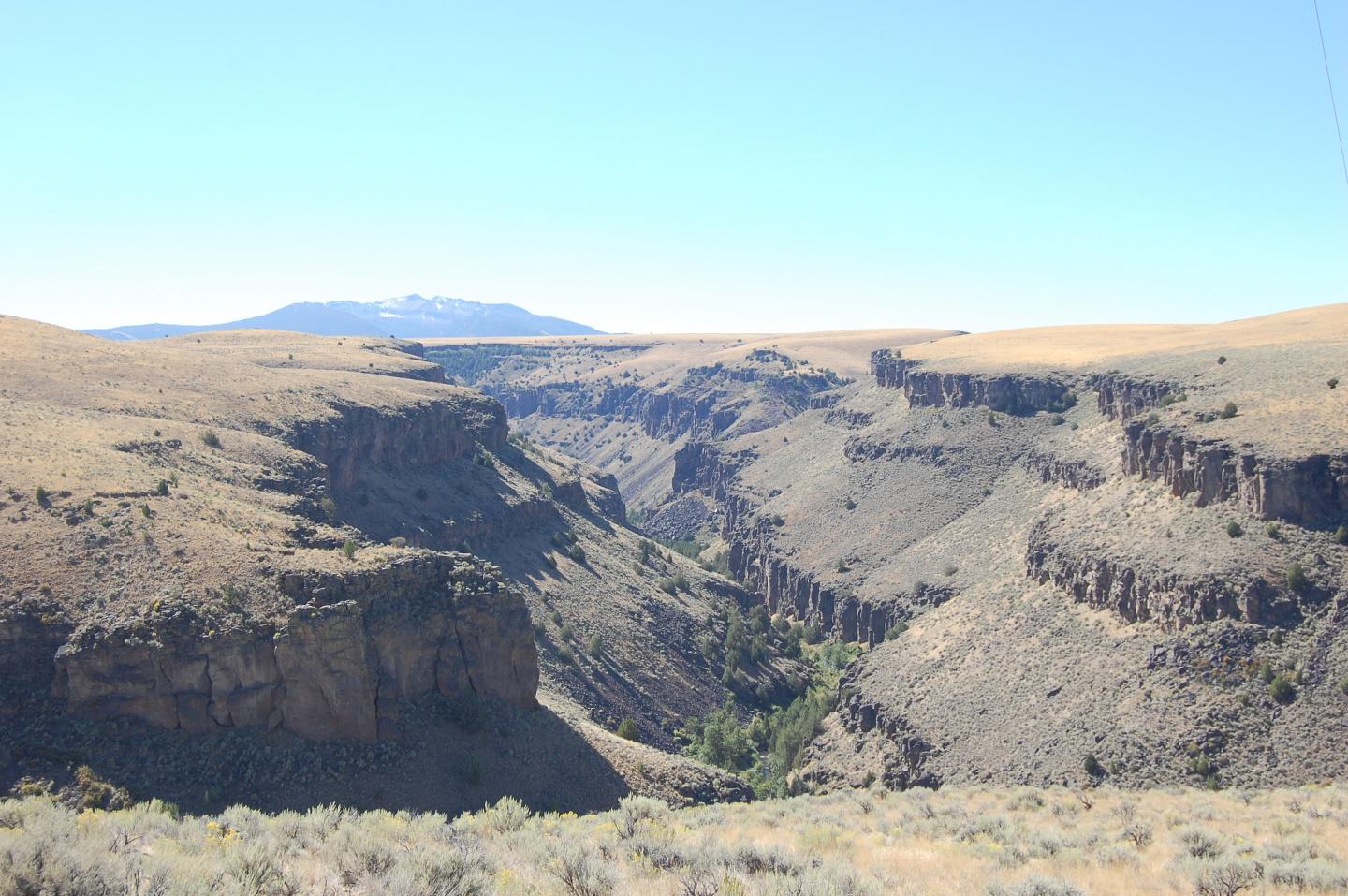
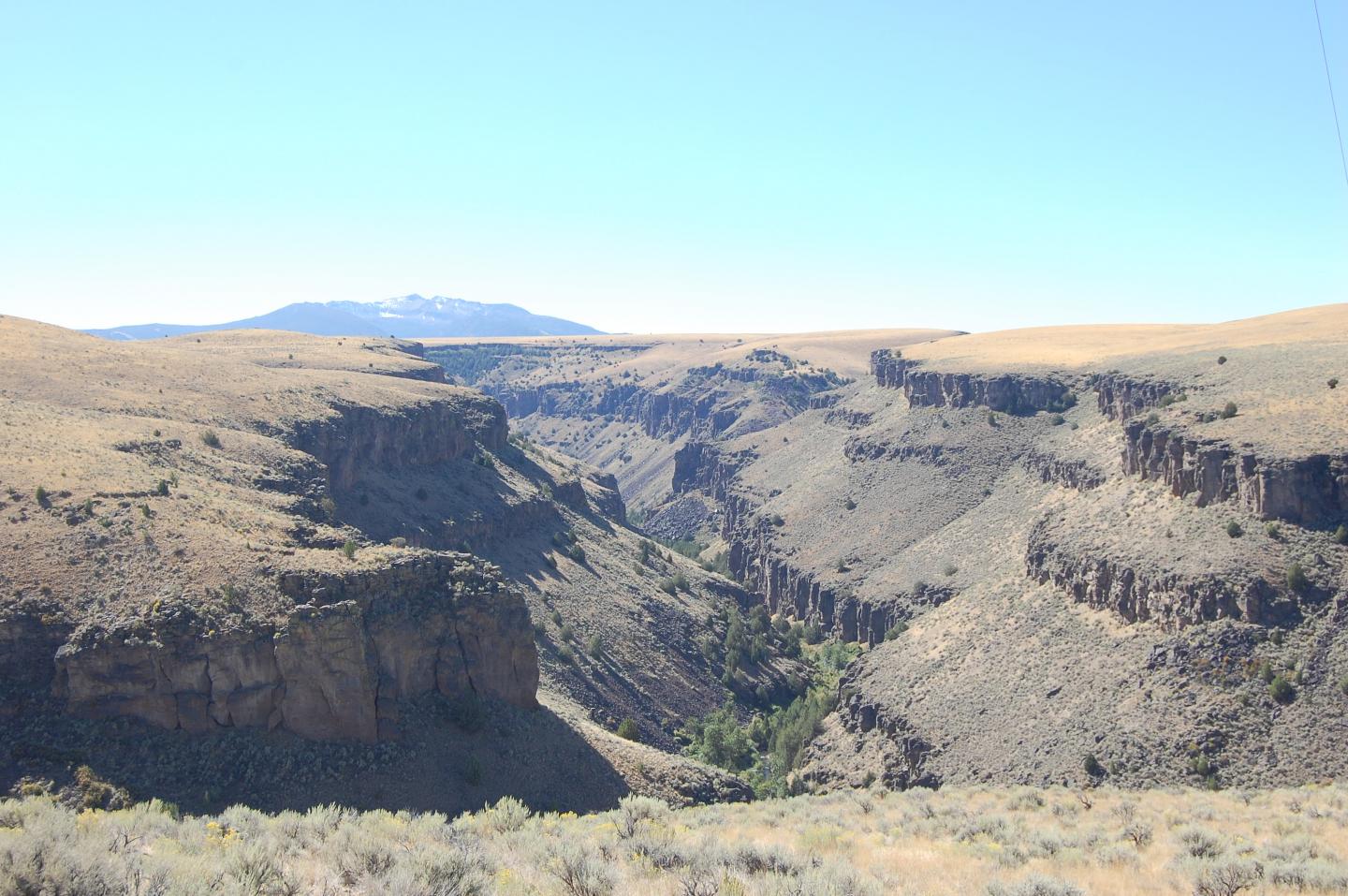
Credit: Photo taken by Marc Reichow, University of Leicester
Images of the Snake River Plain and research team available at: https://www.dropbox.com/sh/jqfwogc4yy5aje1/AABeZbko4OOkOs17_-oM6_RPa?dl=0
A number of giant super-eruptions between 8 and 12 million years ago that could be larger than the colossal eruptions known to have taken place at Yellowstone have been identified in the United States through research led by the University of Leicester.
The international research team suggests that while the number of volcanic eruptions thought to have originated from the central Snake River Plain in Idaho, USA is less than previously believed, the 12 recorded giant eruptions were likely 'significantly larger' than research has previously suggested.
Dr Tom Knott, Professor Mike Branney and Dr Marc Reichow, from the University of Leicester's Department of Geology's Volcanology Group, conducted the research with a team of international collaborators from the University of California, Santa Cruz, USA, the University of Copenhagen, Denmark and Idaho State University, USA.
Using a multi-technique approach, including whole-rock and mineral chemistries, palaeomagnetic data, and radio-isotopic dates, the team has been able to 'fingerprint' individual eruption deposits and correlate these over vast regions (e.g., 1000's km2).
In establishing widespread correlations, the team drastically reduced the number of eruptions previously thought to have originated from the central Snake River Plain by more than half.
The researchers have reported that one of the super-eruptions from the Yellowstone hotspot-track, defined as the Castleford Crossing eruption, occurred about 8.1 million years ago and estimate the eruption volume to have exceeded 1,900 km3. The single volcanic sheet covers an area over 14,000 km2 in southern Idaho, and is more than 1.3 km thick in the caldera of the super-volcano.
This is just one of 12 giant eruptions reported from the area by the Leicester team, who show that intense hotspot magmatism caused major crustal subsidence, forming the 100 km-wide Snake River Basin. The team also demonstrates that these eruptions were in fact significantly larger than previously thought and may rival those better known at Yellowstone.
Dr Knott said: "While it is well-know that Yellowstone has erupted catastrophically in recent times perhaps less widely appreciated is that these were just the latest in a protracted history of numerous catastrophic super-eruptions that have burned a track along the Snake River eastwards from Oregon to Yellowstone from 16 Ma to present.
"The size and magnitude of this newly defined eruption is as large, if not larger, than better known eruptions at Yellowstone, and it is just the first in an emerging record of newly discovered super-eruptions during a period of intense magmatic activity between 8 and 12 million years ago."
###
The paper, which is published in the Geological Society of America Bulletin, is based on Dr Knott's PhD research and funded by the Natural Environment Research Council (NERC) with the drilling of the Kimberly borehole funded by the International Continental Drilling Program (ICDP) and U.S. Department of Energy.
Several former University of Leicester undergraduates, including Mark Baldwin, Stuart Hatter, Liam McDonnell, Fabian Wadsworth and Luke Wooldridge, helped with the US fieldwork. They also enjoyed the opportunity of gaining experience through interacting with the international scientists, such as palaeomagnetists David Finn and Rob Coe of the University of California, Santa Cruz.
As their research continues the team is asking the question: "Is Yellowstone the dwindling member of a volcanic system that was much larger and much more violent during its adolescence in the Mid-Miocene (12-8 million years ago)?"
The paper, 'Mid-Miocene record of large-scale Snake River-type explosive volcanism and associated subsidence on the Yellowstone hotspot track: The Cassia Formation of Idaho, USA' published in the journal Geological Society of America Bulletin is available here:http://bulletin.geoscienceworld.org/content/early/2016/02/10/B31324.1.1.full.pdf+html
Media Contact
Dr Tom Knott
[email protected]
01-162-523-817
@UoLNewsCentre
http://www.leicester.ac.uk