• HOME
  • NEWS
  • EXPLORE
    • CAREER
      • Companies
      • Jobs
    • EVENTS
    • iGEM
      • News
      • Team
    • PHOTOS
    • VIDEO
    • WIKI
  • BLOG
  • COMMUNITY
    • FACEBOOK
    • INSTAGRAM
    • TWITTER
Thursday, December 4, 2025
BIOENGINEER.ORG
No Result
View All Result
  • Login
  • HOME
  • NEWS
  • EXPLORE
    • CAREER
      • Companies
      • Jobs
        • Lecturer
        • PhD Studentship
        • Postdoc
        • Research Assistant
    • EVENTS
    • iGEM
      • News
      • Team
    • PHOTOS
    • VIDEO
    • WIKI
  • BLOG
  • COMMUNITY
    • FACEBOOK
    • INSTAGRAM
    • TWITTER
  • HOME
  • NEWS
  • EXPLORE
    • CAREER
      • Companies
      • Jobs
        • Lecturer
        • PhD Studentship
        • Postdoc
        • Research Assistant
    • EVENTS
    • iGEM
      • News
      • Team
    • PHOTOS
    • VIDEO
    • WIKI
  • BLOG
  • COMMUNITY
    • FACEBOOK
    • INSTAGRAM
    • TWITTER
No Result
View All Result
Bioengineer.org
No Result
View All Result
Home NEWS Science News Chemistry

Ancient Greek tholos-like architecture composed of archaeal proteins

Bioengineer by Bioengineer
February 3, 2020
in Chemistry
Reading Time: 2 mins read
0
IMAGE
Share on FacebookShare on TwitterShare on LinkedinShare on RedditShare on Telegram

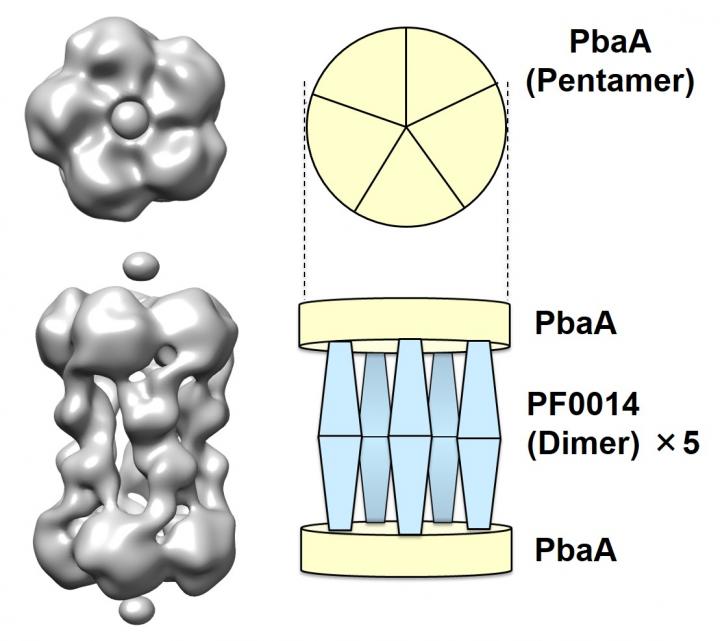
A unique archaeal protein complex having a spacious center surrounded by five columns
IMAGE

Credit: © Biomolecular Organization Research Group


Proteins often form assemblies and thereby perform sophisticated functions in cells as best exemplified by proteasomes, which are huge enzyme complexes functioning as proteolytic machines. In eukaryotes, this proteasome formation is not a spontaneous process but is assisted by several other proteins, termed proteasome-assembling chaperones. Paradoxically, archaeal genomes encode proteasome-assembling chaperone homologs, denoting a shared ancestry between genes, although archaeal proteasome formation is a spontaneous process not requiring these chaperones. Therefore, the functional roles of the archaeal chaperone-like proteins remain unknown. The collaborative groups, including researchers at Exploratory Research Center on Life and Living Systems (ExCELLS), Institute for Molecular Science (IMS), and National Institute for Physiological Sciences (NIPS) of National Institutes of Natural Sciences found that a chaperone-like protein originating from a hyperthermophilic archaeon together with another protein from the same species, whose function is also unknown, are assembled together into unique structures. The integrated biophysical data they obtained using native mass spectrometry, solution scattering, high-speed atomic force microscopy, and electron microscopy, along with atomic structure modeling, revealed that this complex forms a five-column tholos-like architecture, harboring a large central cavity, which can potentially accommodate biomolecules, such as proteins. This characteristic architecture of archaeal protein complex provides insight into the molecular evolution between archaeal and eukaryotic proteins. Furthermore, their findings offer a novel framework for designing functional protein cages as molecular warehouses or shelters that are stable in high temperatures.

###

Media Contact
Koichi Kato
[email protected]
81-564-595-226

Original Source

http://www.excells.orion.ac.jp/engnews/20200130pr-1.html

Related Journal Article

http://dx.doi.org/10.1038/s41598-020-58371-2

Tags: BiologyBiomechanics/Biophysics
Share12Tweet8Share2ShareShareShare2

Related Posts

blank

Iridium Catalysis Enables Piperidine Synthesis from Pyridines

December 3, 2025
Neighboring Groups Speed Up Polymer Self-Deconstruction

Neighboring Groups Speed Up Polymer Self-Deconstruction

November 28, 2025

Activating Alcohols as Sulfonium Salts for Photocatalysis

November 26, 2025

Carbonate Ions Drive Water Ordering in CO₂ Reduction

November 25, 2025
Please login to join discussion

POPULAR NEWS

  • New Research Unveils the Pathway for CEOs to Achieve Social Media Stardom

    New Research Unveils the Pathway for CEOs to Achieve Social Media Stardom

    204 shares
    Share 82 Tweet 51
  • Scientists Uncover Chameleon’s Telephone-Cord-Like Optic Nerves, A Feature Missed by Aristotle and Newton

    120 shares
    Share 48 Tweet 30
  • Neurological Impacts of COVID and MIS-C in Children

    107 shares
    Share 43 Tweet 27
  • MoCK2 Kinase Shapes Mitochondrial Dynamics in Rice Fungal Pathogen

    68 shares
    Share 27 Tweet 17

About

BIOENGINEER.ORG

We bring you the latest biotechnology news from best research centers and universities around the world. Check our website.

Follow us

Recent News

Boosting Cancer Immunotherapy by Targeting DNA Repair

Evaluating eGFR Equations in Chinese Children

Metformin-Alogliptin Combo vs. Monotherapy in Diabetes

Subscribe to Blog via Email

Enter your email address to subscribe to this blog and receive notifications of new posts by email.

Join 69 other subscribers
  • Contact Us

Bioengineer.org © Copyright 2023 All Rights Reserved.

Welcome Back!

Login to your account below

Forgotten Password?

Retrieve your password

Please enter your username or email address to reset your password.

Log In
No Result
View All Result
  • Homepages
    • Home Page 1
    • Home Page 2
  • News
  • National
  • Business
  • Health
  • Lifestyle
  • Science

Bioengineer.org © Copyright 2023 All Rights Reserved.