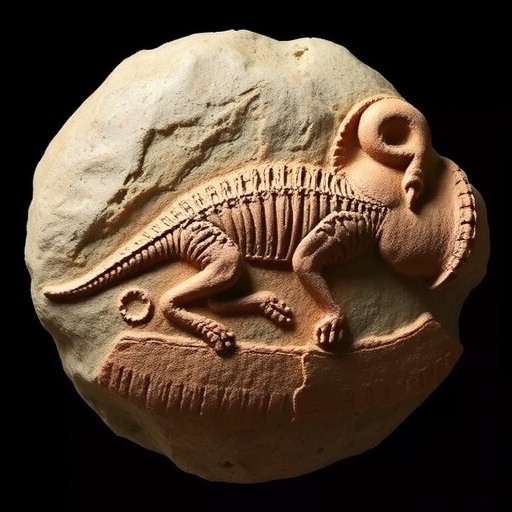
Life on land has long been shaped by the creatures that inhabit it, but few epochs offer as fascinating a glimpse into the origins of terrestrial ecosystems as the Carboniferous period, some 300 million years ago. A recent discovery, detailed in the prestigious journal Nature Ecology and Evolution, is rewriting our understanding of early land vertebrates and the advent of herbivory—the ability to consume plant material. Until now, scientific consensus suggested that early terrestrial vertebrates mainly subsisted on animal prey. However, groundbreaking research reveals that a pivotal shift towards plant consumption dates back farther than previously recognized, embodied by a species named Tyrannoroter heberti.
The fossilized skull of Tyrannoroter heberti, unearthed on Nova Scotia’s rugged Cape Breton Island, offers unprecedented insights into the evolutionary experimentation that marked terrestrial vertebrate diets. This animal falls within a group known as recumbirostran microsaurs, early tetrapods notable for their adaptation to fully terrestrial lifestyles. The fossil, although limited to the cranial remains, reveals substantial details about dentition, cranial morphology, and jaw mechanics that collectively suggest a sophisticated capability for processing vegetation, a behavior rarely attributed to its contemporaries.
Tyrannoroter’s skull morphology, characterized by its wide posterior and narrow snout, was analyzed through state-of-the-art CT scanning technology. This non-invasive imaging revealed multiple sets of teeth specialized for crushing and grinding plant matter, including accessory teeth located on the palate, a feature indicative of advanced herbivory. The presence of such dental adaptations challenges previous assumptions that herbivory evolved only after the divergence of amniotes—groups that gave rise eventually to reptiles and mammals—asserting instead that this dietary habit was emerging among earlier branches of terrestrial tetrapods.
The discovery also contextualizes the evolutionary timing of plant consumption. Prior to this finding, the earliest herbivorous tetrapods dated to roughly 250 million years ago, well after the Carboniferous. However, Tyrannoroter, which lived roughly 307 million years ago, fills this temporal gap and indicates that experimentation with plant-based diets was already underway in the late Carboniferous. This period was critical for terrestrial ecosystems as it coincided with significant environmental shifts, including the transition from greenhouse to icehouse conditions and the eventual collapse of the expansive Carboniferous rainforests.
Notably, Tyrannoroter is not believed to have been an obligate herbivore, but rather an omnivore with a diet likely supplemented by small invertebrates. This flexible diet is consistent with modern observations in herbivorous vertebrates, many of which consume animal proteins alongside vegetation. The fossil evidence further suggests that consuming insect exoskeletons may have facilitated the establishment of gut microbiota capable of breaking down fibrous plant material, representing a crucial evolutionary step towards more specialized herbivory among terrestrial vertebrates.
The environmental context of Tyrannoroter’s existence sheds light on the broader narrative of early terrestrial vertebrate adaptation. As a stem amniote, it belongs to the lineage that predates the divergence of reptiles and mammals. Its adaptive traits provide a window into how early tetrapods overcame the challenges of terrestrial life, including dietary diversification to exploit emergent ecological niches. This diversification was essential for the success and proliferation of vertebrates on land, setting the stage for future evolutionary radiations.
Field researchers faced considerable obstacles in recovering this fossil, from the volatile tides of Nova Scotia’s coastline to precarious cliffside excavations. The discovery owed much to the keen eye of Brian Hebert, an avocational paleontologist whose find, encased within a fossilized tree stump, has illuminated aspects of paleobiology that had remained elusive. The combination of meticulous fieldwork, advanced imaging technologies, and interdisciplinary collaboration underscores the multifaceted efforts required to uncover and interpret such ancient evidence.
The implications of this discovery extend beyond paleontology, providing analogs for understanding modern ecological and evolutionary processes. Tyrannoroter lived during a pivotal climatic transition that included the collapse of vast rainforest ecosystems, paralleling current concerns regarding climate change and habitat loss. Understanding how early herbivorous vertebrates responded to such environmental upheavals offers potential predictive power for assessing the resilience and vulnerability of contemporary plant-dependent animals.
Furthermore, the study challenges assumptions about the timing and ecological complexity of early vertebrate herbivory. Teeth adapted for crushing and grinding plants, especially palatal teeth, signify a level of functional complexity previously unattributed to Carboniferous tetrapods. Such morphological details reveal that the evolution of herbivory was not a sudden event but a gradual acquisition of traits enabling efficient plant processing, involving shifts in gut physiology and possibly symbiotic relationships with gut microbes.
This research also accentuates the importance of high-resolution imaging in paleontology. By utilizing CT scans, researchers bypassed the need for destructive preparation techniques, preserving the fossil while uncovering hidden anatomical features. The scans unveiled internal structures including the braincase and the detailed dental arrangement, providing a comprehensive view of Tyrannoroter’s feeding adaptations that a mere external examination could not reveal.
Tyrannoroter heberti’s modest size, roughly comparable to an American football, belies its evolutionary significance. As one of the largest known terrestrial animals of its time, this specimen provides an essential data point in reconstructing Carboniferous ecosystems. Its robust skull and specialized dentition suggest evolutionary pressures favoring herbivory among terrestrial vertebrates well before the emergence of more modern amniotes, highlighting a complex ecological tapestry of opportunistic feeding strategies and adaptation.
Looking forward, this finding invites further exploration into the diversity of early terrestrial ecosystems and the dietary niches occupied by ancient tetrapods. It raises intriguing questions about the evolutionary drivers of herbivory, the co-evolution of plant defenses, and how these interactions shaped the trajectory of vertebrate life on land. Tyrannoroter thus represents both a culmination of past evolutionary experiments and a foundation upon which the future of terrestrial vertebrate herbivory was built.
In summary, Tyrannoroter heberti stands as a remarkable testament to the intricate evolutionary history of vertebrate herbivory. Its fossilized skull, with its specialized crushing teeth exposed through advanced imaging, redefines our understanding of when and how terrestrial vertebrates began incorporating plants into their diets. Situated within an era of climatic volatility and ecological transformation, this species provides a crucial link between early terrestrial vertebrates and the diverse ecosystems they helped establish, offering valuable insights into the complex evolutionary narrative that ultimately gave rise to modern mammals, reptiles, and indeed ourselves.
Subject of Research: Origins of terrestrial herbivory in early tetrapods
Article Title: Carboniferous recumbirostran elucidates the origins of terrestrial herbivory
News Publication Date: 10-Feb-2026
Web References: https://doi.org/10.1038/s41559-025-02929-8
Image Credits: Illustration by Hannah Fredd
Keywords: Paleontology, Fossils, Animal fossils, Life sciences, Evolutionary biology, Evolution
Tags: advanced CT scanning in paleontologyancient land vertebratesCarboniferous period discoveriescranial morphology of early tetrapodsearly herbivory in tetrapodsfossil evidence of herbivorous dietsmajor shifts in vertebrate dietsNova Scotia paleontologyplant consumption in prehistoric animalsrecumbirostran microsaurs evolutionterrestrial ecosystem evolutionTyrannoroter heberti fossil