A newly identified 16th century horse specimen is among the oldest domestic horses from the Americas known to date, and its DNA helps clarify the history of horses in the Western Hemisphere, according to a study published July 27, 2022, in the open-access journal PLOS ONE by Nicolas Delsol of the University of Florida, U.S.A., and colleagues.
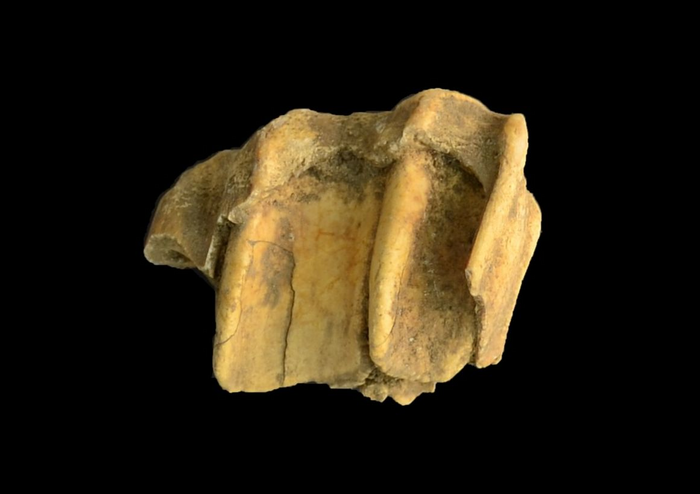
Credit: Nicolas Delsol, CC-BY 4.0 (https://creativecommons.org/licenses/by/4.0/)
A newly identified 16th century horse specimen is among the oldest domestic horses from the Americas known to date, and its DNA helps clarify the history of horses in the Western Hemisphere, according to a study published July 27, 2022, in the open-access journal PLOS ONE by Nicolas Delsol of the University of Florida, U.S.A., and colleagues.
Domestic horses were first brought to the Americas by Europeans in the late 15th century and became a pivotal part of European industry and military in the Western Hemisphere. Historical documents suggest the earliest domestic horses were brought to the Caribbean from the Iberian Peninsula, but little archaeological evidence exists to corroborate this. In this study, researchers present a genetic analysis of a late 16th century horse specimen, shedding light on the origins and spread of American domestic horses.
The specimen is a tooth fragment, originally misidentified as cow, from the Spanish colonial site of Puerto Real in what is now Haiti. The authors sequenced the mitochondrial genome, not only allowing for a correct identification, but also making this the earliest known complete mitogenome of a post-Columbian domestic horse in the Americas.
This horse belongs to a genetic lineage called equine haplogroup A, whose members are well known from Southern Europe, supporting the hypothesis that they originated on the Iberian Peninsula. Furthermore, this horse’s closest living relatives are the feral ponies of Chincoteague Island, Virginia, said by local folk stories to have become stranded after a Spanish shipwreck.
Although this study presents only a single mitochondrial genome, the authors suggest the results are significant in multiple respects. First, this horse’s position within a common Iberian lineage supports documentation of the Iberian Peninsula as the source of many early American domestic horses. Second, the relationships between this horse and others in the Americas will help clarify our understanding of the path horses took as they colonized the Americas.
The authors add: “Our study highlights how ancient DNA can help us understand cultural and historical processes, not only in the remote past but also in understudied episodes of more recent history. The analysis of the introduction of European domesticates (e.g. the horse) in the Americas is such a fascinating yet understudied topic. Our results support the Iberian origins of these animals but they also highlight another narrative: the exploration of the mid-Atlantic coast by the Spanish early during the colonial period.”
#####
In your coverage please use this URL to provide access to the freely available article in PLOS ONE: https://journals.plos.org/plosone/article?id=10.1371/journal.pone.0270600
Citation: Delsol N, Stucky BJ, Oswald JA, Reitz EJ, Emery KF, Guralnick R (2022) Analysis of the earliest complete mtDNA genome of a Caribbean colonial horse (Equus caballus) from 16th-century Haiti. PLoS ONE 17(7): e0270600. https://doi.org/10.1371/journal.pone.0270600
Author Countries: U.S.A.
Funding: KFE and ND received support from NSF DDRIG grant (#1930628) for this research (https://beta.nsf.gov/funding/opportunities/archaeology-and-archaeometry-0). ND’s initial research was also funded by a Fulbright scholarship. The field research in Haiti was financed through contributions of the Organization of American States, the National Endowment for the Humanities, Dr. William Goya, the Wentworth Foundation, the University of Florida Division of Sponsored Research, and the Florida Museum of Natural History. The funders had no role in study design, data collection and analysis, decision to publish, or preparation of the manuscript.
Journal
PLoS ONE
DOI
10.1371/journal.pone.0270600
Method of Research
Observational study
Subject of Research
Animals
Article Title
Analysis of the earliest complete mtDNA genome of a Caribbean colonial horse (Equus caballus) from 16th-century Haiti
Article Publication Date
27-Jul-2022
COI Statement
The authors have declared that no competing interests exist.