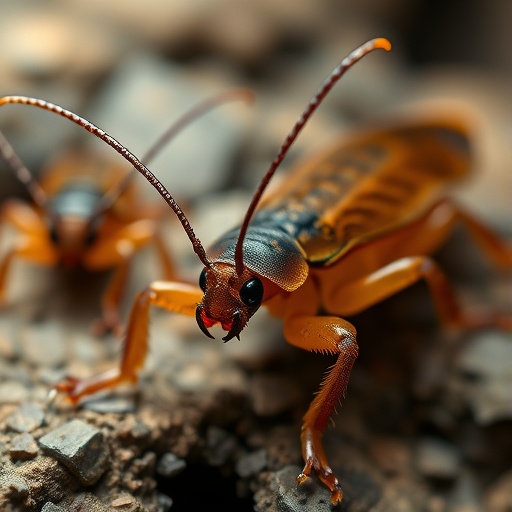
In a remarkable exploration of Cretaceous biodiversity, researchers unveil significant discoveries about ancient cockroaches found in Kachin amber, shedding light on their intriguing adaptations and evolutionary history. The recent study, led by Sendi et al., brings forth new insights into the mid-Cretaceous period, a time pivotal for the evolution of various life forms on Earth. The findings not only enhance our understanding of Blattaria—cockroaches that appear almost timeless—but also highlight the intricate structures of their bipectinate antennae, an evolutionary feature that has often puzzled entomologists.
The study details new specimens of cockroaches belonging to the family Corydiidae, a lineage that has thrived for millions of years. By scrutinizing these fossilized remains in amber, scientists were able to analyze their morphological features in exquisite detail. The Kachin region of Myanmar, famed for its amber deposits, has proven to be a hotspot for paleontological discoveries. Each fossil encapsulated in the golden resin serves as a time capsule, preserving biological details that would otherwise be lost to history.
Bipectinate antennae, which are characterized by their comb-like structures, serve critical roles in the sensory perception of these insects. The new species identified in the study exhibit distinct variations in antennae morphology when compared to their modern relatives, revealing clues about their environmental adaptations. Understanding how these structures functioned in the past aids scientists in reconstructing the behavioral ecology of ancient insect species.
The emergence of bipectinate antennae in cockroaches is significant for several reasons. These adaptations suggest a reliance on enhanced olfactory cues, enabling survival in diverse habitats. The intricate design of these antennae likely played a role in navigating through the lush forests of the Cretaceous, allowing these insects to find food, mates, and evade predators more effectively. Such revelations not only contribute to evolutionary biology but also provoke questions regarding how other species may have adapted similarly in response to their environments over time.
The research methodology employed is both rigorous and innovative. Using advanced imaging techniques, including high-resolution microscopy, the team meticulously documented the structural intricacies of these ancient cockroaches. This approach allowed for a comprehensive morphological analysis, which is essential for accurately classifying and understanding the evolutionary relationships among these species. Moreover, these techniques emphasize the importance of precision in paleontological studies, ensuring that even the smallest details are not overlooked.
The implications of this research extend beyond the mere taxonomy of ancient species. By establishing a clearer phylogenetic relationship among cockroaches, researchers can more effectively trace the evolutionary history of these insects and their relatives. These findings reinforce the concept that modern cockroaches are direct descendants of a highly successful lineage, adept at surviving drastic environmental changes over millions of years.
As the study gains traction within the scientific community, implications for broader ecosystems emerge. Cockroaches play an essential role in nutrient recycling and ecosystem health. Understanding their evolutionary history can provide context for contemporary ecological dynamics, particularly in relation to pest management and conservation efforts. Despite their notoriety as pests, cockroaches also serve as crucial indicators of environmental changes, making their study increasingly relevant in the context of biodiversity conservation.
Furthermore, the research team accentuated the urgency of exploring lesser-known fossil deposits to uncover additional secrets of the Cretaceous ecosystems. The Kachin amber, with its preserved flora and fauna, serves as a reminder of the rich biodiversity that existed during this era and the potential to discover more yet-undefined species. Each new discovery adds layers of complexity to our understanding of life on Earth, underscoring that even small insects played significant roles within their respective ecosystems.
The collaboration among scientists from different fields also highlights the interdisciplinary nature of modern paleontological studies. By combining expertise in geology, entomology, and imaging technologies, the research demonstrates how multifaceted approaches can yield comprehensive insights into ancient life forms. The need for such collaboration is increasingly crucial in addressing questions about biodiversity and evolution, as contemporary research often straddles multiple domains of science.
Anticipation grows as the scientific world prepares for more revelations from Kachin amber, promising fresh perspectives on ancient biodiversity. The study not only contributes to the existing body of knowledge but also acts as a catalyst for future research initiatives aimed at unearthing new fossil records. By encouraging exploration of unexplored deposits, scientists can further enrich our understanding of the prehistoric world.
As we move forward, the legacy of the mid-Cretaceous cockroaches now rests upon enhanced appreciation for their unique evolutionary adaptations. The study conducted by Sendi and colleagues serves as an essential touchstone for understanding the intricate connections between ancient ecosystems and the evolutionary paths they forged. It challenges us to view these insects not merely as pests but as pivotal pieces in the broader narrative of life that continues to unfold.
Through their unwavering dedication to this research, the authors illuminate a path for future inquiries, advocating for a deeper examination of the evolutionary tapestry that has shaped all living organisms. The cosmic dance of life, woven through epochs, presents an everlasting mystery that beckons scientists to continue seeking answers in every nook and cranny of our planet’s fossilized past.
The fascination with ancient life will undoubtedly endure, as each discovery opens new chapters in the intricate story of evolution. As we continue to uncover the secrets of the Cretaceous, the revelations from this study promise to resonate for generations to come, providing a vital link between our past and present in the ever-evolving realm of natural history.
Subject of Research: Mid-Cretaceous Cockroaches from Kachin Amber
Article Title: New mid-Cretaceous cockroaches (Blattaria: Corydiidae) from Kachin amber illuminate the diversity of bipectinate antennae.
Article References:
Sendi, H., Samay, J., Šmídová, L. et al. New mid-Cretaceous cockroaches (Blattaria: Corydiidae) from Kachin amber illuminate the diversity of bipectinate antennae.
Sci Nat 113, 7 (2026). https://doi.org/10.1007/s00114-025-02060-5
Image Credits: AI Generated
DOI: 02 January 2026
Keywords: Cretaceous, cockroaches, Kachin amber, biodiversity, bipectinate antennae, evolution, entomology, fossil records, ancient ecosystems, phylogenetic relationship.
Tags: ancient cockroaches Kachin amberbipectinate antennae structuresBlattaria adaptationscockroach evolutionary historyCorydiidae family discoveriesentomological research advancementsfossilized remains analysisinsect sensory perception featuresmid-Cretaceous biodiversitymorphological variations in cockroachesMyanmar amber depositspaleontological findings