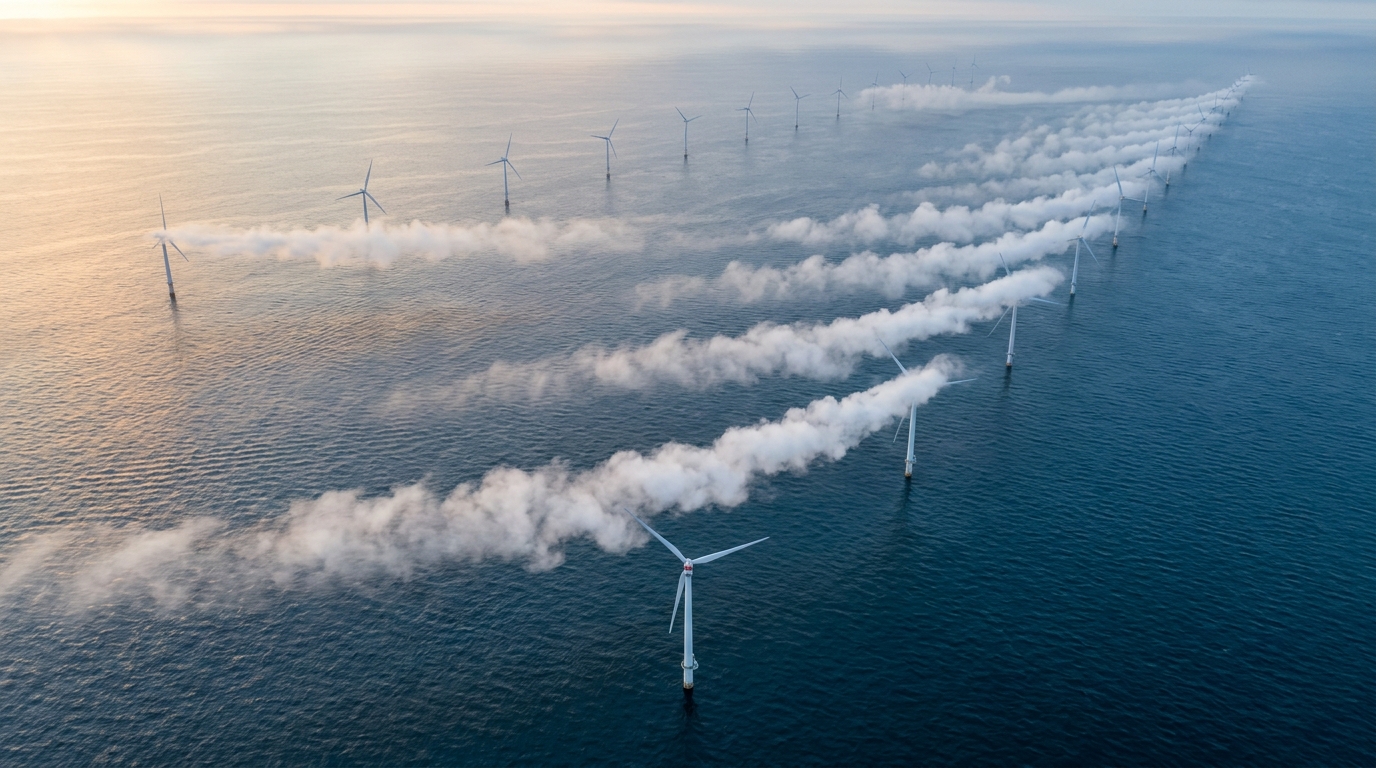
An analytical, non-iterative model derived directly from the conservation of momentum accurately predicts cumulative streamwise and lateral velocity deficits as well as wake deflection in wind farms operating with yawed turbines, according to a preprint under review in Wind Energy Science. Developed by Nils Joseph Gaukroger, Diego Siguenza-Alvarado, Maarten Paul van der Laan, and Majid Bastankhah, the formulation allows wake bending to emerge naturally from fundamental governing physics rather than being artificially imposed.
Wake interactions between individual turbines represent a primary source of power loss across wind farms, prompting operators to implement yaw-based wake steering that redirects wakes away from downwind machines to raise total power generation. However, existing engineering models commonly superpose separate single-turbine deficit and deflection models, an approach that struggles with non-linear phenomena such as secondary wake steering. Previous momentum-conserving formulations that capture these interactions have relied on iterative numerical calculations or proxies such as effective yaw angles.
To overcome these limitations, the authors extended an approximate conservation of momentum deficit solution to the lateral direction. By distinguishing the streamwise wake from the lateral wake, their analytical framework makes the spatial distribution of lateral momentum induced by yaw misalignment explicit. In this formulation, wake deflection is determined diagnostically through integration of the local flow skew angle across the farm.
The theoretical framework provides direct physical insight into the mechanisms governing secondary wake steering, explaining why wakes located further downstream also bend. The model shows that the wake of an unyawed downstream turbine is deflected not only by the cross-flow produced by upstream wakes, but also, for approximately one-third of its total deflection, by the turbine’s own streamwise deficit slowing the flow that carries that cross-flow.
When evaluated against wind-tunnel measurements of single-turbine and multi-turbine configurations, the analytical model reproduced far-wake deflection pathways and lateral velocity distributions, demonstrating greater accuracy than established engineering models across most evaluated configurations. Furthermore, across the entire hub-height velocity field—which requires no arbitrary wake center definition and remains well defined where merging wakes interact—the proposed formulation proved more accurate in every configuration tested.
The primary discrepancies identified in the study were confined to the near-wake region, where the simplified theoretical treatment underpredicts the streamwise velocity deficit. Because the resulting mathematical formulation is analytical and non-iterative, the authors note that the low-order model is particularly well suited for wind farm control and design optimization applications requiring fast, computationally efficient tools.
Beyond theoretical derivation, the authors have made the computational implementation openly accessible to the scientific and engineering communities. The analytical wake deflection framework is distributed as open-source software, with version 1.0.1 archived on the Zenodo platform by Nils Joseph Gaukroger and Diego Siguenza-Alvarado. The validation exercises carried out in the study rely on experimental and theoretical datasets examining wind turbine wakes under yawed operating conditions, previously compiled and published to Zenodo by Majid Bastankhah and Fernando Porté-Agel.
The investigation represents an international research collaboration across several academic engineering institutions. Lead author Nils Joseph Gaukroger and co-author Maarten Paul van der Laan conduct their work at the Technical University of Denmark within the DTU Wind and Energy Systems department, based at the Risø Campus in Roskilde. Co-authors Diego Siguenza-Alvarado and Majid Bastankhah are affiliated with the Department of Engineering at Durham University in the United Kingdom, with Siguenza-Alvarado also holding an affiliation at the Centro de Energías Renovables y Alternativas at Escuela Superior Politécnica del Litoral in Guayaquil, Ecuador.
The manuscript is currently accessible as an open-access preprint undergoing interactive public peer review through Copernicus Publications for the journal Wind Energy Science. Submitted on October 7, 2026, the paper entered formal open discussion on November 4, 2026, with the public commentary period scheduled to remain active until December 2, 2026. As disclosed in the accompanying metadata, at least one contributing co-author is a member of the editorial board of Wind Energy Science, and the preprint itself is made available under a Creative Commons Attribution 4.0 License.
Subject of Research: Analytical wake deflection modeling and secondary steering in wind farms
Article Title: An analytical wake deflection model for wind farms including secondary wake steering
Article References: Gaukroger, N. J., Siguenza-Alvarado, D., van der Laan, M. P., & Bastankhah, M. (2026). An analytical wake deflection model for wind farms including secondary wake steering. https://doi.org/10.5194/wes-2026-183
Image Credits: AI Generated
DOI: 10.5194/wes-2026-183
Keywords: wind energy, wake deflection, secondary wake steering, wind turbines, momentum conservation, velocity deficits, wind tunnel measurements, wind farm control, analytical, wake, deflection, model
News Source: Alan Morgan. (November 8, 2026). Analytical Model Predicts Wind Farm Wake Deflection and Secondary Steering. Scienmag.