An original combination of nanomaterials in a memristive device with the effect of resistive switching stabilization was used for the first time
Credit: Lobachevsky University
Lobachevsky University scientists have implemented a new variant of the metal-oxide memristive device, which holds promise for use in RRAM (Resistive Random Access Memory) and novel computing systems, including neuromorphic ones.
Variability (lack of reproducibility) of resistive switching parameters is the key challenge on the way to new applications of memristive devices. This variability of parameters in “metal-oxide-metal” device structures is determined by the stochastic nature of the migration process of the oxygen ion and/or oxygen vacancies responsible for oxidation and reduction of conductive channels (filaments) near the metal/oxide interface. It is also compounded by the degradation of device parameters in case of uncontrolled oxygen exchange.
Traditional approaches to controlling the memristive effect include the use of special electrical field concentrators and the engineering of materials/interfaces in the memristive device structure, which typically require a more complex technological process for fabricating memristive devices.
According to Alexey Mikhaylov, head of the UNN PTRI laboratory, Nizhny Novgorod scientists for the first time used in their work an approach that combines the advantages of materials engineering and self-organization phenomena at the nanoscale. It involves a combination of the materials of electrodes with certain oxygen affinity and different dielectric layers, as well as the self-assembly of metal nanoclusters that serve as electric field concentrators.
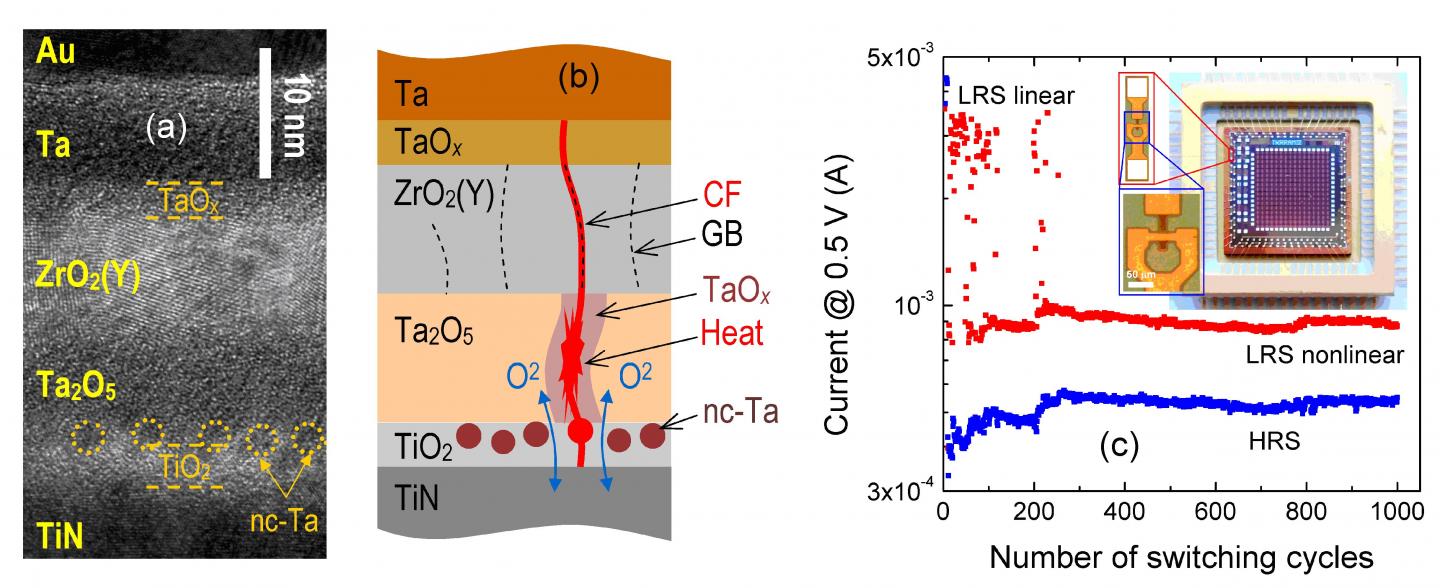
“This approach does not require any additional operations in the process of fabrication of such devices and demonstrates a practically important result: the stabilization of resistive switching between nonlinear resistive states in a multilayer device structure based on yttrium-stabilized zirconium dioxide films with a given concentration of oxygen and additional layers of tantalum oxide,” explains Alexey Mikhaylov.
Following a comprehensive study of the structure and composition of materials by Lobachevsky University scientists, it is possible to interpret the obtained result on the basis of the concept about the formation of filaments with a central conductive part in the ZrO2(Y) film and reproducible structural transformations between a more conductive rutile-like TaOx phase and the dielectric Ta2O5 phase in the underlying tantalum oxide film under Joule heating of the local area near the filament.
The presence of grain boundaries in ZrO2(Y) as preferred nucleation sites for filaments, the presence of nanoclusters as field concentrators in the Ta2O5 film, and the exchange of oxygen between the oxide layers at the interface with TiN contribute to the stabilization of resistive states.
“It is important to note that the optimized structure has also been implemented as part of the memristive chip with cross-point and cross-bar devices (device size – 20 μm × 20 μm), which demonstrate robust switching and low variation of resistive states (less than 20%), which opens up the prospect of programming memristive weights in large passive arrays and their application in the hardware implementation of various functional circuits and systems based on memristors. It is expected that the next step towards commercialization of the proposed engineering solutions will consist in integrating the array of memristive devices with the CMOS layer containing peripheral and control circuits”, concludes Alexey Mikhaylov.
For this purpose, a new integrated circuit topology is being developed at Lobachevsky University. This work is funded by a Nizhny Novgorod region grant in the field of science, technology and engineering (Agreement No. 316-06-16-20/19).
###
A paper based on the results of this research was published in Advanced Materials Technologies, a journal from the prestigious Wiley series (Q1 based on JCR 2018 database): Multilayer Metal-Oxide Memristive Device with Stabilized Resistive Switching / A. Mikhaylov, A. Belov, D. Korolev, I. Antonov, V. Kotomina, A. Kotina, E. Gryaznov, A. Sharapov, M. Koryazhkina, R. Kryukov, S. Zubkov, A. Sushkov, D. Pavlov, S. Tikhov, O. Morozov, D. Tetelbaum // Advanced Materials Technologies. – – 2020. – Vol.5. – P.1900607. DOI: 10.1002/admt.201900607 / IF = 5.395 Q1 (JCR 2018).
Media Contact
Alexey Pomazov
[email protected]
Related Journal Article
http://dx.