

• HOME
  • NEWS
  • EXPLORE
    • CAREER
      • Companies
      • Jobs
    • EVENTS
    • iGEM
      • News
      • Team
    • PHOTOS
    • VIDEO
    • WIKI
  • BLOG
  • COMMUNITY
    • FACEBOOK
    • INSTAGRAM
    • TWITTER
Saturday, February 7, 2026
BIOENGINEER.ORG
No Result
View All Result
  • Login
  • HOME
  • NEWS
  • EXPLORE
    • CAREER
      • Companies
      • Jobs
        • Lecturer
        • PhD Studentship
        • Postdoc
        • Research Assistant
    • EVENTS
    • iGEM
      • News
      • Team
    • PHOTOS
    • VIDEO
    • WIKI
  • BLOG
  • COMMUNITY
    • FACEBOOK
    • INSTAGRAM
    • TWITTER
  • HOME
  • NEWS
  • EXPLORE
    • CAREER
      • Companies
      • Jobs
        • Lecturer
        • PhD Studentship
        • Postdoc
        • Research Assistant
    • EVENTS
    • iGEM
      • News
      • Team
    • PHOTOS
    • VIDEO
    • WIKI
  • BLOG
  • COMMUNITY
    • FACEBOOK
    • INSTAGRAM
    • TWITTER
No Result
View All Result
Bioengineer.org
No Result
View All Result
Home NEWS Science News Biology

An evolutionary breakpoint in cell division

Bioengineer by Bioengineer
February 9, 2018
in Biology
Reading Time: 2 mins read
0
Share on FacebookShare on TwitterShare on LinkedinShare on RedditShare on Telegram
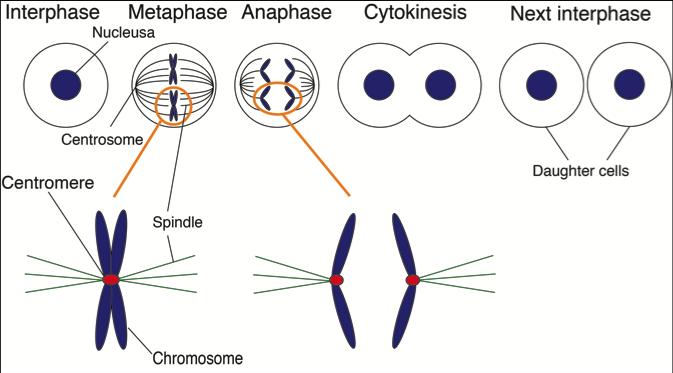
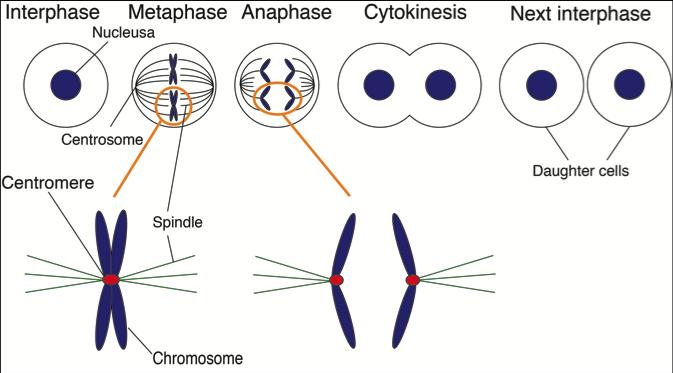
IMAGE

Credit: Osaka University

Japanese researchers from Osaka University have discovered that the interaction between two proteins, M18BP1/KNL2 and CENP-A, is essential for cell division in various species except for mammals including human.

Mitosis is a process in living organisms in which a cell divides into two new daughter cells. It is necessary for growth, and replacement and repair of older cells. During mitosis, all genome information in an individual cell is copied and then divided equally into the daughter cells.

The centromere is a critical structure consisting of DNA and proteins that plays an important role in the distribution of genome information during mitosis. If the centromere is disrupted, an unequal division of the genome information can occur, resulting in defective cells and possibly cancer. Specifically, Osaka University Professor Tatsuo Fukagawa, who was the principal investigator of the study, was interested in mechanisms how the centromere is established and maintained in the cells.

"CENP-A is a key factor for the establishment and maintenance of the centromere," he said. "We looked into the mechanisms how CENP-A is deposited into centromere and especially focused relationship between the Mis18 complex and CENP-A, because previous studies had shown it regulates CENP-A deposition to the centromere."

"Research has suggested that the Mis18 complex associates with CENP-A on chromatin (old CENP-A) for new CENP-A deposition in non-mammalian vertebrates like chicken, but this unique loading system is lost in mammalian cells" he added.

The Mis18 complex is made up of three subunits: Mis18α, Mis18β, and M18BP1/KNL2. Fukagawa and his team found that the M18BP1/KNL2 subunit in chicken had a specific binding motif that allowed the complex to bind to CENP-A on chromatin, which allowed new CENP-A deposition into the centromere to maintain centromeres in chicken cells.

Interestingly, evidence suggests a similar mechanism in plant and frog cells, but not in human or mouse cells.

"We predict M18BP1/KNL2 does not bind CENP-A in human or mouse cells. This binding motif is lost during evolution," said Fukagawa.

"When we looked further into the relationship of M18BP1/KNL2 with CENP-A, we found that CENP-A nucleosomes bind to M18BP1 through a CENP-C-like motif. It is really interesting to know why mammalian cells lose such an efficient mechanism"

As a next question, Fukagawa would like to determine the mechanisms how other centromere proteins on CENP-A nucleosomes are assembled to form functional centromeres, which are common structure in all organisms.

###

Media Contact

Saori Obayashi
[email protected]
81-661-055-886
@osaka_univ_e

http://www.osaka-u.ac.jp/en

Original Source

http://resou.osaka-u.ac.jp/en/research/2017/20170725_1 http://dx.doi.org/10.1016/j.devcel.2017.06.019


Share12Tweet7Share2ShareShareShare1

Related Posts

Florida Cane Toad: Complex Spread and Selective Evolution

Florida Cane Toad: Complex Spread and Selective Evolution

February 7, 2026
New Study Uncovers Mechanism Behind Burn Pit Particulate Matter–Induced Lung Inflammation

New Study Uncovers Mechanism Behind Burn Pit Particulate Matter–Induced Lung Inflammation

February 6, 2026

DeepBlastoid: Advancing Automated and Efficient Evaluation of Human Blastoids with Deep Learning

February 6, 2026

Navigating the Gut: The Role of Formic Acid in the Microbiome

February 6, 2026
Please login to join discussion

POPULAR NEWS

  • Robotic Ureteral Reconstruction: A Novel Approach

    Robotic Ureteral Reconstruction: A Novel Approach

    82 shares
    Share 33 Tweet 21
  • Digital Privacy: Health Data Control in Incarceration

    63 shares
    Share 25 Tweet 16
  • Study Reveals Lipid Accumulation in ME/CFS Cells

    57 shares
    Share 23 Tweet 14
  • Breakthrough in RNA Research Accelerates Medical Innovations Timeline

    53 shares
    Share 21 Tweet 13

About

We bring you the latest biotechnology news from best research centers and universities around the world. Check our website.

Follow us

Recent News

Decoding Prostate Cancer Origins via snFLARE-seq, mxFRIZNGRND

Digital Health Perspectives from Baltic Sea Experts

Florida Cane Toad: Complex Spread and Selective Evolution

Subscribe to Blog via Email

Enter your email address to subscribe to this blog and receive notifications of new posts by email.

Join 73 other subscribers
  • Contact Us

Bioengineer.org © Copyright 2023 All Rights Reserved.

Welcome Back!

Login to your account below

Forgotten Password?

Retrieve your password

Please enter your username or email address to reset your password.

Log In
No Result
View All Result
  • Homepages
    • Home Page 1
    • Home Page 2
  • News
  • National
  • Business
  • Health
  • Lifestyle
  • Science

Bioengineer.org © Copyright 2023 All Rights Reserved.
