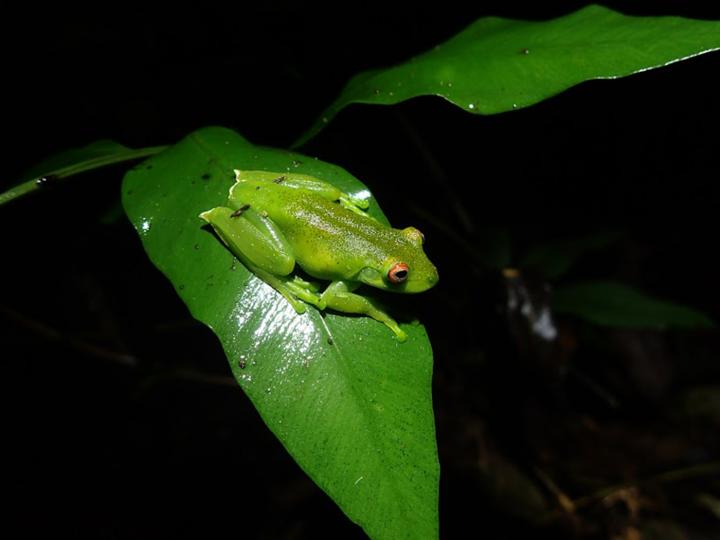
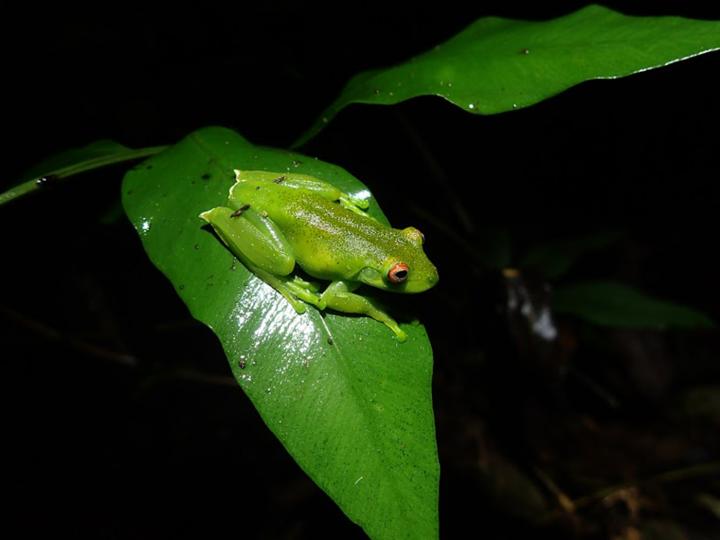
Credit: Courtesy of MSU
EAST LANSING, Mich. – Deforestation remains the biggest threat to animals that call the rain forest "home." However, even measured, sensible development projects can have unforeseen effects because there's no model to follow.
Now, thanks to new research published in Ecological Applications, there's a guide to help land-use development and efforts to conserve amphibians, which are rapidly declining worldwide.
"This research provides a roadmap to determine the best locations for future surveys and help assess where to prioritize conservation efforts in human-modified landscapes," said José Wagner Ribeiro Jr., former Michigan State University visiting student now a Sao Paulo State University (Brazil) ecologist, who led the research. "Our results, combined with land use and topographic maps, can be used to make predictions of amphibian distributions even beyond our study area."
The study took place in the Atlantic Forest in southeastern Brazil. This region harbors great diversity of amphibians. Most of them, including many frogs, are native to that region. The study location was chosen, in part, because 85 percent of the original forest has been lost, and less than 10 percent of the remnant forest is protected.
"Our research demonstrates the significance of forests to tropical amphibians, but an important fraction of species may be retained in forest fragments as some frogs are not as sensitive to the amount of forest cover," said Elise Zipkin, MSU integrative biologist and co-author of the study. "The remnants are predominantly small fragments on rural properties, thus it is imperative to understand how other landscape characteristics influence the distribution of frogs in this biome."
Little is known about these rare frogs. In fact, many of them have Latin names only and no common monikers. The team's research, however, establishes a baseline measuring the relationship between species occurrences and landscape features, including forest cover, topography and agriculture. It captures how patchworks of forest and farmland intertwine. Areas surrounding forest plots, and how they are used, are key elements that determine whether forest fragments can support amphibians.
Land use is important, but the type of waterway is equally vital to amphibian distributions. The team revealed that areas with small streams and flat topography, as opposed to ones with waterfalls and rapids, are likely to have the highest number of amphibian species.
"Small headwater streams are particularly fragile ecosystems and are highly susceptible to human impacts," Wagner Ribeiro Jr., said. "Riparian zones are protected by law in Brazil, but farmers commonly let livestock access the small streams to drink water, altering physical characteristics, which could pose threats to conserving frogs in tropical regions."
###
Michigan State University has been working to advance the common good in uncommon ways for 160 years. One of the top research universities in the world, MSU focuses its vast resources on creating solutions to some of the world's most pressing challenges, while providing life-changing opportunities to a diverse and inclusive academic community through more than 200 programs of study in 17 degree-granting colleges.
For MSU news on the Web, go to MSUToday. Follow MSU News on Twitter at twitter.com/MSUnews.
Media Contact
Layne Cameron
[email protected]
517-353-8819
@MSUnews
http://msutoday.msu.edu/journalists/
Original Source
http://go.msu.edu/3HH http://dx.doi.org/10.1002/eap.1741