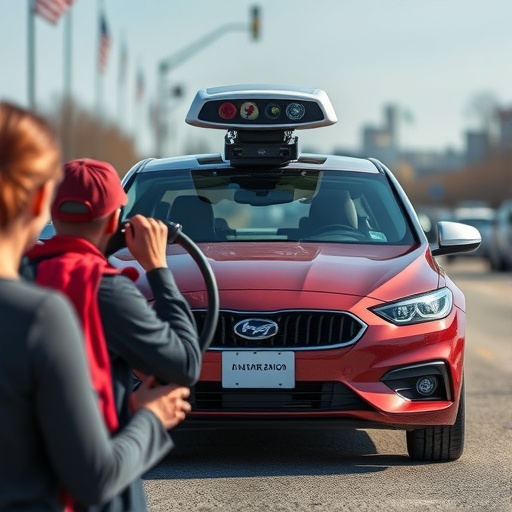
In a groundbreaking new study conducted by researchers at the University of California San Diego, fascinating insights have emerged about American attitudes towards driverless vehicles, a technology poised to revolutionize transportation. The research challenges the prevalent notion that public skepticism around automated vehicles (AVs) hinges solely on safety concerns. Instead, it reveals a deeper, more complex tapestry of economic uncertainty and social apprehension that could critically influence the adoption trajectory of this transformative technology.
This comprehensive national survey analyzed data from over 4,600 adults, sourced from the Pew Research Center’s American Trends Panel, to explore attitudes and perceptions surrounding autonomous vehicles. The study uncovers a phenomenon that transcends technological trust in artificial intelligence systems: Americans are deeply concerned about the economic repercussions that the widespread integration of self-driving cars might herald. Among the most significant worries are job displacement in sectors like ride-hailing, ridesharing, and delivery services, alongside a broader fear that AVs may exacerbate existing income inequalities.
Quantitatively, the data is striking. Approximately 85% of respondents anticipate job losses linked to autonomous vehicle adoption, underscoring intense economic anxiety among the populace. Concurrently, nearly half of the participants expressed the belief that AVs would widen the gap between affluent and lower-income individuals—reflecting a profound concern about the potential for technology to reinforce societal disparities rather than ameliorate them. These results challenge the narrative that driverless vehicles represent unequivocal progress, presenting instead a picture of ambivalence and guarded skepticism.
The study delves into how trust in AV technology extends beyond the technical realm, engaging with broader societal and ethical dimensions. Trust in autonomous systems is a multidimensional construct, encompassing not only confidence in their ability to navigate complex, dynamic environments replete with unpredictable human behaviors but also trust in the socio-economic systems that support and regulate these technologies. Driverless cars represent a particularly salient test case for artificial intelligence trust because they interact directly with physical environments and human lives, requiring split-second decision-making based on sophisticated machine learning models.
Notably, the research highlights a stark socio-technical divide within the American public. Individuals with greater technological literacy, higher educational attainment, and higher incomes show more openness to riding in driverless cars. However, paradoxically, these same cohorts also express heightened concerns about the negative economic outcomes of AV deployment, including job disruption and the potential expansion of income inequality. In contrast, lower-income and rural populations tend to exhibit greater reluctance to embrace AVs, fuelled by fears of economic displacement and diminished access to the emerging benefits of automation.
This divergence underscores a fundamental challenge: technology adoption is not merely an engineering problem but a complex socio-economic transformation with uneven winners and losers. The findings suggest that without thoughtful policy interventions to address economic vulnerabilities and ensure equitable access, AVs risk entrenching social divides rather than bridging them. The entrenched skepticism among non-metropolitan and economically disadvantaged groups signals that technical advances alone will not suffice to build broad-based public trust or acceptance.
Leading the study, Behram Wali, assistant professor at the UC San Diego School of Social Sciences, emphasizes the importance of viewing autonomous vehicles as part of a larger “socio-technical” transition. This perspective insists that advancing automated vehicle technology must proceed hand-in-hand with deliberate policy responses aimed at cushioning the economic shocks for workers and communities likely to be affected. Wali advocates for proactive measures such as workforce reskilling, upskilling initiatives, and expanded social safety nets to address the root economic concerns intertwined with AV adoption.
Such recommendations carry profound implications for policymakers and industry leaders alike. The research calls for an integrated approach that goes beyond marketing campaigns promoting the safety and convenience of driverless cars. Instead, it urges the development of comprehensive social frameworks that ensure equitable distribution of the economic benefits derived from automation, particularly across diverse geographic and socioeconomic landscapes. Only by doing so can the formidable challenge of earning public trust and acceptance be effectively met.
This study also contributes to ongoing debates about artificial intelligence at large. The American public’s response to AVs mirrors broader anxieties about how AI technologies could transform labor markets and socioeconomic structures. It is not simply a question of whether AI-powered systems are capable but a more profound inquiry into who stands to gain, who might suffer, and how the societal fabric could be reshaped. Automated vehicles thereby serve as a rendezvous point, where cutting-edge AI intersects with urgent social justice and policy concerns.
Interestingly, the research exposes a nuanced behavioral framework governing AV adoption decisions. Adoption willingness is influenced by awareness, internet usage frequency, and education — factors correlating with exposure to innovative technologies and ideas. Yet, these same factors correlate with greater recognition of potential risks. This duality highlights the complexity of public perception: familiarity breeds both enthusiasm and critical reflection, suggesting that proponents of AVs must prepare for sophisticated, informed public discourse rather than naïve acceptance.
Moreover, the data point toward geographic disparities. Rural and non-metropolitan populations are notably more skeptical of AVs, which may stem from geographical digital divides, infrastructural gaps, and differences in economic reliance on driving-related occupations. Addressing these disparities will require place-sensitive policies, acknowledging that the transition to automated vehicles will not unfold uniformly across all regions. Equitable integration mandates investments in infrastructure and training tailored to the needs of diverse communities.
The findings also bear on the technical development of autonomous systems. While engineering prowess remains crucial—ensuring vehicles can safely navigate chaotic real-world environments featuring pedestrians, cyclists, and erratic drivers—the social dimension adds complexity. Manufacturers and developers must appreciate that technical trustworthiness alone cannot guarantee societal acceptance. Without transparent communication about ethical considerations, job impacts, and economic fairness, the widespread societal embrace of AVs remains elusive.
In sum, this UC San Diego study provides a pivotal contribution to understanding the multifaceted challenges of automated vehicle adoption in America. It reveals that the path toward driverless mobility is as much an economic and social challenge as it is a technological ambition. Future success will likely hinge on bridging the socio-technical divide through robust, anticipatory policy frameworks that foster trust, equity, and shared benefits—ensuring that the promise of automated vehicles fulfills its potential as an inclusive force for progress.
Subject of Research:
Automated Vehicle Adoption and Perceived Employment and Economic Impacts
Article Title:
The Future on Wheels: A Joint Heterogeneous Model of Automated Vehicle Adoption and Perceived Employment and Economic Impacts
News Publication Date:
Not specified
Web References:
Not provided
References:
Not specified
Image Credits:
Not provided
Keywords
Automated Vehicles, Driverless Cars, Artificial Intelligence, Autonomous Vehicles, Vehicle Automation, Socio-technical Systems, Economic Impacts, Job Displacement, Income Inequality, Public Trust, Technology Adoption, Workforce Reskilling
Tags: adoption challenges for autonomous vehiclesAI trust and driverless vehiclesAmericans attitudes towards driverless carsautonomous vehicles and employment uncertaintydriverless cars job loss fearseconomic anxiety from self-driving carseconomic impact of autonomous vehiclesincome inequality and AV technologyjob displacement in ride-hailing industryPew Research Center autonomous vehicle surveypublic perception of self-driving carssocial apprehension about automation