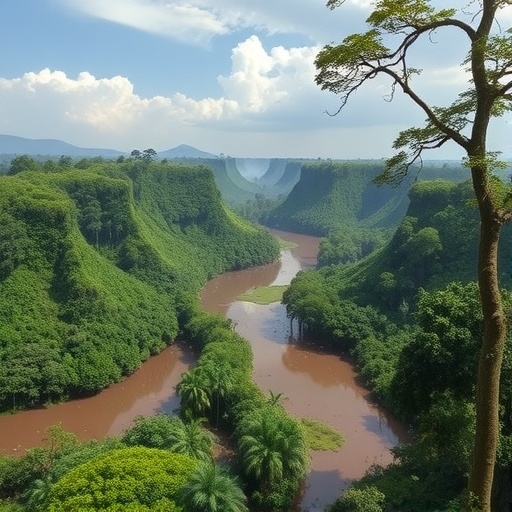
As the planet continues to warm under relentless anthropogenic pressures, tropical forests—arguably the most vital and complex ecosystems on Earth—are undergoing unprecedented transformations. These ecosystems, characterized by their immense biodiversity and key role in global carbon cycling, are now facing “hot droughts,” a perilous climate phenomenon that threatens their survival and offers a stark preview of a future environment unlike any known today. Recent comprehensive research conducted in the central Amazon basin exposes how these watersheds of life may be teetering on the edge of irreversible change.
Tropical forests have long thrived in warm and wet conditions, but climate signatures indicate increasing intensity and frequency of drought events coinciding with progressively hotter temperatures. An extensive multi-decadal investigation spanning over 30 years used detailed forest demographic data collected from a selective logging experiment, revealing that tree mortality rates surged conspicuously during periods of intense drought. This mortality was not randomly distributed among species; rather, the fastest-growing pioneers, endowed with lower wood density, succumbed disproportionately. Such selectivity in drought vulnerability casts doubts on forest resilience and future composition under sustained climatic stresses.
Delving deeper into plant physiology, field measurements during recent El Niño–induced drought events of 2015 and 2023 highlighted a critical soil moisture threshold that acts as a tipping point for tree functionality. Above this threshold, trees maintain regular transpiration, facilitating carbon assimilation and cooling. However, upon crossing this boundary, the rate of transpiration plummeted abruptly. This decline implicates a loss of hydraulic function, increasing the likelihood of hydraulic failure—a fatal impairment of water transport within the tree—and a dangerous deficit in carbon resources that can lead to starvation and death.
The implications of this physiological sensitivity extend beyond individual trees. When prolonged dry conditions push soil moisture below critical levels, the entire forest canopy experiences stress, making systemic dieback increasingly probable. The coupling of elevated temperatures with these moisture shortages compounds thermal stress and exacerbates evaporative demand, effectively accelerating the onset of hydraulic dysfunction. This coupling challenges previous assumptions that tropical forests possess robust buffering capacities against climatic extremes, signaling that their physiological thresholds may be narrower than once thought.
Parallel to these field observations, climate model projections from the Coupled Model Intercomparison Project Phase 6 offer a sobering forecast. Under high-emission scenarios—consistent with continued fossil fuel reliance and limited mitigation—large expanses of tropical forest are likely to shift toward what the researchers term a “hypertropical” climate by the year 2100. This novel climate regime will exhibit unprecedented combinations of temperature and moisture extremes, conditions currently without historical analogues. Such a transformation portends a wholesale reorganization of tropical forest ecosystems both structurally and functionally.
Elevated temperatures characteristic of hypertropical climates exacerbate soil desiccation during dry seasons, pushing forests beyond their established physiological limits with greater frequency and intensity. Analysis within this emergent regime predicts that temperature and moisture conditions regularly breach the identified drought-induced mortality thresholds, markedly raising the risk of widespread tree mortality events. Such dieback episodes have cascading consequences, including the release of vast carbon stocks stored in biomass, which could feedback into global climate systems and accelerate warming.
Intriguingly, the ongoing hot droughts already observed represent more than mere anomalies; they serve as vital analogues for the predicted climate state. These episodes furnish researchers with a natural experiment to study responses of tropical forests confronted by extreme heat coupled with water deficits—a scenario expected to become the new normal. Understanding these physiological and ecological responses under current stress conditions is critical to refining models that project tropical forest futures, informing conservation strategies, and guiding climate policy.
The selective vulnerability of tree functional types to drought underscores complexities in ecosystem turnover and regeneration patterns. Pioneer species, typically rapid colonizers following disturbance, showed increased mortality during droughts, which could slow forest recovery and alter successional trajectories. Conversely, species with denser wood, often slower growing, seem better equipped to endure such extremes, hinting at potential shifts in forest species composition driven by climatic filtering.
Moreover, the study emphasizes the integral role of soil moisture in modulating drought impacts. The identified threshold marks a physiologically significant boundary where water availability ceases to sustain normal tree transpiration, triggering a cascade of biochemical and biomechanical failures. These findings spotlight soil hydrology as a critical factor in predicting forest resilience and stress, demanding greater integration of hydrological data into ecosystem response models.
The integrative approach—combining long-term demographic datasets, fine-scale physiological measurements, and sophisticated climate simulations—exemplifies the multifaceted efforts required to disentangle the complex feedbacks at play. This research pushes beyond correlative observations, linking empirical evidence with mechanistic insights and future projections to construct a comprehensive narrative of tropical forest vulnerability.
Crucially, these insights bear significant implications for climate mitigation and adaptation policies. With forests serving as key carbon sinks, their degradation threatens to amplify atmospheric CO2 concentrations, undermining global efforts to curb warming. Protecting and managing tropical forests amid accelerating climate stressors is paramount, necessitating strategies that enhance resilience, such as reducing deforestation, promoting species diversity, and sustaining hydrological regimes.
In conclusion, the research paints a chilling picture of tropical forests confronted by hot droughts that foreshadow a hypertropical future—a regime defined by heightened thermal and hydrological extremes beyond historical experience. These findings not only unravel the physiological thresholds precipitating tree mortality but also project the broader ecosystem consequences under sustained warming trends. As these hot droughts escalate, they demand urgent attention, offering both a warning and a real-world laboratory to understand and mitigate the impacts of climate change on some of Earth’s most vital terrestrial ecosystems.
Subject of Research:
Physiological and ecological responses of tropical forests to hot droughts in the Amazon and projections of future hypertropical climate conditions.
Article Title:
Hot droughts in the Amazon provide a window to a future hypertropical climate.
Article References:
Chambers, J.Q., Nogueira Lima, A.J., Pastorello, G. et al. Hot droughts in the Amazon provide a window to a future hypertropical climate. Nature (2025). https://doi.org/10.1038/s41586-025-09728-y
Image Credits:
AI Generated
DOI:
https://doi.org/10.1038/s41586-025-09728-y
Keywords:
Amazon, hot drought, tropical forest mortality, hydraulic failure, carbon starvation, soil moisture threshold, El Niño, climate change, hypertropical climate, forest dieback, Coupled Model Intercomparison Project, high-emission scenarios
Tags: Amazon rainforest climate changeanthropogenic climate pressurescarbon cycling in tropical forestsclimate-induced species vulnerabilityEl Niño effects on Amazonfuture hypertropical climate predictionshot droughts impact on biodiversityirreversible changes in rainforest ecosystemslong-term ecological research in Amazonselective logging and forest healthtree mortality during drought eventstropical forest ecosystem resilience