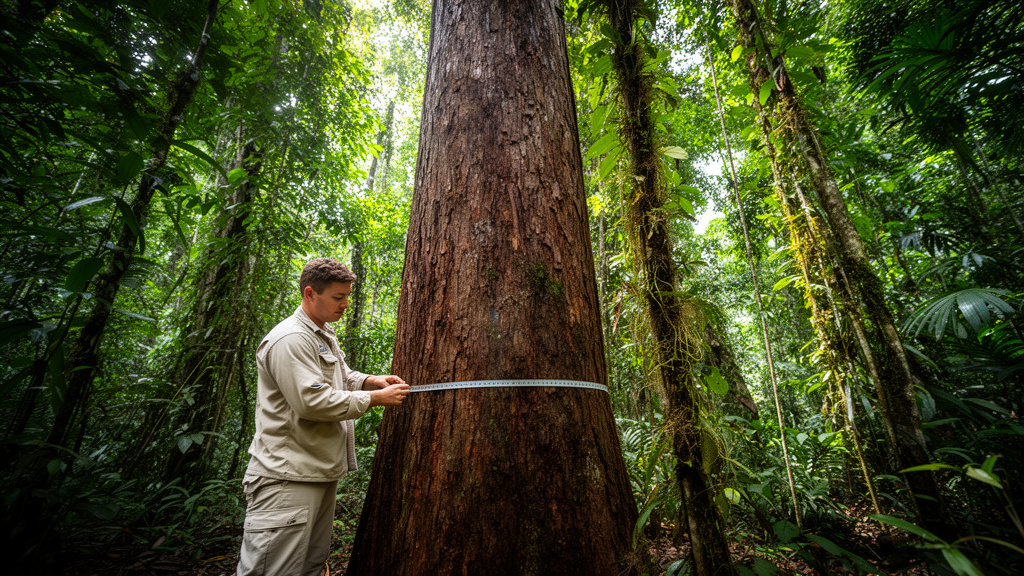
In a formal scientific response regarding mature tropical forest dynamics, an international research team led by Adriane Esquivel-Muelbert and colleagues reaffirmed that multi-decadal increases in tree size observed across Amazonian forest plots reflect genuine ecological changes rather than observational artefacts caused by missed mortality events.
The debate arose following a critique by S. Leuzinger and C. Körner, who questioned the significance and underlying mechanisms behind previously reported increases in Amazonian tree size, arguing that permanent plot networks might inadequately sample infrequent mortality events and thereby produce biased assessments of long-term forest dynamics.
Addressing these concerns, Esquivel-Muelbert and co-authors emphasized that natural disturbance regimes in Amazonia are overwhelmingly dominated by frequent small events that dictate overall biomass dynamics, noting that almost 99 percent of all Amazon forest biomass loss is driven by disturbances smaller than 0.1 hectares.
The authors highlighted earlier simulation analyses conducted by Gloor and colleagues, which demonstrated that although estimates of forest biomass change can appear skewed over very short monitoring intervals, this skewness resolves with sufficient sampling, proving that a decade of monitoring across 135 plots totaling 2,260 hectare-years is fully capable of distinguishing directional shifts in biomass.
The empirical dataset evaluated in the researchers’ original analysis was more than 50 percent larger than the Gloor simulation baseline, spanning 3,532 hectare-years across 188 permanent forest plots with an average monitoring duration of 13 years per plot.
Further countering the suggestion that mortality went unobserved, the researchers reported that the count of large stems exceeding 40 centimeters in diameter declined in 28 percent of census intervals across the network, and the same monitoring infrastructure has repeatedly detected short-term pulses of elevated tree mortality.
The team also examined whether self-thinning or successional recovery from earlier disturbances could account for the structural patterns, reporting that plots with initially smaller trees showed no faster structural gains in mean basal area between first and last censuses, with statistical testing revealing an absence of recovery signatures (two-sided t-test, t = 1.8, P = 0.89, R² = 0).
Furthermore, long-term floristic monitoring of species composition and diversity across partner networks found that coherent community-level changes in wood density, functional composition, and diversity—expected if stands were collectively recovering—are weak, absent, or negative, and where present are linked to climatic factors rather than recovery trajectories.
The observed gains in tree size and basal area align with broader multi-decadal patterns documented across mature Amazon forests, including rising productivity and lagged mortality, with comparable structural changes recorded across mature tropical forests in lowland Africa, the Andes, and Borneo, as well as in temperate and boreal biomes.
The authors concluded that the observed structural changes remain consistent with modest growth stimulation under elevated atmospheric carbon dioxide interacting with background gap-phase dynamics, emphasizing that while growth-longevity trade-offs, fragmentation, and climate shifts may influence the future persistence of the forest carbon sink, permanent plot networks remain the most reliable methodology for tracking directional changes in tropical forest structure.
The exchange, published under the Matters Arising section of Nature Plants, directly addresses methodological criticisms raised by S. Leuzinger and C. Körner regarding earlier findings on Amazonian forest dynamics. Leuzinger and Körner questioned whether permanent inventory networks could reliably capture long-term structural shifts, hypothesizing that rare or catastrophic mortality events might escape detection and thereby create a misleading appearance of sustained structural growth across mature forest tracts.
In evaluating the spatial and temporal nature of forest turnover, the author team emphasized that natural disturbance regimes in Amazonian ecosystems are overwhelmingly dominated by frequent, localized events rather than widespread stand-clearing disturbances. Empirical assessments indicate that disturbances smaller than 0.1 hectare account for nearly 99 percent of all biomass loss across Amazonian forests. Because these small-scale canopy gaps drive the overwhelming majority of forest biomass dynamics, permanent monitoring plots are situated within the primary operational scale of natural disturbance regimes rather than missing the dominant drivers of mortality.
To evaluate whether plot networks could be structurally biased by infrequent disturbance events, previous simulation analyses conducted by Gloor and colleagues modeled sampling performance across domains subject to the full spectrum of Amazonian disturbance phenomena, including rare high-intensity events equivalent to those cited by Leuzinger and Körner. Those simulations established that although estimates of biomass change exhibit skewness when evaluated over very brief observation windows, this sampling skewness resolves as monitoring accumulates. Specifically, the simulations demonstrated that a monitoring effort spanning 135 plots over a single decade, totaling 2,260 hectare-years of observation, provides sufficient statistical power to distinguish true directional changes in biomass from background sampling variability.
The empirical dataset evaluated in the original study substantially exceeded the baseline established by the Gloor simulation models. Encompassing 188 permanent forest plots and accumulating 3,532 hectare-years of field data, the dataset represents a sampling volume more than 50 percent larger than that evaluated in the simulation, with plots tracked for an average duration of 13 years. This extended observation window and extensive spatial replication provide an empirical foundation capable of overcoming the sampling skewness associated with infrequent disturbances.
Field measurements from within the network further contradict the assertion that elevated mortality escapes detection. Across the censused plots, the absolute count of large trees—defined as stems exceeding 40 centimeters in diameter—declined in 28 percent of all recorded census intervals. Additionally, the network has documented discrete short-term pulses of tree mortality during episodes of environmental stress, confirming that episodic mortality events are registered by the monitoring infrastructure rather than omitted from long-term dynamic estimates.
The researchers also tested whether observed increases in mean tree size could be explained by successional recovery or self-thinning processes following historical disturbance events. Under a successional recovery hypothesis, plots harboring smaller initial mean tree sizes would be expected to display accelerated annual rates of structural accumulation as secondary stands mature toward equilibrium. An examination of the relationship between initial mean tree basal area at the first census and the subsequent annual rate of change in mean basal area across the monitoring period showed no such pattern, with statistical testing revealing an absence of recovery dynamics (two-sided t-test, t = 1.8, P = 0.89, R² = 0).
Complementary floristic data from partner networks tracking species composition and diversity across time provided additional evidence against a basin-wide recovery trajectory. If the observed structural gains were driven by generalized recovery from past disturbances, forest stands would be expected to demonstrate directional shifts in functional composition, increases in community-wide wood density, and coordinated changes in species diversity. Long-term floristic monitoring indicates that such signatures are absent, weak, or negative in Amazonian plots, and where compositional shifts occur, they correlate with climatic drivers and ongoing climate change rather than the predictable trajectories of successional recovery.
The structural changes documented in Amazonia form part of a broader pattern of multi-decadal shifts observed across old-growth tropical forests globally. Similar increases in forest dynamics and structural metrics have been reported across mature forest tracts in lowland Africa, the Andes, and Borneo, alongside documented increases in biomass and tree size across temperate and boreal forests that exceed expectations from stand development alone. Within the Amazonian RAINFOR network, measured increases in mortality temporally lag behind observed gains in productivity, a dynamic sequence consistent with modest growth stimulation under elevated atmospheric carbon dioxide accompanied by background gap-phase turnover.
The authors noted that although individual plots across the network exist in various states of localized recovery or recent natural disturbance, this background mosaic of local gap dynamics cannot account for coherent, basin-wide structural changes. While physiological trade-offs between growth and longevity, forest fragmentation, and climate shifts may constrain the future magnitude and persistence of the forest carbon sink, permanent plot networks remain the primary empirical tool for identifying subtle structural and floristic shifts across tropical forest ecosystems.
Subject of Research: Detection of multi-decadal tree size increases across Amazonian forest plot networks
Article Title: Reply to Leuzinger and Körner: Increasing tree size across Amazonia detected by plot-networks
Article References: Esquivel-Muelbert, A., Banbury Morgan, R., Baker, T. R., Gloor, E., Brienen, R., Cristo de Almeida, E., del Aguila Pasquel, J., Aymard, G., Castro, W., Chama M. Oscoso, V., Dexter, K. G., Feldpausch, T. R., Flores Llampazo, G., Brown, I. F., Killeen, T. J., Laurance, W. F., Lewis, S. L., Marimon Junior, B. H., Marimon, B. S., … Phillips, O. L. (2026). Reply to Leuzinger and Körner: Increasing tree size across Amazonia detected by plot-networks. Nature Plants, 12(11), 2162-2164. https://doi.org/10.1038/s41477-026-02461-y
Image Credits: AI Generated
DOI: 10.1038/s41477-026-02461-y
Keywords: Amazonia, tree size, forest plot networks, RAINFOR, biomass dynamics, tree mortality, forest structure, old-growth tropical forests, disturbances, basal area, successional recovery, atmospheric carbon dioxide, forest productivity, stand development, stem diameter, community wood density, Gloor simulation, carbon dynamics
News Source: Drew Townsend. (November 21, 2026). Amazon Forest Plot Networks Confirm Multi-Decadal Increases in Tree Size. Scienmag.