Alpine newts were observed feeding on a rodent carcass in a subalpine lake in Greece, providing the first reported evidence that the amphibians can scavenge mammalian prey. The observation involved two male and one female alpine newt, Ichthyosaura alpestris, at Lake Kosmeou, also known as Tsouka Rossa, in the Province of Metsovo, Ioannina, at an elevation of 1,690 metres. Three female newts later approached the same carcass after it was moved to another part of the lake and began consuming its decomposing tissue. The episode expands the known diet of the species beyond the invertebrates, amphibian prey and other non-prey items documented in earlier stomach-content studies.
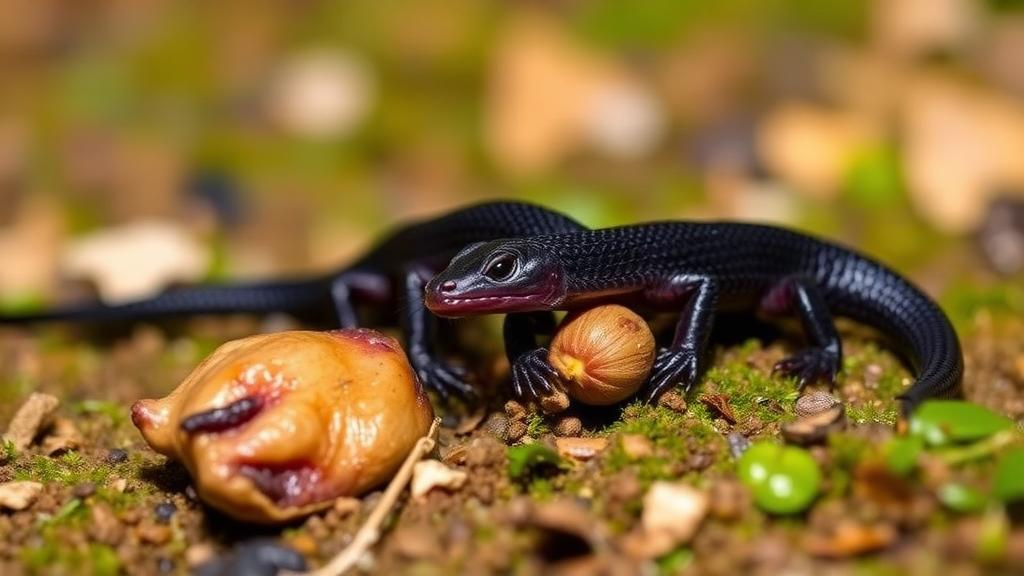
The field observation was made at midday in October 2023 during a survey designed to assess the presence of newt species at the lake. Near the end of that survey, researchers noticed a rodent carcass at the shallow end of the lake bank. On closer inspection, they saw two male and one female alpine newt nibbling at the carcass, removing small pieces and swallowing them. The animals were therefore not merely investigating the object: the observed behaviour involved active consumption of the carcass tissue.
Researchers took steps to exclude an alternative explanation before recording the animals as scavengers. They removed the carcass with a kick net fitted with 0.5-millimetre mesh and examined it for aquatic invertebrates or worms that might have attracted the newts independently of the rodent tissue. The inspection found no evidence of hidden invertebrates. In the researchers’ assessment, the absence of those organisms meant that the carcass itself was the most likely object drawing the alpine newts to the site. This was an observational check rather than a controlled experiment, so it does not establish every possible cause of the newts’ behaviour.
The carcass was then returned to the water at a different site, closer to the lake’s overflow point. Within minutes, three female alpine newts approached it and started eating the decomposing flesh again. The second group’s response to the relocated carcass further supported the interpretation that the animals were exploiting the carcass itself. The sympatric Macedonian newt, Triturus macedonicus, showed no interest in the carcass. The observation therefore records a difference in feeding behaviour between two newt species at the same lake, although it does not explain why the species responded differently.
Lake Kosmeou is a small, spring-fed water body in Greece’s Metsovo Province. It is slightly more than 100 metres long and more than 60 metres wide, with depths ranging from approximately half a metre to two metres, and it is continuously supplied by low-output springs. The carcass was encountered at the shallow end of the lake bank, where the newts were observed feeding. The setting is part of a range of environments occupied by alpine newts across Europe, including permanent or ephemeral water bodies such as lakes, troughs and puddles. In Greece, the species has been recorded at elevations between 659 and 2,350 metres.
The alpine newt is a small, polyphagous and opportunistic predator whose feeding relationships vary substantially across daily, seasonal and spatial scales. Studies conducted in countries including Romania, Italy, Czechia, Austria and Greece have examined its diet, feeding habits and predatory behaviour. Much of this work has involved flushing the stomach contents of numerous captured animals, a method that has helped document the composition of its diet. The species feeds principally on invertebrates belonging to groups such as crustaceans, stoneflies, springtails, isopods, beetles, flies and true bugs. Tadpoles and larvae of the fire salamander, Salamandra salamandra, have also been recorded as prey.
Alpine newts have additionally been observed consuming their own eggs and those of other amphibians without discriminating among them. Shed skin from the animals themselves or from conspecifics has been found in stomach contents as a regular non-prey item. Plant material and inorganic particles from substrate sediment have also been reported, with both interpreted as accidental ingestion during feeding. These findings portray the species as a flexible generalist that can exploit a wide range of food sources. However, the available literature had contained no account of an alpine newt, or another newt species, feeding on an animal prey item belonging to the class Mammalia. The rodent observation fills that specific gap in the available dietary record.
Scavenging is generally described as a way of overcoming food scarcity, and it occurs across many carnivorous vertebrates. Vultures are the only obligate scavengers identified in the cited background research, while animals including coyotes and freshwater turtles are facultative scavengers that capitalise on opportunities as they arise. No amphibian is known to be an obligate scavenger, although facultative scavenging has been recorded in several frog species and in one salamander species. Among newts, the earlier record cited in the study involved several crested newts, Triturus cristatus, consuming a fish carcass. The Greek observation therefore extends the recorded scavenging behaviour of newts from a fish carcass in another species to a rodent carcass in the alpine newt.
The researchers said the finding indicates that alpine newts are generalists and opportunists able to adopt an energy-efficient foraging strategy when food is limited. That interpretation is consistent with the species’ multiphasic life cycle: adults shift between terrestrial and aquatic phases, their activity changes over daily and seasonal cycles, and they occur in high-altitude lakes where prey availability can be scarce or unpredictable. The carcass-feeding observation does not establish how frequently scavenging occurs, whether it has measurable effects on population survival, or whether the behaviour is widespread across the species’ European range. It is a single field observation, but it documents a distinct foraging mode that previous diet surveys had not captured.
Scavenging can also increase nutrient recycling and contribute to food-web stability, according to the background research cited by the study. In harsh environments, flexibility in foraging may be particularly valuable when normal prey is unavailable. For the alpine newt, the finding adds a new dimension to the species’ natural history and may help researchers identify habitats in which flexible access to alternative foods matters. That relevance is heightened by the loss of suitable aquatic habitats and breeding sites associated with agriculture and agrochemical pollution. The study does not directly demonstrate that carcass feeding has caused a population decline or that scavenging offsets habitat loss, but it documents an additional food-related behaviour that may be useful for understanding how the species responds to variable conditions in the environments it occupies.
Subject of Research: First field record of alpine newts scavenging a rodent carcass in a Greek subalpine lake.
Article Title: First evidence of scavenging behaviour in Ichthyosaura alpestris (Laurenti, 1768)
Article References: Daftsios, T., Iakovidis, D., Gogolos, N., & Sagonas, K. (2024). First evidence of scavenging behaviour in Ichthyosaura alpestris (Laurenti, 1768). Herpetozoa, 37, 137-140. https://doi.org/10.3897/herpetozoa.37.e123069
Image Credits: AI Generated
DOI: 10.3897/herpetozoa.37.e123069
Keywords: alpine newt, Ichthyosaura alpestris, scavenging behaviour, rodent carcass, facultative scavenging, Lake Kosmeou, amphibian ecology, animal behaviour, opportunistic feeding, Greece, First, evidence
News Source: Gavin Prescott. (October 19, 2026). Alpine Newts Recorded Feeding on Rodent Carcass. Scienmag.