• HOME
  • NEWS
  • EXPLORE
    • CAREER
      • Companies
      • Jobs
    • EVENTS
    • iGEM
      • News
      • Team
    • PHOTOS
    • VIDEO
    • WIKI
  • BLOG
  • COMMUNITY
    • FACEBOOK
    • INSTAGRAM
    • TWITTER
Saturday, February 7, 2026
BIOENGINEER.ORG
No Result
View All Result
  • Login
  • HOME
  • NEWS
  • EXPLORE
    • CAREER
      • Companies
      • Jobs
        • Lecturer
        • PhD Studentship
        • Postdoc
        • Research Assistant
    • EVENTS
    • iGEM
      • News
      • Team
    • PHOTOS
    • VIDEO
    • WIKI
  • BLOG
  • COMMUNITY
    • FACEBOOK
    • INSTAGRAM
    • TWITTER
  • HOME
  • NEWS
  • EXPLORE
    • CAREER
      • Companies
      • Jobs
        • Lecturer
        • PhD Studentship
        • Postdoc
        • Research Assistant
    • EVENTS
    • iGEM
      • News
      • Team
    • PHOTOS
    • VIDEO
    • WIKI
  • BLOG
  • COMMUNITY
    • FACEBOOK
    • INSTAGRAM
    • TWITTER
No Result
View All Result
Bioengineer.org
No Result
View All Result
Home NEWS Science News Biology

Air pollution reduces global life expectancy by more than one year, study finds

Bioengineer by Bioengineer
August 22, 2018
in Biology
Reading Time: 2 mins read
0
Share on FacebookShare on TwitterShare on LinkedinShare on RedditShare on Telegram
IMAGE

Credit: Cockrell School of Engineering, The University of Texas at Austin

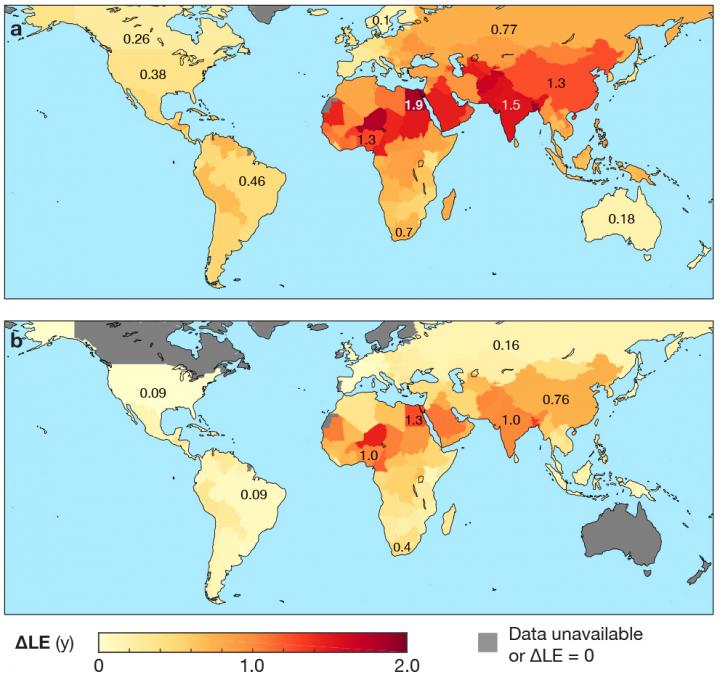
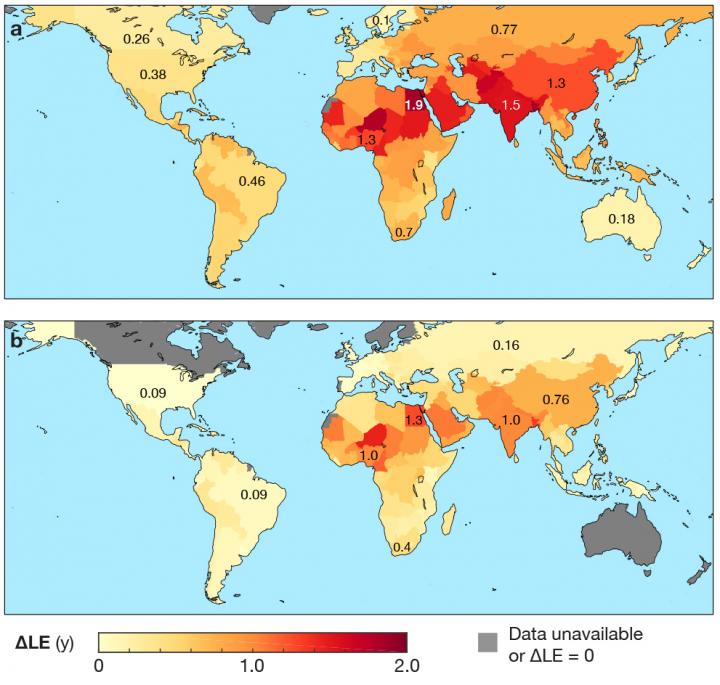
Air pollution shortens human lives by more than a year, according to a new study from a team of leading environmental engineers and public health researchers. Better air quality could lead to a significant extension of lifespans around the world.

This is the first time that data on air pollution and lifespan has been studied together in order to examine the global variations in how they affect overall life expectancy.

The researchers looked at outdoor air pollution from particulate matter (PM) smaller than 2.5 microns. These fine particles can enter deep into the lungs, and breathing PM2.5 is associated with increased risk of heart attacks, strokes, respiratory diseases and cancer. PM2.5 pollution comes from power plants, cars and trucks, fires, agriculture and industrial emissions.

Led by Joshua Apte in the Cockrell School of Engineering at The University of Texas at Austin, the team used data from the Global Burden of Disease Study to measure PM2.5 air pollution exposure and its consequences in 185 countries. They then quantified the national impact on life expectancy for each individual country as well as on a global scale.

The findings were published Aug. 22 in Environmental Science & Technology Letters.

"The fact that fine particle air pollution is a major global killer is already well known," said Apte, who is an assistant professor in the Cockrell School's Department of Civil, Architectural and Environmental Engineering and in the Dell Medical School's Department of Population Health. "And we all care about how long we live. Here, we were able to systematically identify how air pollution also substantially shortens lives around the world. What we found is that air pollution has a very large effect on survival – on average about a year globally."

In the context of other significant phenomena negatively affecting human survival rates, Apte said this is a big number.

"For example, it's considerably larger than the benefit in survival we might see if we found cures for both lung and breast cancer combined," he said. "In countries like India and China, the benefit for elderly people of improving air quality would be especially large. For much of Asia, if air pollution were removed as a risk for death, 60-year-olds would have a 15 percent to 20 percent higher chance of living to age 85 or older."

Apte believes this discovery is especially important for the context it provides.

"A body count saying 90,000 Americans or 1.1 million Indians die per year from air pollution is large but faceless," he said. "Saying that, on average, a population lives a year less than they would have otherwise — that is something relatable."

###

The study was funded through the Center for Air, Climate, and Energy Solutions, an interdisciplinary research collaboration supported by the U.S. Environmental Protection Agency. Apte was joined in this study by colleagues from University of British Columbia, Imperial College London, Brigham Young University and the Health Effects Institute.

Media Contact

John Holden
[email protected]
512-529-6013
@UTAustin

http://www.utexas.edu

Share19Tweet8Share2ShareShareShare2

Related Posts

Florida Cane Toad: Complex Spread and Selective Evolution

Florida Cane Toad: Complex Spread and Selective Evolution

February 7, 2026
New Study Uncovers Mechanism Behind Burn Pit Particulate Matter–Induced Lung Inflammation

New Study Uncovers Mechanism Behind Burn Pit Particulate Matter–Induced Lung Inflammation

February 6, 2026

DeepBlastoid: Advancing Automated and Efficient Evaluation of Human Blastoids with Deep Learning

February 6, 2026

Navigating the Gut: The Role of Formic Acid in the Microbiome

February 6, 2026
Please login to join discussion

POPULAR NEWS

  • Robotic Ureteral Reconstruction: A Novel Approach

    Robotic Ureteral Reconstruction: A Novel Approach

    82 shares
    Share 33 Tweet 21
  • Digital Privacy: Health Data Control in Incarceration

    63 shares
    Share 25 Tweet 16
  • Study Reveals Lipid Accumulation in ME/CFS Cells

    57 shares
    Share 23 Tweet 14
  • Breakthrough in RNA Research Accelerates Medical Innovations Timeline

    53 shares
    Share 21 Tweet 13

About

We bring you the latest biotechnology news from best research centers and universities around the world. Check our website.

Follow us

Recent News

Decoding Prostate Cancer Origins via snFLARE-seq, mxFRIZNGRND

Digital Health Perspectives from Baltic Sea Experts

Florida Cane Toad: Complex Spread and Selective Evolution

Subscribe to Blog via Email

Enter your email address to subscribe to this blog and receive notifications of new posts by email.

Join 73 other subscribers
  • Contact Us

Bioengineer.org © Copyright 2023 All Rights Reserved.

Welcome Back!

Login to your account below

Forgotten Password?

Retrieve your password

Please enter your username or email address to reset your password.

Log In
No Result
View All Result
  • Homepages
    • Home Page 1
    • Home Page 2
  • News
  • National
  • Business
  • Health
  • Lifestyle
  • Science

Bioengineer.org © Copyright 2023 All Rights Reserved.