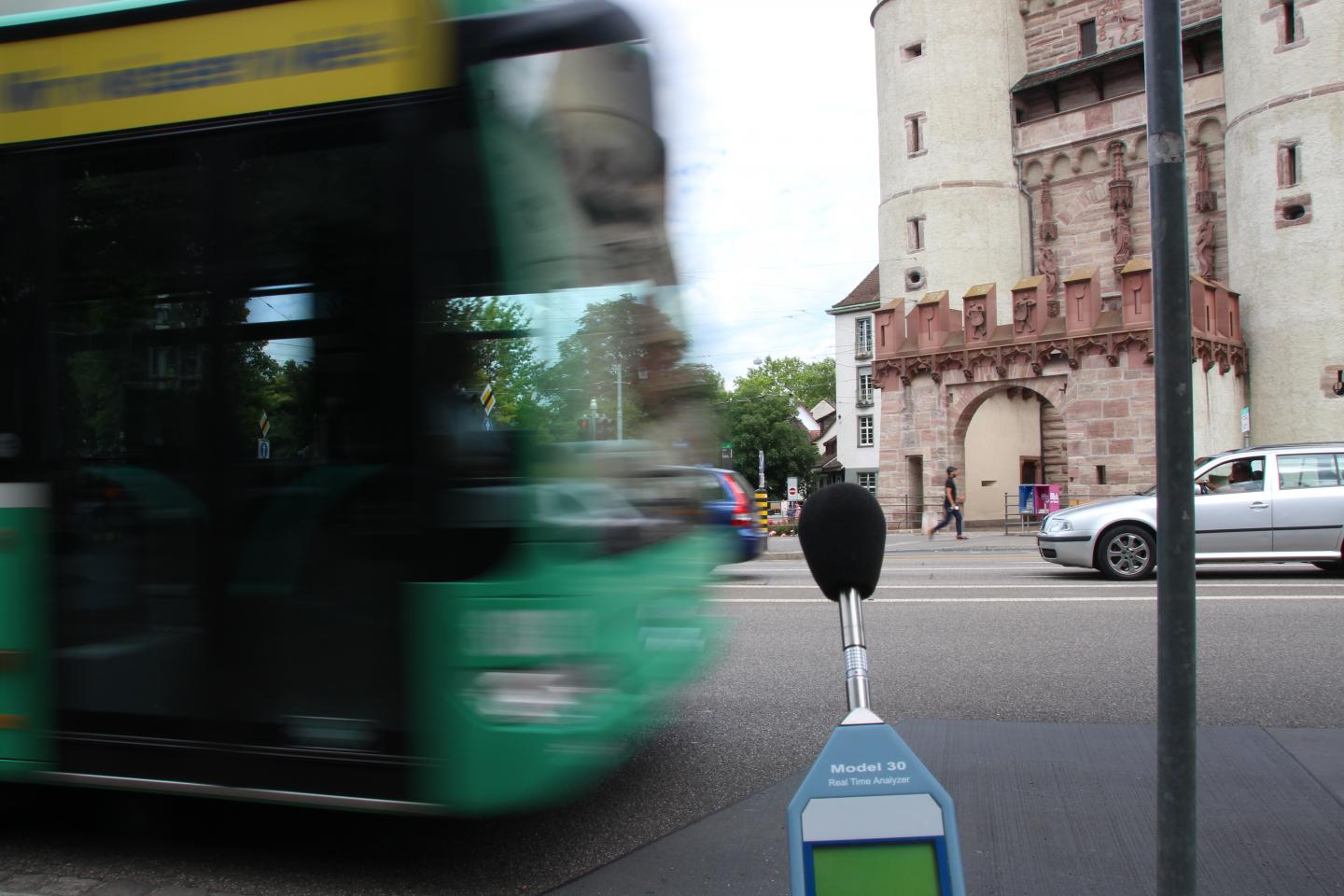
Credit: Jana Sönksen / Swiss TPH
Where air pollution is high, the level of transportation noise is usually also elevated. Not only air pollution negatively impacts on health, but also car, train and aircraft noise increases the risk for cardiovascular diseases and diabetes, as previous research has demonstrated. Studies investigating the effect of air pollution without sufficiently taking into account the impact that noise exhibits on health, might overestimate the effect of air pollution. These are the results of a comprehensive study conducted by the Swiss Tropical and Public Health Institute (Swiss TPH), which was published today in the peer-reviewed European Heart Journal.
The study looked at the combined effects of air pollution and transportation noise for heart attack mortality, by considering all deaths that occurred in Switzerland between 2000 and 2008. Analyses that only included fine particulates (PM2.5) suggest that the risk for a heart attack rises by 5.2% per 10 μg/m³ increase in the long-term concentration at home. Studies which also account for road, railway and aircraft noise reveal that the risk for a heart attack attributable to fine particulates in fact increases considerably less; 1.9% per 10 μg/m³ increase. These findings indicate that the negative effects of air pollution may have been overestimated in studies which fail to concurrently consider noise exposure.
"Our study showed that transportation noise increases the risk for a heart attack by 2.0 to 3.4% per 10 decibels increase in the average sound pressure level at home." said Martin Röösli, Head of the Environmental Exposures and Health Unit at Swiss TPH, and lead author of the published research. "Strikingly, the effects of noise were independent from air pollution exposure."
Effect of noise and air pollution are additive
The study also found that people exposed to both air pollution and noise are at highest risk of heart attack. Hence, the effects of air pollution and noise are additive. "Public discussions often focus on the negative health effects of either air pollution or noise but do not consider the combined impact." said Röösli. "Our research suggests that both exposures must be considered at the same time." This has implications for both policy as well as future research. Hence, Röösli and co-researchers recommend including transportation noise exposure in any further research related to air pollution and health to avoid overestimating the negative effects of air pollution on the cardiovascular system.
Data from across Switzerland
The study included all deaths (19,261) reported across Switzerland from the period 2000 to 2008. The air pollution (PM2.5) was modelled using satellite and geographic data, calibrated with air pollution measurements from 99 measurement sites throughout Switzerland. Nitrogen dioxides (NO2) were also modelled using 9,469 biweekly passive sampling measurements collected between 2000 and 2008 at 1,834 locations in Switzerland. Transportation noise was modelled by well-established noise propagation models (sonRoad, sonRAIL and FLULA 2) by Empa and n-sphere. The air pollution and the transportation noise models were applied for each address of the 4.4 million Swiss adult citizen (aged 30 years and above).
###
About the study
Héritier H et al. A systematic analysis of mutual effects of transportation noise and air pollution exposure on myocardial infarction mortality: a nationwide cohort study in Switzerland. (2018) European Heart Journal. https://doi.org/10.1093/eurheartj/ehy650
The research was funded by the Swiss National Science Foundation (SNSF) and the Swiss Federal Office for the Environment (BAFU). The study was part of SiRENE (Short and Long Term Effects of Transportation Noise Exposure), an interdisciplinary research project combining experiments in the sleep laboratory, epidemiological investigations, survey data and acoustic calculations and modelling.
Media contact
* Martin Röösli, PhD, Professor of Environmental Epidemiology and Head of the Environmental Exposures and Health Unit, Department of Epidemiology and Public Health, Swiss Tropical and Public Health Institute (Swiss TPH), Tel +41 61 284 8383, [email protected]
* Sabina Beatrice-Matter, Head of Communications, Swiss Tropical and Public Health Institute (Swiss TPH), Tel +41 61 284 8364, Mob +41 79 737 9158, [email protected]
Media Contact
Sabina Beatrice-Matter
[email protected]
41-612-848-364
@swisstph
http://www.swisstph.ch
Original Source
https://www.swisstph.ch/en/news/news-detail/news/air-pollution-and-noise-increase-risk-for-heart-attacks/ http://dx.doi.org/10.1093/eurheartj/ehy650