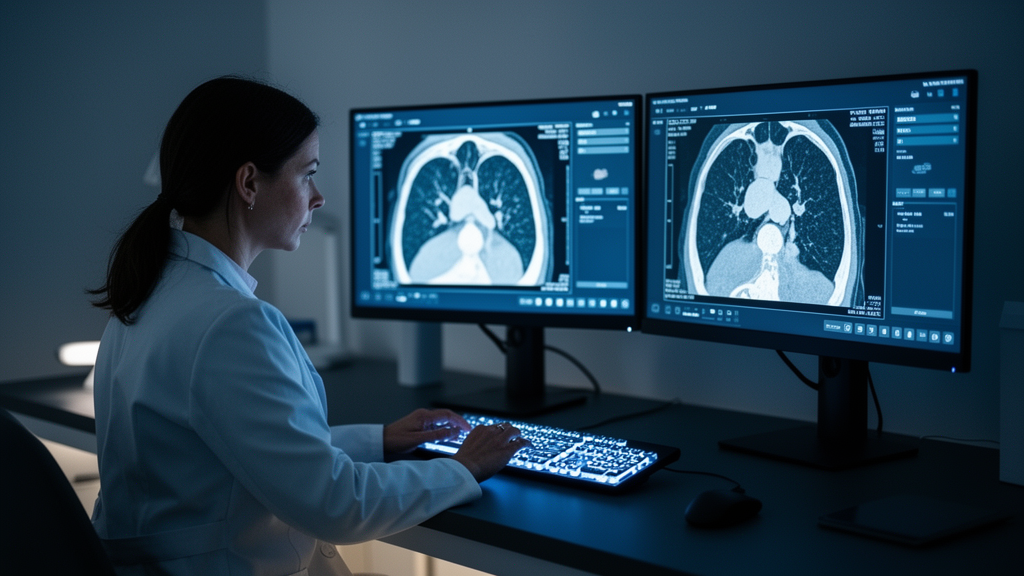
A retrospective study published in Frontiers in Systems Biology evaluated the performance of deep learning models for detecting and classifying breast cancer findings in digital mammography and digital breast tomosynthesis images. The research team developed convolutional neural network models to distinguish between normal, benign, and malignant breast images, aiming to support physicians who often face challenges when reading mammograms due to overlapping or similar-looking tissues. The study focused on comparing the efficacy of these artificial intelligence systems across two standard imaging modalities: standard digital mammography (DM) and digital breast tomosynthesis (DBT).
The study included a dataset of 679 original images per view, comprising 31 images with malignant breast lesions, 175 images with benign findings, and 475 normal images. To address the limited number of malignant cases, the researchers increased the malignant class from 31 to 100 images in the training set using data augmentation for the stage-2 classifier. The models were built using ResNet-18 and ResNet-50 architectures, which are deep learning convolutional neural networks. The team trained the models using 10-fold cross-validation and holdout validation, ensuring that performance metrics were computed on original, non-augmented images to maintain the integrity of the evaluation.
For the initial classification task, which distinguished normal images from abnormal ones, the ResNet-18 model demonstrated high performance across all imaging views. In the craniocaudal (CC) view of digital mammography, the model achieved an area under the receiver operating characteristic curve (AUC-ROC) of 0.995, with a 95% confidence interval of 0.991 to 0.998. The sensitivity was 95.1% and the specificity was 96.6%. In the mediolateral oblique (MLO) view of digital mammography, the AUC-ROC was 0.984, with a sensitivity of 95.6% and a specificity of 94.1%. For the MLO view of digital breast tomosynthesis, the AUC-ROC reached 0.994, with a sensitivity of 95.1% and a specificity of 98.5%.
Statistical analysis revealed that digital breast tomosynthesis had significantly higher specificity than digital mammography in selected comparisons. Specifically, the ResNet-18 model showed higher specificity for DBT compared to DM MLO, and the ResNet-50 model showed higher specificity for DBT compared to DM CC, with Holm-adjusted p-values of 0.002 or less. However, there were no significant differences in AUC-ROC between the imaging modalities or between the ResNet-18 and ResNet-50 architectures, with all Holm-adjusted p-values being 0.13 or greater. This suggests that while tomosynthesis may offer better specificity in certain views, the overall discriminative ability measured by AUC-ROC is comparable across the different systems and architectures.
In the second stage of classification, the models were tasked with distinguishing between benign and malignant findings. This analysis involved 131 original images, of which 31 were malignant. The AUC-ROC values for this task ranged from 0.977 to 0.999, and the average precision (AP) values ranged from 0.946 to 0.996. Similar to the normal versus abnormal classification, there were no significant differences in performance between digital mammography and digital breast tomosynthesis, nor between the ResNet-18 and ResNet-50 models, with all Holm-adjusted p-values being 0.50 or greater.
The researchers used paired DeLong tests and exact McNemar tests with Holm correction to compare the models statistically. Performance metrics were derived from 10-fold cross-validated predictions, and 95% confidence intervals were calculated using a stratified patient-level bootstrap with 2,000 replicates.
The authors note that the detection and classification of malignant, benign, and normal images in both DBT and DM using an AI training model achieved performance comparable to the medical field.
Subject of Research: Evaluation of ResNet-based AI models for breast cancer detection in digital mammography and tomosynthesis
Article Title: Comparative evaluation of ResNet-Based AI models for breast cancer detection in digital mammography and digital breast tomosynthesis
Article References: Alakhras, M., Orabi, E., Zain, N. M., Mustafa, W. A., Alquran, H., Alsalatie, M., & Btayneh, E. (2026). Comparative evaluation of ResNet-Based AI models for breast cancer detection in digital mammography and digital breast tomosynthesis. Frontiers in Systems Biology, 6, Article 1921782. https://doi.org/10.3389/fsysb.2026.1921782
Image Credits: AI Generated
DOI: 10.3389/fsysb.2026.1921782
Keywords: breast cancer, artificial intelligence, deep learning, digital mammography, digital breast tomosynthesis, ResNet, convolutional neural network, medical imaging, diagnostic accuracy, retrospective study, Comparative, evaluation
News Source: Nathaniel Bowman. (November 10, 2026). AI Models Show High Accuracy in Breast Cancer Imaging. Scienmag.