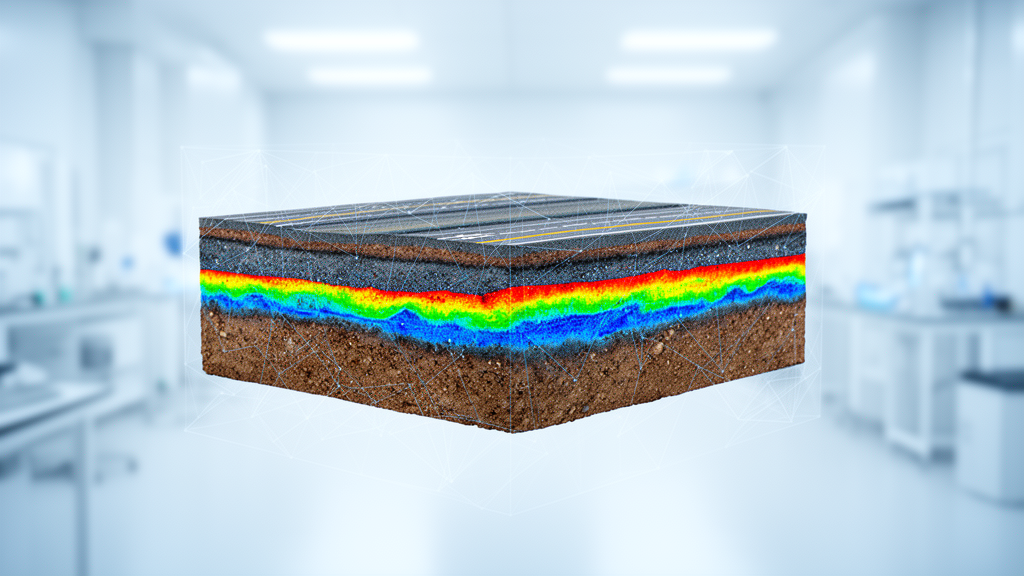
A systematic literature review and bibliometric analysis evaluating 180 peer-reviewed investigations published between 2015 and 2025 demonstrates that artificial intelligence algorithms can accurately predict critical mechanical properties of stabilized soils used in road construction. Modern road infrastructure frequently encounters weak or unstable subgrade soils that cannot support operational traffic loads without deliberate engineering interventions. Traditional ground improvement practices rely on stabilizing these problematic soils by mixing binders such as cement, lime, fly ash, ground granulated blast-furnace slag, or other industrial by-products into weak subgrades to elevate their load-bearing capacity and long-term durability. Cohesive soils exhibiting an unconfined compressive strength below approximately 200 kilonewtons per square meter typically require structural stabilization before serving as reliable highway foundation layers. While utilizing in-situ soils significantly reduces material transportation demands and conserves non-renewable mineral aggregates, conventional design protocols depend heavily on labor-intensive, iterative laboratory testing, including standard Proctor compaction, California Bearing Ratio, and unconfined compressive strength procedures across varied additive formulations.
To synthesize how data-driven modeling addresses these empirical constraints, researchers conducted an extensive literature search using the Scopus database. The initial keyword formulation covering machine learning and soil yielded 5,170 records, which narrowed to 4,104 documents following language and publication type filtering, and ultimately focused on 180 core peer-reviewed studies when incorporating stabilizing terminology. The subsequent bibliometric analysis revealed that research activity remained modest until 2019, after which annual publication volumes experienced steep exponential growth driven by accessible computational resources and expanding experimental datasets. Keyword co-occurrence mapping grouped research themes into distinct clusters connecting foundational soil mechanics with predictive algorithms, while thematic mapping identified established motor themes such as soil testing alongside emerging frontiers including explainable artificial intelligence frameworks like Shapley Additive Explanations. Machine learning has functioned as the central conceptual bridge, with recent terminological expansions toward deep learning and broader data-driven modeling reflecting an evolving focus from isolated numerical prediction toward systematic interpretability and optimization.
Across the examined literature, advanced ensemble tree-based models have consistently demonstrated superior predictive accuracy compared to traditional empirical formulations. Implementations based on Random Forest and Gradient Boosting Machines, including Extreme Gradient Boosting, LightGBM, and CatBoost, frequently achieved coefficients of determination exceeding 0.90 while reducing root mean square error values by up to 50 percent for primary geotechnical metrics like unconfined compressive strength and California Bearing Ratio. In specific comparative investigations, tuned hybrid gradient boosting models attained unconfined compressive strength testing coefficients of determination as high as 0.993, markedly outperforming single models such as K-Nearest Neighbor, standard decision trees, and standalone support vector machines that often exhibited high training accuracy but suffered from testing degradation. Furthermore, gradient boosting classifiers successfully categorized compressive strength into qualitative structural classifications such as firm, very stiff, and hard, reaching overall accuracies of 0.920 alongside precision scores of 0.938.
Artificial neural networks represent another widespread modeling paradigm, functioning as universal function approximators capable of learning non-linear, multi-parameter interactions without relying on traditional empirical power-law formulas. In controlled laboratory assessments, neural network architectures achieved test coefficients of determination reaching 0.994 for cement-stabilized sands and 0.96 across extensive databases of over one thousand deep-mixed organic soil tests. When applied to California Bearing Ratio prediction, artificial neural networks attained testing accuracy levels between 0.94 and 0.95, significantly outperforming multiple linear regression baselines that produced coefficients between 0.78 and 0.81. However, the internal complexity of multilayer feed-forward networks introduces notable operational constraints. The dense network of weights, threshold biases, and non-linear activation functions obscures the physical rationale governing predictions, creating black-box models that perform well on familiar training mixes but struggle when evaluating novel or sustainable binder mixtures not represented in laboratory archives.
Support vector machines and support vector regression models operate through statistical learning theory, mapping input features into higher-dimensional mathematical spaces via kernel functions to define optimal margin hyperplanes and epsilon-insensitive error tubes. In geotechnical strength modeling, Gaussian radial basis function kernels have proven especially effective at capturing complex non-linear behaviors, such as the rapid initial strength gain observed with minor lime additions followed by asymptotic plateaus, as well as strength reductions occurring past optimum moisture contents. Empirical comparisons demonstrate that kernel selection alone can alter regression accuracy by up to 15 percent, while hyperparameter configurations governing error penalty constants and kernel bandwidths directly dictate whether models underfit non-linear responses or overfit experimental noise. A distinct advantage of support vector regression is the diagnostic transparency offered by support vectors themselves, which highlight boundary conditions such as soils possessing plasticity indices exceeding 40, thereby identifying operational ranges that require additional experimental data.
K-Nearest Neighbor algorithms provide a transparent instance-based learning structure that generates predictions by calculating distance metrics, typically Euclidean distance across normalized numerical parameters, to average known values from analogous historical specimens. Because individual estimates directly reflect weighted combinations of real laboratory records, engineers can audit neighbor sets to extract physical insight. For example, evaluations of resilient modulus databases revealed that over 80 percent of dominant reference neighbors shared the exact moisture class of query points, corroborating triaxial laboratory evidence indicating that moisture state exerts dominant mechanical control. Additionally, neighbor audits have identified applicability domains for compaction models, where sharp error increases occurred whenever candidate soils exceeded upper-quartile liquid limit thresholds, establishing safeguards against unwarranted extrapolation. Hybrid models integrating metaheuristic optimization algorithms to adaptively weight geotechnically vital parameters, such as liquid limit and sleeve friction, improved regression accuracy from a baseline coefficient of determination of 0.971 to 0.993 while lowering root mean square error from 168.17 to 85.19.
Explainable artificial intelligence frameworks, particularly feature importance analyses, Partial Dependence Plots, Local Interpretable Model-agnostic Explanations, and Shapley Additive Explanations, have increasingly been deployed to inspect internal model logic. These post-hoc interpretability tools have consistently identified binder content as the primary governing factor in strength development, with slag content accounting for over 90 percent of unconfined compressive strength variance in soft clays stabilized with ground granulated blast-furnace slag. Similarly, analyses of cement-treated soils confirmed that cement dosage and porosity-to-cement ratios act as critical strength predictors, whereas compaction variables primarily influence performance through multi-factor interactions. Nevertheless, reviewers emphasize an interpretability paradox: post-hoc explanation techniques frequently depend on assumptions of feature independence or local linearity that directly conflict with geotechnical realities, where parameters like Atterberg limits and moisture contents are inherently correlated, risking the generation of illusory transparency or mathematically misleading explanations.
Severe generalization challenges persist because the vast majority of published models rely on narrow, homogeneous datasets derived from isolated laboratory testing programs. When neural networks trained on aggregated multi-source datasets were evaluated on external data, test coefficients of determination dropped from training values above 0.90 down to approximately 0.60 due to unstandardized laboratory procedures and cross-source noise. Furthermore, an unresolved lab-to-field performance gap remains across the discipline, as laboratory curing environments fail to capture in-situ moisture fluctuations, construction variability, and cyclic traffic loading. The authors conclude that translating artificial intelligence from academic demonstration into standard road engineering practice requires developing paired datasets linking laboratory characterization with long-term field monitoring, incorporating physics-informed machine learning architectures grounded in soil mechanics principles, implementing probabilistic uncertainty quantification, and embedding validated predictive algorithms within multi-objective optimization frameworks that balance mechanical bearing capacity, economic expenditure, and environmental decarbonization.
Beyond standard predictive tasks, researchers are directing modeling frameworks toward active mix optimization and sustainability objectives. Simulation–optimization systems couple surrogate predictive models with evolutionary algorithms to explore wide formulation spaces, directly balancing mechanical strength against financial costs and embodied carbon emissions. In one notable investigation, an artificial neural network surrogate paired with a multi-objective evolutionary algorithm determined that replacing between 30 and 45 percent of cement with natural zeolite in treated sand elevated compressive strength while lowering material expenses and carbon footprints. Similar multi-objective systems deployed in concrete engineering and cemented paste backfill have successfully reduced carbon dioxide emissions by more than 10 percent without sacrificing required structural thresholds. Applying comprehensive life cycle assessment functions alongside these optimization routines produces Pareto fronts, presenting engineers with trade-off menus tailored to project constraints.
Probabilistic uncertainty quantification has simultaneously emerged to replace rigid deterministic estimates with calibrated risk metrics. Two-stage modeling frameworks predict central strength values using ensemble algorithms such as Random Forest in the initial phase, and subsequently model residual prediction errors through nested cross-validation to construct reliable confidence intervals. By delivering point forecasts flanked by 90 percent confidence intervals calibrated so that approximately 90 percent of physical observations fall within predicted bounds, these probabilistic pipelines inform safety margins and reliability assessments under uncertain field conditions. Gaussian process regression models likewise contribute to this framework by inherently predicting output probability distributions rather than solitary values.
Looking toward future computational frontiers, generative and inverse-design architectures represent an unexplored pathway for geotechnical stabilization recipes. Although generative diffusion models and inverse platforms have already demonstrated success in inorganic material synthesis—such as tailoring cement raw-material mixtures to satisfy specific target specifications—no deep generative model has yet directly synthesized stabilized soil recipes. Adapting these inverse platforms would allow practitioners to specify target strength criteria or budgetary boundaries directly, prompting computational models to determine optimal stabilizer blends autonomously.
Subject of Research: AI-driven predictive modeling and soil stabilization in road construction
Article Title: From lab to algorithm: a review of AI-driven predictive modeling in soil stabilization for road construction
Article References: M’harzi Alaoui, F. E., Taki, Y., Aalil, I., Dadah, O., & Ben Abbou, S. (2026). From lab to algorithm: a review of AI-driven predictive modeling in soil stabilization for road construction. Journal of Umm Al-Qura University for Engineering and Architecture, 17(4), 1305-1335. https://doi.org/10.1007/s43995-026-00294-6
Image Credits: AI Generated
DOI: 10.1007/s43995-026-00294-6
Keywords: soil stabilization, road construction, machine learning, unconfined compressive strength, California Bearing Ratio, random forest, gradient boosting, artificial neural networks, support vector regression, K-nearest neighbors, explainable artificial intelligence, SHAP analysis, geotechnical engineering, binder optimization, lab-to-field gap, subgrade improvement
News Source: Denise Maddox. (November 20, 2026). AI Models Predict Stabilized Road Soil Strength but Face Validation Gaps. Scienmag.