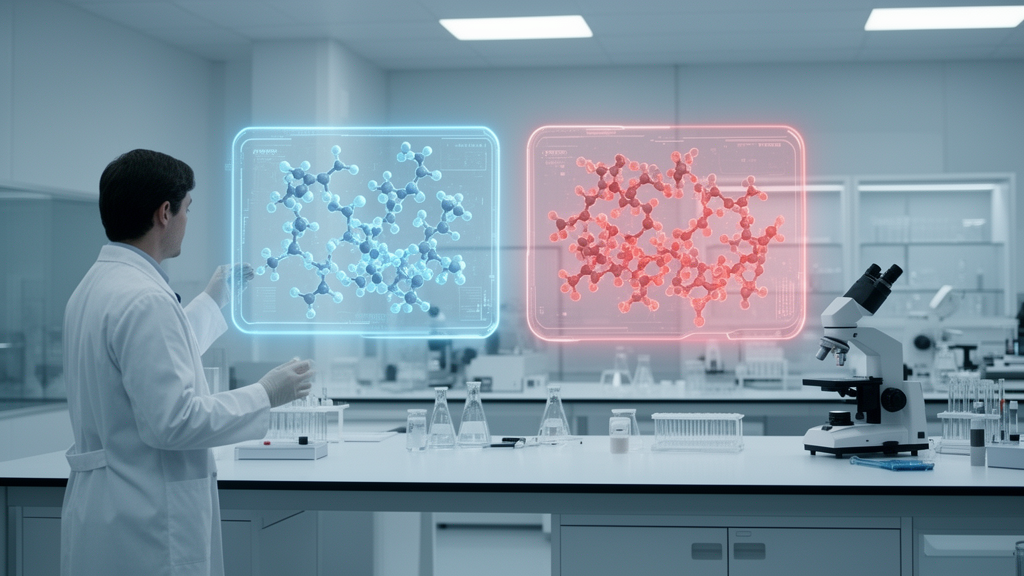
The study, published in June 2026, focused on the antihypertensive drugs atenolol and amlodipine, testing their interactions with three common excipients: mannitol, lactose, and polyvinyl pyrrolidone. The primary objective was to assess the reliability of these artificial intelligence-based systems in identifying potential incompatibilities before physical formulation begins. By benchmarking a machine-learning model against a knowledge-driven expert system, the authors aimed to establish a framework for interpreting conflicting computational predictions in early-stage drug development.
The two systems evaluated operate on fundamentally different algorithmic principles. DE_Interact is a machine-learning-based computational model that relies on implicit statistical learning. It was developed by Patel et al. and utilizes a dataset comprising 179 incompatible and 3,549 compatible drug-excipient combinations sourced from peer-reviewed literature. The model uses PubChem fingerprints of individual compounds as input vectors and employs an artificial neural network with three hidden layers. In contrast, PharmDE is a knowledge-driven expert system developed by Wang et al. that relies on explicit chemical knowledge. It contains 532 documented cases related to 200 drugs and 123 excipients, derived from 288 peer-reviewed sources. PharmDE uses a rule-based engine that evaluates interactions between identified functional groups to assign risk levels.
The selection of atenolol and amlodipine as model drugs was driven by their clinical relevance in treating hypertension and angina. Atenolol is a selective beta-1 blocker, while amlodipine is a calcium channel blocker with a long half-life that supports once-daily dosing. The excipients chosen—mannitol, lactose, and polyvinyl pyrrolidone—were selected for their potential use in 3D-printed solid oral dosage forms. Specifically, the study noted that while these polymers are not suitable for direct use in selective laser sintering, formulations like Ludipress and SmartEx, which contain high percentages of lactose or mannitol, are compatible with 3D printing technologies. This context underscores the practical application of the in silico screening for future innovative dosage forms.
The DE_Interact model was trained using an artificial neural network with specific hyperparameters to address data imbalance. The original dataset was heavily skewed, with over 95% of entries labeled as compatible and only 4.80% as incompatible. The model achieved a maximum validation accuracy of 0.9161 and a training accuracy of 0.9930. However, the authors noted that accuracy alone is unreliable for imbalanced data, emphasizing the importance of recall to avoid false negatives, which are critical in identifying actual incompatibilities.
The PharmDE expert system employs a more transparent, rule-based approach to risk assessment. It categorizes risk into three levels: low, medium, and high. The system uses Extended Connectivity Fingerprints to perform similarity searches and identify analogous cases in its database. The rule-based engine generalizes specific database cases into broad chemical principles, such as the reaction between amines and reducing sugars. If no interaction rule matches, the risk is rated as low; if one rule matches, it is medium; and if two or more rules match, it is high. This mechanistic approach allows PharmDE to provide explanations for its predictions, citing specific chemical reactions and peer-reviewed literature, which is a distinct advantage over the black-box nature of the machine-learning model.
The results revealed significant discrepancies between the two tools for certain drug-excipient pairs. For atenolol, DE_Interact predicted compatibility with polyvinyl pyrrolidone with a probability score of 1, indicating high confidence. However, PharmDE rated the atenolol-polyvinyl pyrrolidone pair as high risk, citing peer-reviewed literature that documents a strong interaction between these compounds. The authors highlighted that DE_Interact’s prediction of compatibility in this case could be a false positive, as the expert system’s finding was supported by experimental evidence from previous studies. This contradiction illustrates the limitations of relying solely on machine-learning predictions without corroborating mechanistic data.
For amlodipine, the tools showed different risk profiles for mannitol. DE_Interact predicted compatibility with a probability of 0.9944, while PharmDE assigned a medium level of recommended risk. The medium risk in PharmDE was based on a single rule-based match related to an esterification reaction, although the identified risk was low because no previous peer-reviewed studies had reported incompatibilities for this specific combination. The authors concluded that despite the medium risk flag, the amlodipine-mannitol pair was the most suitable candidate for the final solid oral dosage form. This decision was based on the complementary nature of the predictions, where the absence of high-risk flags in both systems suggested a favorable coexistence profile.
Lactose was identified as a high-risk excipient for both drugs due to its nature as a reducing sugar. The study explained that lactose can undergo Maillard reactions with amine-containing drugs, leading to chemical degradation and the formation of brown-black products. This interaction is well-documented in the literature and was consistently flagged as high risk by both DE_Interact and PharmDE. Consequently, lactose was excluded from the recommended formulation. The authors emphasized that while computational tools can identify such known interactions, they are limited by the scope of the training data and may not capture novel or underreported interactions.
The study proposes a hierarchical framework for utilizing these in silico tools in preformulation. The authors suggest that DE_Interact should be used first as a screening tool to flag potential incompatibilities, given its strength in detecting high-risk pairs. PharmDE should then be used as a confirmatory tool to provide mechanistic insights and validate the predictions. This sequential approach allows formulation scientists to balance the broad screening capability of machine learning with the detailed, rule-based reasoning of the expert system.
Limitations of the study include the reliance on peer-reviewed literature for training data, which may introduce publication bias and dataset compositional limitations. The predictive ability of the models is constrained by the chemical space represented in their training sets, meaning novel drug-excipient combinations may fall outside their reliable predictive range. The authors acknowledge that the discrepancies between the tools highlight the need for further experimental validation to map in silico outcomes with in vitro observations. They recommend prioritizing differential scanning calorimetry and Fourier transform infrared spectroscopy over isothermal stress testing for validating the computational predictions in future work.
The findings contribute to the broader field of computational pharmaceutics by demonstrating that in silico tools can serve as valuable pre-screening aids to prioritize excipients and mitigate risks. However, the study underscores that these tools should not replace traditional experimental methods but rather complement them. By integrating AI-based models with expert systems, formulation scientists can make more informed and efficient choices in the early stages of development. The study provides a practical example of how to interpret conflicting computational results, offering a structured approach to decision-making in pharmaceutical preformulation.
The research highlights the evolving role of artificial intelligence in drug development, where computational models are increasingly used to streamline the formulation process. As the field advances, the integration of diverse data interpretation methods and transparent rule-based systems will be crucial for improving the reliability of in silico predictions. The authors encourage the adoption of this layered approach in the industry, emphasizing that while computational tools can save time and cost, they must be used with caution and always corroborated by experimental evidence to ensure the safety and effectiveness of final pharmaceutical products.
Subject of Research: Comparative evaluation of AI-based computational models and expert systems for drug-excipient compatibility prediction
Article Title: In silico preformulation studies, including drug-excipient interaction or compatibility studies, using an AI-based computational model and expert system
Article References: Awasthi, G., & Banerjee, S. (2026). In silico preformulation studies, including drug-excipient interaction or compatibility studies, using an AI-based computational model and expert system. AAPS Open, 12(1), Article 30. https://doi.org/10.1186/s41120-026-00164-4
Image Credits: AI Generated
DOI: 10.1186/s41120-026-00164-4
Keywords: in silico preformulation, drug-excipient interaction, DE_Interact, PharmDE, machine learning, expert system, atenolol, amlodipine, mannitol, lactose, polyvinyl pyrrolidone, pharmaceutical formulation, 3D printing, solid oral dosage form, computational pharmaceutics, Maillard reaction, risk assessment, false positive prediction, data imbalance, preformulation screening
News Source: Ophelia Keating. (November 14, 2026). AI Models Disagree on Drug-Excipient Compatibility in Preformulation. Scienmag.