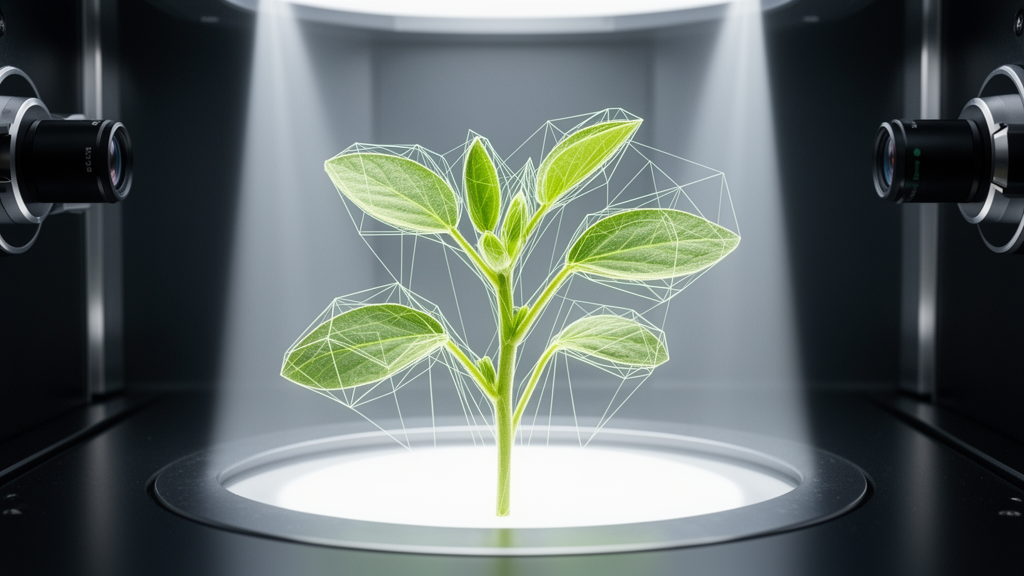
Researchers from the School of Information and Intelligent Science at Donghua University in Shanghai have developed a new artificial intelligence framework called 3D OGT, or 3D Organ Growth Tracking, which automatically follows every individual plant organ throughout an entire growth sequence. The system, published in the journal Plant Phenomics on September 10, 2026, requires only the organ labels from the very first moment of observation to track leaves, stems, and buds over time. This approach addresses a significant bottleneck in modern plant phenotyping, where tracking individual organs across time-series 3D point cloud data has traditionally been either extremely labor-intensive or incapable of real-time operation. The framework achieves an average tracking accuracy of 88.10% across multiple crop species, outperforming existing methods while requiring a fraction of the manual annotation effort typically needed for such tasks.
Traditional methods for tracking plant organs often rely on a strategy known as tracking by segmentation, which depends on having complete and accurate organ labels for every single time point in the growth sequence. Other approaches use back tracing mechanisms, which require collecting the entire growth sequence before any analysis can begin, thereby rendering real-time monitoring impossible. The 3D OGT framework introduces a fundamentally new paradigm by performing organ tracking and segmentation simultaneously, using only the initial moment’s organ labels as a starting point. This shift allows for continuous monitoring without the need for extensive manual intervention at each stage of the plant’s development.
The technical architecture of 3D OGT involves iteratively processing pairs of adjacent point clouds in chronological order, propagating organ labels forward through the entire growth sequence. A pre-trained deep learning module called 3D NOD, or 3D New Organ Detection, is integrated to identify emerging buds and new leaves. This module assigns fresh, independent labels to these new structures, preventing them from being confused with older organs.
The label broadcasting system begins with bidirectional point cloud registration, which aligns adjacent moments both forward and backward in time using a technique called Coherent Point Drift, or CPD. The aligned point clouds are then fed into a semi-supervised Graph Convolutional Network, or GCN, which propagates the sparse labels from the previous time point to the unlabeled points of the new one. A final refinement step corrects any residual label errors, ensuring high precision in the tracking process.
Once the propagated labels are merged with the newly detected organs, the complete, labeled point cloud for the next moment is produced, allowing the process to continue uninterrupted. The authors highlighted the transformative potential of this approach, noting that a single labeled snapshot is enough to follow an entire plant’s growth journey. They described a specific instance where the system automatically picked up a tiny new bud that even human annotators had missed, demonstrating the framework’s ability to detect subtle changes that might be overlooked by manual inspection.
The ability to track every organ’s growth automatically and in real time has far-reaching implications for agriculture and fundamental plant biology. For high-throughput phenotyping, 3D OGT can dramatically accelerate breeding programs by enabling rapid, quantitative assessment of how different genotypes respond to environmental conditions such as drought, heat, or disease pressure. The framework’s robustness against noisy sensor data and missing parts makes it well suited for deployment in real-world field conditions, where data quality can be inconsistent.
Moreover, the framework’s capacity to detect not only new organs but also sudden organ loss provides a powerful new tool for studying plant stress responses and senescence patterns. By monitoring the appearance and disappearance of organs over time, researchers can gain insights into how plants react to environmental stresses, potentially guiding the development of more resilient crop varieties in an era of climate uncertainty.
The study demonstrates the potential of 3D OGT to reduce the burden of manual labeling and enable more detailed analysis of plant growth dynamics.
Subject of Research: Development of an AI framework for 3D organ growth tracking in plants
Article Title: Minimal labels, maximal tracking: new AI framework follows every plant organ in 3D
Article References: Minimal labels, maximal tracking: new AI framework follows every plant organ in 3D. Original publication (Bibliographic details unavailable.)
Image Credits: AI Generated
DOI: Not provided
Keywords: plant phenomics, AI tracking, 3D point clouds, crop breeding, machine learning, organ growth, real-time monitoring, Donghua University, Minimal, labels, maximal, tracking
News Source: Alan Morgan. (November 10, 2026). AI framework tracks plant organs in 3D with minimal labels. Scienmag.