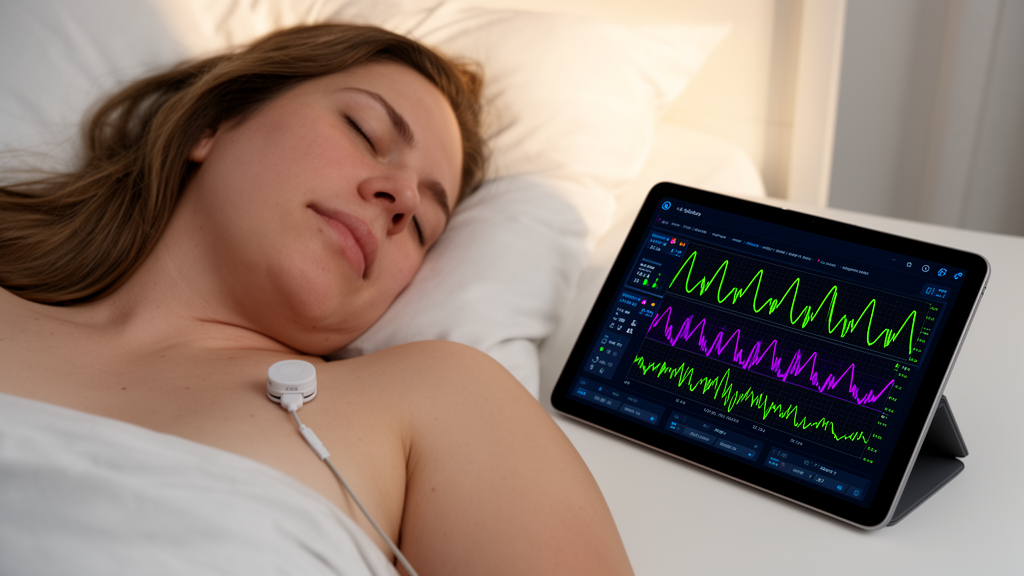
Researchers have developed an artificial intelligence framework capable of predicting the severity of obstructive sleep apnea (OSA) from short segments of physiological signals. Published in Nature Communications, the study introduces a method called Long-Range Interdependencies Aware (LRIA) analysis, which extracts multifractal coupling features from physiological data. These features capture long-range dependencies among various physiological processes, providing a robust representation of sleep dynamics. The framework was validated across five heterogeneous cohorts comprising more than 35,000 subjects, demonstrating consistent performance in classifying OSA severity levels.
Obstructive sleep apnea is a chronic disorder characterized by frequent interruptions in breathing and intermittent hypoxia. It is a significant public health concern due to its potential to increase morbidity and mortality across multiple organ systems. While polysomnography (PSG) remains the gold standard for diagnosis, it is laborious, costly, and operationally complex. Current deep learning approaches often rely on full-night recordings or small datasets, limiting their generalizability and clinical accessibility. The LRIA framework addresses these limitations by utilizing a biological geometry-aware approach to process physiological signals efficiently.
The LRIA method employs fractional dynamic modeling to extract a coupling matrix that represents the spatial coupling between physiological processes over time. This matrix serves as a unique fingerprint of the physiological state, capturing both short-term and long-term memory within the signals. The study found that these coupling features converge rapidly, stabilizing after approximately 10 minutes of recording. This rapid convergence suggests that stable physiological representations can be extracted from relatively short segments, reducing the data requirements for accurate severity prediction compared to traditional full-night analyses.
To validate the framework, the researchers used five large-scale polysomnography datasets: the Sleep Heart Health Study (SHHS), the Multi-Ethnic Study of Atherosclerosis (MESA), the Osteoporotic Fractures in Men Sleep Study (MrOS), a cohort from Massachusetts General Hospital (MGH), and a Western Romanian clinical cohort. These datasets span diverse demographic and clinical profiles, including home-based and hospital-based recordings. The inclusion of such heterogeneous cohorts allows for a rigorous assessment of the model’s generalizability across different populations and recording environments, ensuring that the method is not overly tuned to a specific dataset or demographic group.
The model architecture combines the LRIA-derived coupling matrices with a deep neural network for classification. In some configurations, a Two-Tower Transformer model was used to integrate the coupling matrix with raw signal data, leveraging the transformer’s capacity to model high-dimensional temporal dynamics. The deep learning component was trained to classify OSA severity into four categories: normal, mild, moderate, and severe. This multi-class approach provides more detailed stratification than binary detection models, offering insights into the spectrum of disease severity that are relevant for clinical management and risk assessment.
Performance evaluations showed that the LRIA framework achieved area-under-the-curve (AUROC) values exceeding 0.91 across the validated cohorts. In the Western Romanian dataset, the model outperformed baseline deep learning architectures, including DNN, CNN, CNN-LSTM, and STFT-CNN models. The LRIA model demonstrated higher accuracy, precision, recall, and F1 scores, indicating its ability to accurately extract relevant features from physiological signals. Confusion matrices revealed that the model consistently distinguished between non-OSA participants and those with varying degrees of apnea severity, with high sensitivity in identifying apnea cases.
External validation on the SHHS, MESA, MrOS, and MGH datasets confirmed the model’s robustness. In the MESA dataset, the LRIA framework achieved an AUROC of 94%, with an accuracy of 88%, sensitivity of 87%, and specificity of 89%. Similarly, in the MrOS dataset, the AUROC was 92%, demonstrating strong cross-cohort validity. The MGH dataset, which includes hospital-based recordings, also showed strong performance with an AUROC of 92%. These results highlight the model’s resilience to demographic variability and signal noise, particularly in elderly and hospital-based cohorts where data quality can be challenging.
Compared to recent state-of-the-art models such as SleepFM and Informer, the LRIA framework showed significant improvements. In the SHHS dataset, LRIA attained an AUROC of 95%, improving upon SleepFM’s 82% by more than 12%. In MESA, the method achieved 94% versus 83% for SleepFM. The performance gains were even more pronounced in clinically challenging datasets like MrOS and MGH, where LRIA outperformed SleepFM by up to 18% in AUROC. These comparisons suggest that the LRIA approach provides a competitive and consistent performance across heterogeneous cohorts, offering a substantial margin over existing deep learning methods for OSA diagnosis.
The study also examined the temporal stability of the coupling matrices using Wasserstein distance analysis. The Wasserstein distance, which measures the difference between two distributions, consistently converged to a small value after 600 seconds. This mathematical analysis supports the sufficiency of 10-minute segments for robust OSA severity classification, as the statistical structure of physiological interdependencies stabilizes within this window. Extending the segment length beyond 10 minutes provided diminishing gains in discriminative information, validating the efficiency of the short-window approach for rapid analysis.
Despite its strong predictive performance, the LRIA framework has several limitations. The study notes that short-window analysis, while mathematically justified for representation stability, does not substitute for full-night PSG in detecting REM- or position-dependent OSA. Aggregating data across multiple windows is preferable when full-night recordings are available to capture distributed physiological information. Additionally, the current framework does not explicitly differentiate between obstructive and central apnea subtypes, nor does it consider less common forms of sleep-disordered breathing such as hypoventilation syndromes. Night-to-night variability remains a significant challenge that within-night analysis alone cannot fully resolve.
The LRIA framework represents a methodological advancement in the analysis of sleep physiology by introducing a representation-level approach for modeling long-range dependencies. By leveraging fractional dynamics and multifractal coupling matrices, the method captures system-level alterations in physiological dynamics that persist even in the presence of transient noise. This approach enables the deep learning framework to operate on stable, interpretable representations rather than raw, noise-sensitive signals. The study suggests that LRIA may offer a potential avenue for exploring respiratory phenotypes that are not fully captured by event counts alone, although further validation is required to determine its applicability to specific subtypes.
Future work will include validation in cohorts with higher proportions of non-OSA subjects and additional stratified analyses across demographic subgroups to further assess external generalizability. The integration of LRIA with clinical workflows will be essential to assess its potential impact on healthcare practice. While the approach shows strong predictive performance, its primary contribution lies in providing a perspective on physiological signal representation rather than serving as a standalone clinical screening tool. The development of such automated and efficient analytical methods could enhance the accessibility of OSA diagnosis and support early detection efforts in large populations.
To ensure the stability of extracted physiological fingerprints, the researchers employed an Expectation-Maximization (EM) algorithm to estimate the coupling matrix. The algorithm iteratively separates intrinsic physiological dynamics from unmodeled perturbations, characterizing these as unknown stimuli that could confound machine learning results. During each iteration, the model performs an E-step to infer latent inputs, using a sparsity-promoting parameter to ensure only significant hidden influences are retained. A subsequent M-step updates the coupling matrix by minimizing residual errors. This process reaches convergence within five to ten iterations, providing a computationally efficient method for processing large-scale polysomnography datasets while maintaining robustness against imperfect data.
The selection of physiological signals was critical, as the team utilized SpO2, heart rate, thoracic and abdominal effort, and airflow due to their inherent intercorrelation. These signals provide a cohesive representation of cardiorespiratory function. By modeling these relationships through a multi-dimensional fractional-order linear system, the framework captures long-range memory properties often overlooked by standard deep learning models. Unlike recurrent networks that may lose information from initial timestamps, the fractional dynamic model considers all preceding states, effectively synthesizing a holistic fingerprint of the system’s dynamics during sleep.
For large-scale datasets such as the Sleep Heart Health Study, the framework was extended into a Two-Tower Transformer architecture. This hybrid design features two parallel pathways: one for raw signals and another for the LRIA-derived coupling matrix. The raw data tower utilizes an Informer block, which incorporates a ProbSparse self-attention mechanism to reduce computational overhead. By concatenating the outputs of these two towers, the model captures both global coupling structures and local temporal variations. This integration allows the framework to maintain high-dimensional contextual information while benefiting from the interpretability of the coupling matrices. The model demonstrated that including structural coupling features significantly improves predictive accuracy compared to models relying solely on temporal dynamics.
To address this, the researchers emphasized the use of the area under the receiver operating characteristic curve (AUROC) as the primary evaluation metric. In datasets like the SHHS, where only 2.9% of participants had no evidence of apnea, AUROC provided a refined assessment by comparing the rankings of positive and negative instances. This rigor ensures that the model’s performance reflects genuine discriminative power across all severity levels rather than a bias toward the most prevalent classes.
Subject of Research: Long-range interdependencies aware signal analysis for rapid and accurate obstructive sleep apnea prediction
Article Title: Long-range interdependencies aware signal analysis for rapid and accurate obstructive sleep apnea prediction
Article References: Wang, Z., Yin, C., Cheng, A., Chen, X., Cheng, M., An, L., Wang, H., Sun, H., Ding, L., Mihaicuta, S., Udrescu, L., Gozal, D., del Campo, F., Vaquerizo-Villar, F., Hornero, R., Hedner, J., Randerath, W., Mannino, D. M., Nazarian, S., … Bogdan, P. (2026). Long-range interdependencies aware signal analysis for rapid and accurate obstructive sleep apnea prediction. Nature Communications, 17(1), Article 11024. https://doi.org/10.1038/s41467-026-76274-0
Image Credits: AI Generated
DOI: 10.1038/s41467-026-76274-0
Keywords: Long-range, interdependencies, aware, signal, analysis, rapid, accurate, obstructive, sleep, apnea, prediction
News Source: Ophelia Keating. (November 16, 2026). AI Framework Predicts Sleep Apnea Severity from Short Physiological Signals. Scienmag.