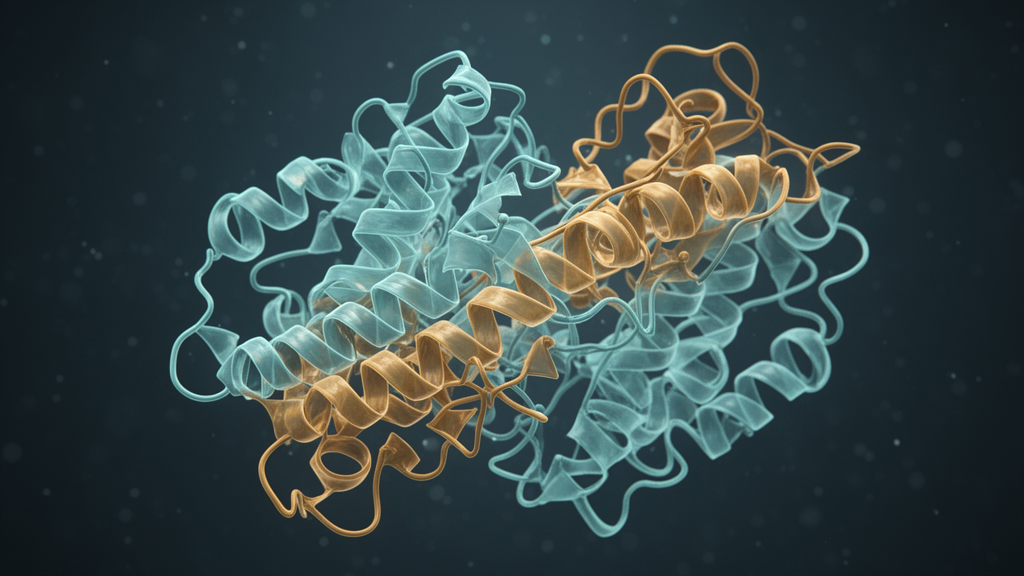
Determining macromolecular architecture forms the cornerstone of rational drug design and molecular biology, yet conventional structural methods like X-ray crystallography, NMR spectroscopy, and cryo-electron microscopy have mapped only a fraction of known sequences. In the human proteome, experimental structures exist for approximately twenty-five percent of sequences, leaving vast biological domains uncharacterized. This sequence-structure gap is particularly acute across the dark proteome, encompassing proteins and regions lacking experimental coordinates or annotations, which often comprise over forty percent of eukaryotic genomes. Even after recent algorithmic breakthroughs, roughly ten percent of human proteins remain structurally dark. A comprehensive review in BioData Mining by Shivani Singh, Ruhani Singh, and Sunita Sharma assesses how machine learning frameworks developed between 2018 and 2025 are illuminating these neglected families. The authors evaluate predictive capabilities while identifying persistent challenges in conformational dynamics, disordered regions, and experimental validation.
Historically, computational structural biology relied on two methodologies that struggled on targets lacking close relatives. Template-based modeling, implemented in platforms like SWISS-MODEL and HHpred, aligns query sequences against experimentally solved structures in the Protein Data Bank. When sequence identity drops below thirty percent into the twilight zone, alignment errors accumulate and structural divergence degrades model accuracy. Conversely, ab initio approaches like Rosetta attempted to assemble atomic folds from first principles using Monte Carlo simulations. While conceptually elegant, these physical simulations proved computationally demanding and were largely restricted to small proteins under one hundred residues. The paradigm shifted as direct coupling analysis extracted structural restraints from co-evolutionary patterns in sequence alignments. Subsequent deep learning models utilized residual convolutional networks to predict distance distributions, as demonstrated by DeepFold, which achieved a 40.3 percent TM-score improvement over trRosetta on challenging targets while accelerating folding simulations roughly 262-fold.
A major breakthrough occurred when end-to-end architectures replaced heuristic modeling with spatial attention mechanisms. DeepMind’s AlphaFold2 transformed the discipline at CASP14, employing its two-track Evoformer attention module alongside an invariant point attention structure module to output coordinates directly from evolutionary alignments. Achieving a median domain GDT-TS of 92.4, AlphaFold2 matched experimental accuracy across numerous globular targets. Simultaneously, the Baker Laboratory developed RoseTTAFold, a three-track network processing sequence, distance maps, and coordinates on a single graphics processing unit. Open-source initiatives widened access through OpenFold, which reproduced AlphaFold2’s accuracy with trainable pipelines. Concurrently, transformer-based protein language models such as ESMFold bypassed multiple sequence alignments entirely. By deploying a 15-billion-parameter language model to generate atomic-resolution predictions from single sequences, ESMFold enabled the modeling of nearly 618 million metagenomic proteins, providing an essential computational strategy for orphan proteins lacking evolutionary alignments.
The introduction of AlphaFold3 marked another decisive architectural departure. Rather than dedicating extensive computation to multiple sequence alignments, AlphaFold3 condenses alignment processing into four initialization blocks before passing data to a 48-block Pairformer module. Crucially, it replaces specialized structural modules with a generative diffusion model that denoises raw atomic coordinates directly. This unified framework enables simultaneous modeling of proteins, nucleic acids, small molecules, metal ions, and modified residues. On benchmark evaluations, AlphaFold3 achieved a 76 percent success rate in protein-ligand pose prediction with root-mean-square deviations under 2 Å, markedly exceeding AutoDock Vina’s 48 percent baseline. For protein-nucleic acid interactions, it achieved a contact interface lDDT of 0.83 against 0.65 for RoseTTAFold2NA. Developer benchmarks also reported acceptable docking predictions, defined as DockQ scores of at least 0.23, across 91 percent of complexes compared to 78 percent for AlphaFold-Multimer, while successfully predicting a 4,665-residue spike protein complex.
Despite these metrics, the review highlights significant limitations when applying AlphaFold3 to poorly characterized proteins. Independent blinded assessments in CASP and CAPRI indicate that performance remains target-dependent, with overall success rates dropping to forty to sixty percent on challenging multimers. Stereochemical defects persist within diffusion outputs, evidenced by a 4.4 percent chiral violation rate on the PoseBusters benchmark alongside distortions in ligand geometries. Furthermore, the diffusion architecture frequently hallucinates ordered structures in intrinsically disordered regions. A systematic study by Gopalan and Narayanan evaluating 72 DisProt disordered proteins revealed that 22 percent of residues were misclassified as hallucinations, affecting 18 percent of residues linked to biological processes. Alarmingly, these hallucinated folds were not reliably flagged by model confidence scores, with AlphaFold3 assigning confident pLDDT scores above 70 to disordered residues. This finding refutes the assumption that internal confidence scores alone prevent structural misinterpretations.
To overcome licensing restrictions associated with proprietary models, an active open-source ecosystem has reproduced and expanded biomolecular co-folding capabilities. Boltz-1 was released under a permissive MIT license, becoming the first fully open-source framework with complete training pipelines to reach AlphaFold3-level accuracy. Its successor, Boltz-2, integrated binding affinity prediction directly into structure modeling. Boltz-2 became the first deep learning model to approach the accuracy of physics-based free-energy perturbation while operating roughly one thousand times faster, winning the CASP16 blind affinity challenge without fine-tuning. Other community platforms provide complementary strengths: Chai-1 incorporates protein language model embeddings and user restraints, matching AlphaFold3’s performance with a 77 percent success rate on PoseBusters, while OpenFold3 utilizes a Federated Training Initiative uniting pharmaceutical companies to incorporate proprietary data beyond public archives. Additionally, standardized frameworks like ABCFold enable unified benchmarking across AlphaFold3, Boltz-1, and Chai-1, facilitating consensus modeling for challenging targets.
Modeling protein-protein complexes is vital for understanding cellular signaling and guiding interface-directed therapeutics, yet classical docking approaches face persistent challenges. Traditional fast Fourier transform methods treat proteins as rigid bodies, restricting accuracy whenever binding partners undergo induced-fit rearrangements. Flexible docking suites like HADDOCK and LightDock incorporate experimental restraints to accommodate local movements, while deep learning tools like EquiDock use equivariant graph neural networks to predict rigid-body transformations rapidly. Nonetheless, docking requires pre-existing structures, compounding errors when applied to predicted models. Co-folding architectures overcome this hurdle by folding multimeric assemblies directly from primary sequences. AlphaFold-Multimer achieved acceptable interface quality in 67 to 70 percent of heteromeric complexes, though it struggles with antibody-antigen interfaces and short linear motifs unless sequences are fragmented. Demonstrating co-folding at proteome scale, Zhang and colleagues deployed RoseTTAFold2-PPI across 200 million human protein pairs, identifying 17,849 high-confidence interactions at 90 percent precision, including 3,631 previously uncharacterized complexes.
In computational ligand discovery, identifying binding sites and predicting small-molecule poses on understudied proteins involves significant obstacles. Virtual screening against artificial intelligence models generally yields lower hit rates than screening against holo crystal structures because predicted pockets typically adopt apo-like geometries with misplaced side chains. While machine learning scoring functions like RF-Score and DeepAtom improved binding affinity predictions on PDBbind benchmarks, generative docking tools have driven a broader paradigm shift. DiffDock models ligand placement as a generative diffusion process, achieving a 38 percent top success rate compared to 20 to 23 percent for classical physics-based docking. For uncharacterized targets lacking defined pockets, deep learning methods provide automated identification: Kalasanty uses 3D U-Net segmentation to locate pocket centers within 4 Å with 66 percent accuracy, while PocketMiner detects cryptic binding sites that emerge through conformational fluctuations. Additionally, AlphaFill transplants homologous ligands onto predicted folds to formulate initial binding hypotheses.
The practical efficacy of this computational workflow was validated in an empirical study targeting trace amine-associated receptor 1, an orphan G-protein-coupled receptor lacking solved experimental structures. These membrane targets undergo dynamic transitions between active and inactive states, historically complicating structure-based discovery. Addressing this challenge, Díaz-Holguín and colleagues deployed an AlphaFold2-derived model of human TAAR1 to screen approximately 16 million chemical compounds in silico. Biological testing of the 30 top-ranked candidates identified 18 confirmed agonists with potencies between 0.03 and 12 micromolar, representing a 60 percent experimental hit rate that more than doubled standard homology modeling results. The most potent agonist displayed selective TAAR1 activity in vitro and triggered antipsychotic-like effects in wild-type mice, while showing no behavioral impact in TAAR1-knockout models. This validation proves that high-quality artificial intelligence predictions can successfully navigate dynamic binding pockets to accelerate lead discovery for intractable orphan receptors.
Addressing conformational flexibility is equally essential for intrinsically disordered proteins, which lack defined folds but mediate cellular regulation and phase separation. In CAID community benchmarks, AlphaFold2’s pLDDT metric proved to be an effective disorder predictor, outperforming simple secondary structure heuristics and identifying conditionally folded regions that organize upon binding partners. Moving beyond static models, Brotzakis and colleagues utilized AlphaFold-derived distance distributions as restraints with statistical reweighting to construct accurate conformational ensembles for disordered targets like 4E-BP2, ACTR, and Ephrin-B2. Simultaneously, generative dynamics models have emerged to simulate equilibrium ensembles without lengthy simulations. BioEmu uses diffusion modeling across static structures and trajectories to generate thousands of independent conformations per hour on a single graphics processing unit, accelerating sampling 10,000- to 100,000-fold over classical molecular dynamics while estimating free energies within 1 kcal/mol. Hybrid approaches like AF2-RAVE and AlphaFold-seeded simulations further bridge this gap, uncovering cryptic druggable pockets in targets like PPM1D phosphatase.
To prevent computational overconfidence, the authors establish an evaluation framework pairing distinct quality metrics with a five-tiered exploration roadmap for understudied proteins. Reliable assessment requires distinguishing between superposition-based global scores like GDT-TS and TM-score—where values above 0.5 confirm shared topology and scores exceeding 0.7 indicate high quality—and superposition-free metrics like lDDT, which evaluate local packing without penalizing domain orientations. Model-internal metrics like pLDDT and predicted aligned error heatmaps help researchers identify reliable domains while recognizing ambiguous inter-domain orientations. However, the review emphasizes that high confidence does not guarantee structural correctness for evolutionarily isolated proteins. To navigate these limitations, the authors’ roadmap begins with sequence analysis and multi-model consensus prediction combining AlphaFold, RoseTTAFold, Boltz, and Chai-1, progresses through functional annotation using DeepFRI and ensemble modeling, and concludes with experimental validation through mutagenesis and biophysical assays. Adherence to Findable, Accessible, Interoperable, and Reusable principles ensures reproducible discoveries across the dark proteome.
Subject of Research: Artificial intelligence methods for structural modeling of understudied protein families
Article Title: Navigating the uncharted: AI-driven advances in protein structure, dynamics, interactions and ligand interactions for understudied families
Article References: Singh, S., Singh, R., & Sharma, S. (2026). Navigating the uncharted: AI-driven advances in protein structure, dynamics, interactions and ligand interactions for understudied families. BioData Mining, 19(1), Article 69. https://doi.org/10.1186/s13040-026-00577-7
Image Credits: AI Generated
DOI: 10.1186/s13040-026-00577-7
Keywords: protein structure prediction, dark proteome, AlphaFold, machine learning, structural biology, protein dynamics, computational biology, drug discovery, Navigating, uncharted, AI-driven, advances
News Source: Jason Bradley. (November 10, 2026). AI Expands Understudied Protein Structural Modeling but Encounters Critical Dynamic Hurdles. Scienmag.