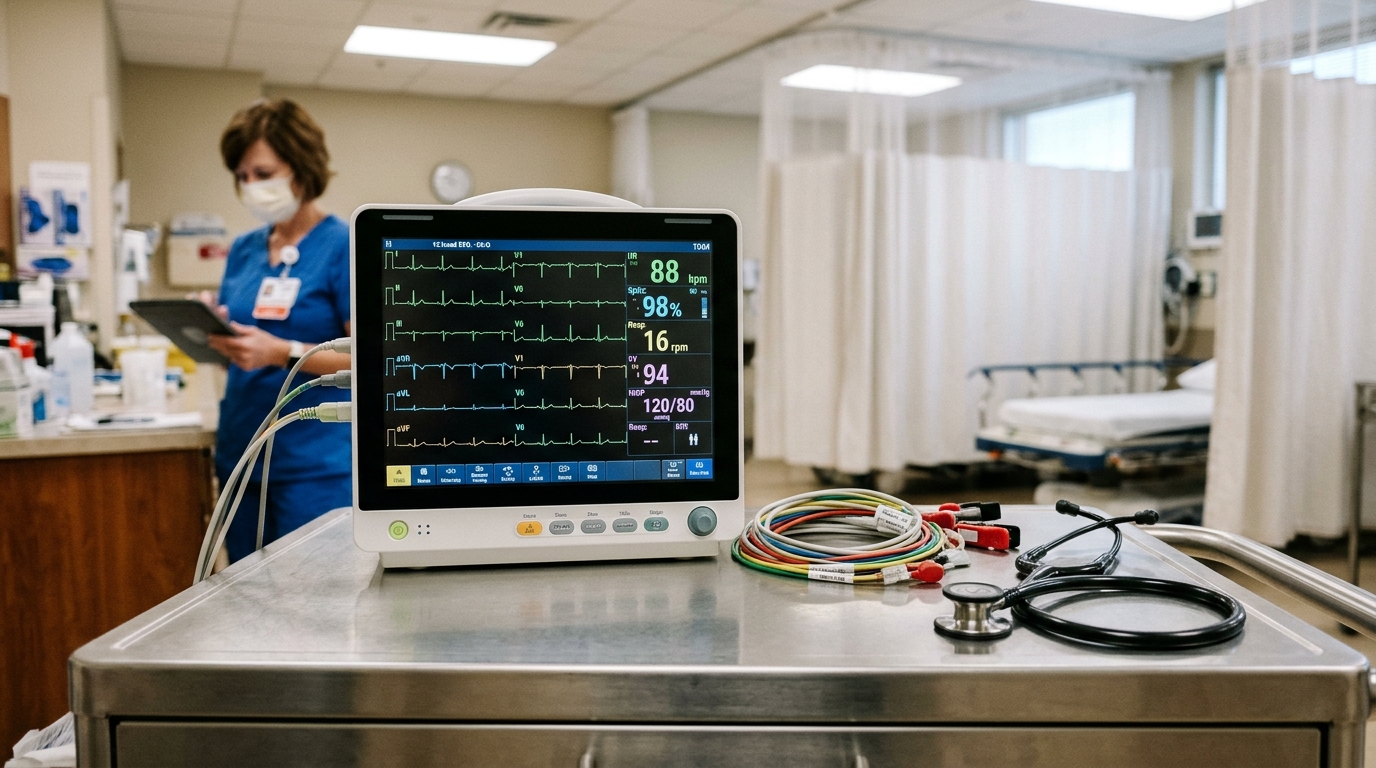
In a prospective diagnostic cohort study published in The Lancet Regional Health – Europe, researchers conducted the first external validation of an artificial intelligence-based electrocardiogram algorithm for the early diagnosis of acute myocardial infarction in two large European cohorts. The study evaluated the AiTiA MI v2.00.00 model, a deep learning algorithm developed in Korean populations, to determine its diagnostic accuracy and incremental value when combined with high-sensitivity cardiac troponin T measurements in emergency department patients presenting with non-traumatic chest pain.
The research team analyzed data from 12,630 eligible patients across the APACE and APACE-Light studies, which enrolled individuals with acute chest discomfort possibly indicating a heart attack. The APACE cohort included 5,047 patients from an international multicentre study, while APACE-Light comprised 7,583 patients from a single-centre registry in Basel, Switzerland. The primary outcome was centrally adjudicated acute myocardial infarction, defined according to the fourth Universal Definition of Myocardial Infarction, with a secondary outcome of all-cause death or non-index myocardial infarction within five years.
The AiTiA MI v2.00.00 algorithm estimates the probability of acute myocardial infarction from raw 12-lead electrocardiogram recordings using a self-supervised foundation model fine-tuned on clinical data from 14 emergency departments in the ROMIAE study. In this validation, the model was applied as a fixed, pre-trained algorithm via an application programming interface without retraining on the European cohort data. The study aimed to assess the model’s performance in direct comparison with established risk scores, high-sensitivity cardiac troponin T concentrations, and integrated physician judgment, while also evaluating the diagnostic and prognostic performance of predefined triage thresholds.
The AI-ECG model demonstrated good discrimination for acute myocardial infarction, achieving an area under the receiver operating characteristic curve of 0.79 in the APACE cohort and 0.84 in the APACE-Light cohort. However, the model’s diagnostic performance was inferior to high-sensitivity cardiac troponin T, which achieved AUCs of 0.94 and 0.93 in the respective cohorts. The AI-ECG also underperformed compared to the recalibrated HEART score and integrated physician judgment, which had an AUC of 0.86 in APACE, indicating that the algorithm alone does not surpass current clinical standards for initial risk stratification.
Despite its inferior standalone performance, the AI-ECG model showed statistically significant incremental diagnostic value when combined with high-sensitivity cardiac troponin T in logistic regression models. The combined model achieved an AUC of 0.95 in both cohorts, outperforming high-sensitivity cardiac troponin T alone. This suggests that the algorithm may serve as a useful adjunct to existing biomarkers rather than a standalone decision-making tool, potentially enhancing the precision of early triage decisions in the emergency department.
When predefined triage thresholds were applied, the AI-ECG model ruled out 14% of patients in APACE and 19% in APACE-Light with a sensitivity of 97.6% and 97.5%, respectively. The negative predictive value was 96.7% in APACE and 97.6% in APACE-Light. Most missed cases, or false negatives, were non-ST-segment elevation myocardial infarctions, with a significant proportion identified as type 2 myocardial infarction. At the rule-in threshold, the model identified 19% of patients in both cohorts with a specificity of 88.3% in APACE and 90.3% in APACE-Light, and a positive predictive value of 50.8% and 57.1%, respectively.
The model exhibited excellent discrimination for ST-segment elevation myocardial infarction and occlusion myocardial infarction, with AUCs of 0.94 and 0.90 to 0.91, respectively. In a post hoc exploratory analysis, a newly derived rule-in threshold targeting a positive predictive value of 70% for ST-segment elevation or occlusion myocardial infarction identified a small group of patients with high precision. This strategy ruled in 40% fewer patients than the main analysis while increasing the positive predictive value for acute myocardial infarction from 55.9% to 79.5%, albeit at the cost of an 11-point drop in sensitivity.
Long-term prognostic analysis revealed that patients classified as rule-in by the AI-ECG model had the highest cumulative incidence of acute myocardial infarction or all-cause death over five years, at 25.9%, compared with 17.2% in the observe group and 4.5% in the rule-out group. This indicates that the model provides meaningful prognostic information beyond the index emergency department visit, potentially aiding in the identification of patients at higher risk for adverse cardiovascular events in the medium term.
Subgroup analyses showed that discrimination was lower in older patients, early presenters, and those with conditions such as chronic kidney disease, atrial fibrillation, left ventricular hypertrophy, and left bundle branch block. The lower performance in patients with left bundle branch block was particularly notable, with AUCs of 0.73 and 0.68 compared to higher values in patients without this condition. Differences in the proportion of type 1 to type 2 myocardial infarction between the Korean development cohort and the European validation cohorts emerged as an important contributor to the observed differences in diagnostic performance.
The study highlights several limitations, including the reliance on a single electrocardiogram at emergency department presentation, which may not capture dynamic changes that serial in-hospital recordings could detect. The high prevalence of acute myocardial infarction in the cohorts may have overestimated the positive predictive value relative to lower-prevalence settings. Furthermore, the lack of explainability in the AI-ECG model, which outputs a probability without identifying underlying electrocardiogram features, may limit its standalone adoption by clinicians who prefer explainable models of comparable performance.
The findings suggest that while the AI-ECG model does not replace high-sensitivity cardiac troponin T or integrated clinical judgment, it offers incremental value when used in combination with these established tools. The algorithm’s ability to precisely identify patients with ST-segment elevation or occlusion myocardial infarction could facilitate triage toward very early coronary angiography, a hypothesis that warrants prospective testing. The study underscores the need for further research on optimally combining AI-ECG with cardiac troponin and clinical variables to improve diagnostic accuracy and patient outcomes.
In conclusion, the external validation of the AiTiA MI v2.00.00 algorithm in two large European cohorts demonstrates its potential as an adjunct to high-sensitivity cardiac troponin T in the early diagnosis of acute myocardial infarction. The model’s main value lies in its ability to rule in patients with high precision for specific subtypes of myocardial infarction, while its standalone performance remains inferior to current clinical standards. These findings support the development of combined models and prospective implementation studies to confirm the clinical benefit of integrating AI-ECG into emergency department diagnostic pathways.
Subject of Research: External validation of an AI-ECG algorithm for acute myocardial infarction diagnosis
Article Title: External validation of an artificial intelligence–based ECG algorithm for the early diagnosis of acute myocardial infarction: a prospective diagnostic cohort study
Article References: Champetier, A., Lee, M. S., Lopez-Ayala, P., Jo, Y.-Y., Boeddinghaus, J., Koechlin, L., Bima, P., Crisanti, L., Zimmermann, T., Kim, K., Kim, K. S., Yoon, S., Kaplan, E., Gualandro, D. M., Recuenco, L. H., Huré, G., Tsao, T.-Y., Nani, M., Lee, H. S., … Buser, A. (2026). External validation of an artificial intelligence–based ECG algorithm for the early diagnosis of acute myocardial infarction: a prospective diagnostic cohort study. The Lancet Regional Health – Europe, 71, Article 101912. https://doi.org/10.1016/j.lanepe.2026.101912
Image Credits: AI Generated
DOI: 10.1016/j.lanepe.2026.101912
Keywords: artificial intelligence, electrocardiogram, acute myocardial infarction, emergency medicine, diagnostic accuracy, cardiac troponin, clinical validation, machine learning, External, validation, artificial, intelligence
News Source: Ophelia Keating. (November 7, 2026). AI ECG Model Validates as Heart Attack Triage Adjunct. Scienmag.