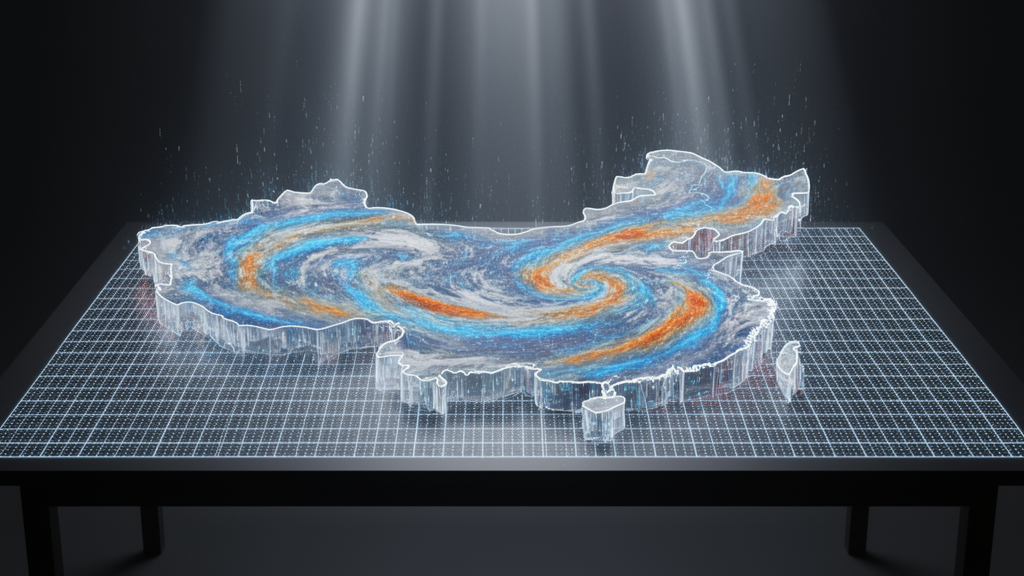
Weather forecasting may be on the verge of a quiet revolution. A team of researchers from the China Meteorological Administration, Tsinghua University, and NVIDIA has demonstrated that a generative artificial intelligence model can transform coarse global weather forecasts into sharp, kilometer-scale regional predictions, outperforming one of China’s most sophisticated operational forecasting systems. The study, published in Geoscientific Model Development, marks the first application of a diffusion-based downscaling framework known as CorrDiff, or Corrective Diffusion, to the entire China region at a resolution of 3 kilometers, and its results challenge long-held assumptions about how high-resolution forecasts should be made.
The core problem the researchers tackled is one of scale and cost. Numerical weather prediction models simulate the atmosphere by solving equations of fluid dynamics and thermodynamics on a grid, and the finer that grid becomes, the more computationally punishing the exercise. Increasing spatial resolution leads to a quadratic or even cubic growth in the number of grid points, translating into orders-of-magnitude more floating-point operations. Even the European Centre for Medium-Range Weather Forecasts, in a landmark experiment, needed a substantial fraction of the Summit supercomputer at Oak Ridge National Laboratory to run a global 1 kilometer simulation at a pace of roughly one simulated week per day. Operational forecasting centers simply cannot afford to run kilometer-scale global models within the time windows that forecasts demand.
The practical workaround has long been downscaling: taking the output of a coarser global model and deriving finer regional detail from it. Dynamical downscaling embeds a high-resolution regional model within the global one, but inherits the same computational burden. Statistical downscaling, by contrast, learns the mapping between low-resolution and high-resolution meteorological fields from historical data, offering simpler implementation, lower cost, and often higher accuracy. Deep learning has supercharged this approach by borrowing techniques from computer vision, where super-resolution models routinely turn blurry images into sharp ones. The catch, as the authors note, is that meteorological downscaling must guarantee accuracy and physical consistency, not merely visual plausibility.
CorrDiff, originally developed by NVIDIA researchers, takes a two-step approach that elegantly sidesteps a fundamental obstacle in generative downscaling. Because low-resolution and high-resolution atmospheric data occupy very different statistical distributions, training a diffusion model directly on the translation between them is difficult. CorrDiff therefore first trains a deterministic regression model, a UNet neural network, to predict the conditional mean of the high-resolution field. A second network, an Elucidated Diffusion Model, is then trained to correct the regression output. During inference, random noise is fed through the denoising process conditioned on the low-resolution input, and the result is added back to the regression prediction. By sampling multiple random noises, the model produces an ensemble of plausible high-resolution fields, yielding a probabilistic forecast rather than a single deterministic answer.
The Chinese team pushed this framework far beyond its original scope. Where the original CorrDiff work covered Taiwan at 2 kilometer resolution on a 448 by 448 grid, the new model covers nearly all of China on a 1600 by 2400 grid at 3 kilometers, roughly twenty times larger. The researchers extended the target variables beyond surface quantities to include upper-air fields across six pressure levels, added high-resolution orography as an input, and introduced a global residual connection: instead of predicting the full high-resolution field, the networks learn the residual between it and a bilinear interpolation of the coarse input, a strategy that accelerated convergence and improved accuracy. Training relied on 25 kilometer ERA5 reanalysis data from ECMWF as inputs and 3 kilometer reanalysis from the China Meteorological Administration Regional Reanalysis Atmospheric System as ground truth, using 11,688 samples spanning 2019 to 2022.
The experimental design was meticulous. Five regression models and their CorrDiff counterparts were trained with different combinations of input and output variables, probing how dependencies between variables affect downscaling quality. On a validation set drawn from January, April, July, and October 2023, all models consistently beat simple interpolation of the coarse data. Notably, the team found that combining radar reflectivity prediction with general downscaling in a single model compromised accuracy for other variables, while adding orography improved surface pressure predictions. A smaller network failed to match the accuracy of its larger sibling, confirming that model capacity matters at this scale. All models were trained on eight NVIDIA H20 GPUs, with training times per epoch ranging from roughly one to four hours.
When the trained models were applied to real global forecasts, the results were striking. The researchers downscaled 25 kilometer forecasts from two sources: the conventional CMA Global Forecast System and Sphere Fusion Forecast, a deep learning weather model built on Spherical Fourier Neural Operators. Against the operational CMA Mesoscale Model, a 3 kilometer regional numerical prediction system, as a baseline, the downscaled forecasts achieved lower Mean Absolute Error for almost all target variables. Power spectral analysis added nuance: the diffusion model generated richer high-frequency detail than the regression model, and for many near-surface variables its spectra agreed more closely with the reanalysis ground truth than CMA-MESO did, though the authors caution it may also introduce some non-physical high-frequency components.
Perhaps the most compelling evidence came from tropical cyclones. In case studies of Typhoons Khanun and Haikui, the regression-based downscaling produced overly smooth wind fields, a consequence of the over-smoothing tendency of deterministic models, and dramatically underestimated the probability of radar reflectivity exceeding 50 dBZ. CorrDiff, by contrast, reproduced realistic small-scale convective structures and matched the reflectivity distribution of the reanalysis data far more closely, outperforming CMA-MESO in Fractions Skill Scores between 12 and 36 hours of forecast lead time. The team also showed that the ensemble variance of CorrDiff predictions correlates with actual error: grid points with low variance tend to be more accurate, offering a practical tool for identifying where a forecast can be trusted.
The authors are candid about limitations. CorrDiff’s Mean Absolute Error is consistently higher than the regression model’s, an expected consequence of diffusion models optimizing a different objective, and the iterative denoising process makes inference several times slower, a cost that grows further when generating ensembles. Analysis of the correction fields revealed that the diffusion model learns spatially organized adjustments concentrated over meteorologically active regions such as the Qinghai-Tibet Plateau, but also over-corrects in some smooth areas, suggesting that region-aware or variable-dependent correction strategies could improve future versions. The uncertainty estimates, while empirically useful, do not yet correspond to physically grounded measures of atmospheric predictability.
Even so, the implications are profound. A data-driven pipeline that ingests coarse global forecasts, whether from traditional numerical models or from rapidly emerging AI weather systems, and emits 3 kilometer regional forecasts that rival or beat an operational mesoscale model could reshape how national weather services deliver local predictions for agriculture, energy, transportation, and disaster risk. With the model code and sample data released on Zenodo, and with promising directions including fine-tuning on operational data, physically grounded uncertainty quantification, and interpretable deep learning, the study signals that generative AI is no longer just painting pretty pictures of the atmosphere. It is learning to fill in the fine print of the weather itself, one denoising step at a time.
Subject of Research: Diffusion-based statistical downscaling of weather forecasts to 3 km resolution over China
Article Title: China regional 3 km downscaling based on residual Corrective Diffusion model
Article References: China regional 3 km downscaling based on residual Corrective Diffusion model. (n.d.). https://doi.org/10.5194/gmd-19-9235-2026
Image Credits: AI Generated
Keywords: downscaling, diffusion models, CorrDiff, weather forecasting, deep learning, numerical weather prediction, China, radar reflectivity, typhoons, ERA5, uncertainty quantification, Geoscientific Model Development
News Source: Rachel Howard. (October 9, 2026). AI Diffusion Model Sharpens China’s Weather Forecasts to 3 km Resolution. Scienmag.