In a groundbreaking development at the intersection of artificial intelligence and medical imaging, researchers have unveiled a novel multi-task deep learning model capable of automating the diagnosis of cervical spondylosis from multimodal medical images. This advancement promises to revolutionize the way spinal disorders are detected and managed, heralding a new era of precision medicine tailored to one of the most prevalent and debilitating musculoskeletal conditions worldwide.
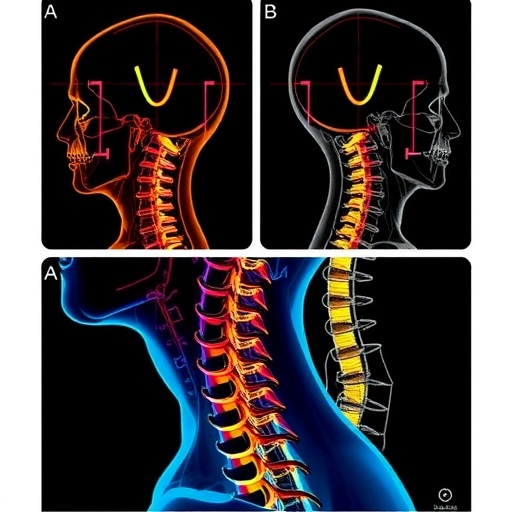
Cervical spondylosis, commonly referred to as age-related wear and tear of the cervical spine, affects a substantial proportion of the global population, especially those in their middle and later years. Its complex etiology, often involving degenerative changes in vertebrae, discs, ligaments, and neural elements, poses significant diagnostic challenges. Traditional diagnostic modalities rely heavily on expert interpretation of diverse imaging techniques such as MRI, CT scans, and X-rays, which may vary significantly in appearance and diagnostic yield, further complicated by interobserver variability.
The team led by Song, Li, and Ouyang recognized these challenges and sought to leverage the power of artificial intelligence to create a system that not only improves diagnostic accuracy but also streamlines clinical workflow. Their approach revolved around creating a deep learning architecture that simultaneously processes and integrates information from multimodal imaging inputs. This multi-task model was meticulously designed to capture the multifaceted features of cervical spondylosis, including bony changes, disc pathology, and neural compression, which often manifest distinctly across different imaging modalities.
Underlying this approach is the concept of multi-task learning, a machine learning paradigm where a single model is trained to perform multiple related tasks concurrently. In this context, the model was trained to simultaneously identify various pathological hallmarks of cervical spondylosis, a strategy that exploits the shared representations among these tasks to enhance overall performance and generalization. This contrasts with traditional models that typically focus on single-task learning, which may limit their applicability in complex clinical conditions characterized by heterogeneous manifestations.
The researchers curated a comprehensive dataset comprising thousands of patient scans from multiple imaging modalities, carefully annotated by a panel of experienced radiologists to ensure robust ground truth labels. Integrating these diverse datasets required sophisticated pre-processing pipelines and normalization techniques to reconcile differences in image resolution, contrast, and anatomical orientation, thereby facilitating effective learning by the neural network.
Architecturally, the model employed convolutional neural networks (CNNs) as the backbone for feature extraction, capitalizing on their proven efficacy in image recognition tasks. Beyond simple feature extraction, the network included specialized layers capable of fusing information from distinct modalities, an innovation critical to capturing the complex spatial and pathological interrelations evident in cervical spondylosis. Moreover, attention mechanisms were incorporated to dynamically prioritize salient features, enabling the model to focus on clinically relevant structures amid noisy backgrounds.
Once trained, the model demonstrated remarkable diagnostic accuracy, surpassing human experts and existing automated systems when evaluated on an independent test cohort. Notably, the multi-task design allowed the system to provide detailed diagnostic outputs, including identification of specific degenerative changes, assessment of stenosis severity, and prediction of potential neurological compromise. Such granularity empowers clinicians with actionable insights that inform personalized treatment planning, from conservative management to surgical intervention.
Equally important was the model’s efficiency and scalability. By integrating multiple diagnostic tasks into a single framework, the system reduced the computational and interpretive burden typically associated with multiple sequential analyses. This efficiency opens avenues for real-time or near-real-time diagnostic support in clinical settings, enhancing throughput and reducing patient wait times without sacrificing accuracy or detail.
The implications of this technology extend beyond cervical spondylosis alone. The research exemplifies how multimodal imaging and multi-task deep learning can be synergistically harnessed to tackle complex medical diagnoses characterized by heterogeneous pathological signatures. Adaptations of this model architecture could be envisaged for a variety of musculoskeletal conditions or other organ systems where multimodal data integration is paramount.
Nevertheless, the study’s authors acknowledge certain limitations and future directions. While performance on curated datasets was outstanding, real-world clinical deployment will require extensive validation across diverse populations and imaging protocols to ensure robustness and generalizability. Additionally, the “black-box” nature of deep learning systems prompts calls for enhanced interpretability and explainability, critical for gaining clinician trust and regulatory approval.
The researchers are actively exploring avenues to integrate longitudinal patient data and clinical variables alongside imaging inputs to further augment diagnostic accuracy and prognostic capabilities. Moreover, prospective studies assessing the impact of AI-augmented diagnosis on patient outcomes and healthcare resource allocation are underway, which could solidify the model’s role in routine clinical practice.
In an era increasingly defined by precision medicine, this innovative multi-task deep learning model embodies a significant stride toward automated, accurate, and comprehensive diagnosis of cervical spine disorders. Its capacity to synthesize complex multimodal data into clinically meaningful, actionable insights heralds a transformative shift in musculoskeletal care, one that empowers both clinicians and patients alike.
As imaging technologies continue to evolve and datasets grow in scale and diversity, the fusion of advanced computational models with clinical expertise promises to unlock new frontiers in diagnostic medicine. The reported breakthrough serves as a compelling testament to the potential of AI-driven tools to address longstanding challenges in diagnosis, treatment planning, and patient management in cervical spondylosis and beyond.
Ultimately, the convergence of deep learning innovation and multispectral medical imaging exemplified by this research nonetheless underscores an important tenet: technology’s greatest impact lies in its ability to augment human expertise, not replace it. By enhancing diagnostic precision through automation while maintaining clinician oversight and judgment, such advances pave the way for a future healthcare landscape that is more efficient, equitable, and personalized.
In summary, the study by Song, Li, Ouyang, and colleagues marks a milestone in applying AI to complex spinal disorders. Their multi-task deep learning model’s ability to assimilate and interpret multimodal imaging data with high fidelity and nuanced diagnostic output sets a new standard. It is poised to transform cervical spondylosis diagnosis, reduce clinical variability, and ultimately improve patient care, embodying the exciting promise of AI-powered medicine in the years ahead.
Subject of Research: Automated diagnosis of cervical spondylosis using multimodal medical imaging and multi-task deep learning.
Article Title: Automated diagnostic of cervical spondylosis on multimodal medical images with a multi-task deep learning model.
Article References:
Song, X., Li, Y., Ouyang, H. et al. Automated diagnostic of cervical spondylosis on multimodal medical images with a multi-task deep learning model. Nat Commun (2026). https://doi.org/10.1038/s41467-026-69023-w
Image Credits: AI Generated
Tags: age-related spinal conditionsAI in medical imagingartificial intelligence in radiologyautomated diagnosis of spinal disorderscervical spondylosis diagnosischallenges in diagnosing cervical spine conditionsclinical workflow optimization in healthcaredeep learning in healthcareimproving diagnostic accuracy with AImultimodal imaging techniquesneural network applications in medicinePrecision Medicine Advancements