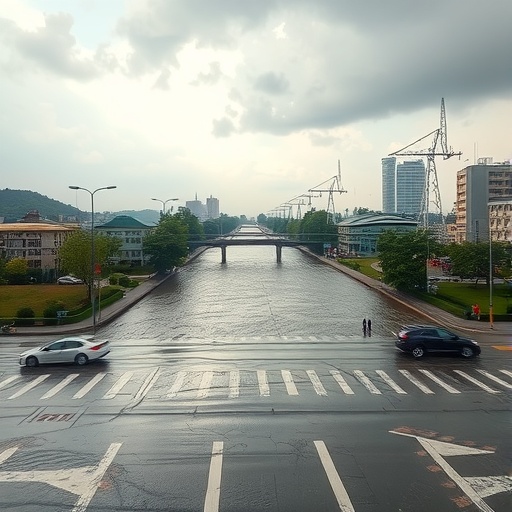
In a groundbreaking advancement at the intersection of hydrology and artificial intelligence, researchers have unveiled a novel approach to forecasting river flows that could revolutionize water management practices worldwide. This pioneering work leverages “foundation models,” a class of sophisticated AI models initially designed to process diverse time-series data across multiple domains, to predict streamflow with remarkable accuracy even in areas devoid of extensive local hydrological records. This breakthrough holds considerable promise for enhancing flood warnings, drought anticipation, and sustainable water-resource management in data-scarce regions, addressing a critical gap in traditional hydrological modeling frameworks.
The research, recently published in the esteemed journal Machine Learning: Earth, was conducted by an interdisciplinary team from The University of Texas at Austin in collaboration with Hydrotify LLC. Their study confronts a longstanding challenge in hydrology: the scarcity and discontinuity of river gauge data in many parts of the globe. Conventional forecasting models typically depend on long-term, high-fidelity hydrological records, which are often unavailable in remote or under-resourced regions. Recognizing this limitation, the team explored novel methodologies that transcend the constraints of localized data dependence by harnessing generalized AI models trained on vast troves of time-series data.
At the core of this research are time-series foundation models (TSFMs), an emerging class of AI architectures originally developed to interpret sequential data across various sectors such as energy consumption, transportation dynamics, and climatic variables. These models are characterized by their ability to learn generalized temporal patterns and representations from large-scale, heterogeneous datasets. The authors hypothesized that by fine-tuning or applying these TSFMs in a hydrological context, it would be possible to generate reliable streamflow forecasts — even in basins lacking direct measurement histories.
To empirically assess the potential of TSFMs in hydrology, the researchers curated an extensive dataset encompassing over 500 river basins across the United States. This comprehensive dataset provided the ideal testbed for evaluating the predictive prowess of TSFMs compared to traditional hydrological forecasting techniques. Among several models scrutinized, one known as Sundial emerged as particularly effective. This model’s performance approached that of a long-short-term memory (LSTM) neural network fully trained on decades of river flow data, a standard benchmark in hydrological modeling.
What is especially notable about the Sundial model’s performance is that it attained near-parity without the benefit of extensive local streamflow training data. This achievement marks a significant conceptual departure from conventional paradigms, demonstrating that AI architectures trained with broadly sourced, cross-domain time-series data can extrapolate meaningful hydrological patterns out-of-the-box. The model excelled in river basins displaying pronounced seasonal flow regimes, such as those driven by snowmelt, suggesting that cyclical hydrological processes provide a natural scaffold for transferring knowledge from generalized training to specific forecasting contexts.
Dr. Alexander Sun, a leading investigator on the project from The University of Texas at Austin and Hydrotify LLC, emphasized the societal impacts of these findings. He noted that reliable water information underpins community resilience and resource planning but lamented that many regions globally still lack the long-term monitoring infrastructure required for conventional forecasting. The implementation of AI-driven zero-shot forecasting techniques like those demonstrated by TSFMs could democratize access to predictive water data, empowering underserved regions with cutting-edge forecasting capabilities.
Despite these encouraging developments, the research team underscored the complexity of river systems that exhibit highly variable or anthropogenically altered flow regimes. While TSFMs show tremendous promise, they recognize that ongoing refinement is needed to navigate the nuances of geomorphologic diversity, non-stationary climatic influences, and human interventions such as dam operations or water diversions. Future research trajectories will involve integrating more specialized Earth system datasets into these foundational AI frameworks to enhance their contextual responsiveness and robustness.
A pivotal insight from the study is the scalable nature of TSFMs. The models’ predictive accuracy and utility are intimately tied to the volume and diversity of the training data they ingest. As the hydrological and Earth science communities increasingly contribute large, standardized datasets — including remote sensing observations, climate records, and hydrometric measurements — TSFMs are poised to improve dramatically. This collaborative data ecosystem will catalyze the evolution of successive AI model generations specifically optimized for environmental forecasting challenges.
An intriguing aspect of the study is its demonstration of AI’s growing capacity to generalize knowledge across domains. The foundational time-series models were not engineered solely for hydrology but were repurposed with success, highlighting AI’s versatility in tackling complex temporal phenomena. This represents a paradigm shift where cross-disciplinary AI tools act as accelerators for traditional scientific endeavors, enabling breakthroughs that were previously hampered by data scarcity or computational constraints.
The inclusion of an undergraduate student, Albert Sun, in the research team highlights the educational dimensions and future workforce development opportunities linked to AI-enhanced hydrological research. Engaging emerging scientists in this frontier field ensures the continuity of innovation and the translation of cutting-edge computational methods into actionable environmental solutions.
Looking forward, the integration of TSFMs with complementary data assimilation techniques, domain-specific physical models, and interpretability frameworks presents a fertile ground for enhancing both the accuracy and explainability of AI-driven flood and drought forecasting. Such integrated modeling pipelines promise to deliver timely, actionable insights vital for informed decision-making in water-sensitive sectors.
In conclusion, this landmark research serves as a testament to the transformative potential of foundational AI models in addressing pressing global water security challenges. By enabling zero-shot streamflow forecasting in data-poor regions, it paves the way toward more inclusive, resilient, and adaptive water-resource management frameworks worldwide. As climate variability intensifies hydrological extremes, innovations like these are indispensable for safeguarding communities and ecosystems reliant on reliable freshwater supplies.
Subject of Research: AI-driven hydrological forecasting utilizing time-series foundation models
Article Title: Zero-shot Forecasting of Streamflow Using Time Series Foundation Models: Are We There Yet?
News Publication Date: 20-Mar-2026
Web References: DOI: 10.1088/3049-4753/ae4982
Keywords
Hydrology, Artificial Intelligence, Time-Series Foundation Models, Streamflow Forecasting, Hydrological Modeling, Zero-Shot Learning, Climate Change, Water Resource Management, Flood Prediction, Drought Planning, Machine Learning, Earth Sciences
Tags: AI applications in remote water monitoringAI flood forecasting in data-scarce regionsAI-driven water resource managementdrought forecasting using artificial intelligenceenhancing flood warning systems with AIfoundation models for environmental time-seriesinterdisciplinary AI and hydrology researchmachine learning in flood risk managementovercoming hydrological data scarcityriver flow prediction without local datasustainable water security solutionstime-series foundation models for hydrology