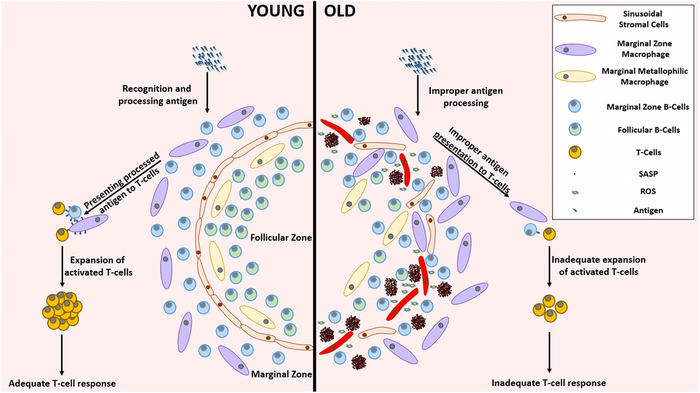
Aging-US published “Cellular senescence in lymphoid organs and immunosenescence” which reported that immunosenescence is a multi-faceted phenomenon at the root of age-associated immune dysfunction.
Credit: Correspondence to: Daohong Zhou email: [email protected]
Aging-US published “Cellular senescence in lymphoid organs and immunosenescence” which reported that immunosenescence is a multi-faceted phenomenon at the root of age-associated immune dysfunction.
Though both cellular senescence and immunosenescence have been studied extensively and implicated in various pathologies, their relationship has not been greatly explored. In the wake of an ongoing pandemic that disproportionately affects the elderly, immunosenescence as a function of age has become a topic of great importance.
The goal of this review is to explore the role of cellular senescence in age-associated lymphoid organ dysfunction and immunosenescence, and provide a framework to explore therapies to rejuvenate the aged immune system.
Dr. Daohong Zhou from The University of Florida said, “Aging is the gradual process of organismal deterioration which is associated with a multitude of age-related disorders and diseases that make one wonder if aging itself is a disease that needs to be addressed.”
A shadow is cast on the benefits of longevity if the elderly are faced with the possibility of a decline in their quality of life. The world currently has over 700 million people who are over the age of 65, a number that is projected to grow rapidly in the near future. As advancing age is strongly correlated to decreased quality of life and increased risk of several age-related diseases, these demographics seem more dismal in prospering countries, with the USA and the UK having about 16–18% of their population over the age of 65.
The silver lining to this otherwise tragic situation is that results from recent studies indicate that the aging process and the pace of organismal deterioration is malleable and can be influenced greatly by physiological, genetic, dietary and pharmaceutical interventions.
The Zhou Research Team concluded in their Aging-US Research Output, “The increasing array of genetic models of SnC clearance along with a growing panel of senolytic and senostatic agents, provide a unique opportunity for scientists to answer these questions to lay a strong foundation to this new avenue of research in immunosenescence. Ultimately, gaining a deeper understanding of the interaction between cellular senescence and immunosenescence will help in the development of improved therapeutics that will aid in the conservation of our vitality as we age.”
Full Text – https://www.aging-us.com/article/203405/text
Correspondence to: Daohong Zhou email: [email protected]
Keywords: cellular senescence, immunosenescence, immune senescence, senescence associated secretory phenotype (SASP), thymus
About Aging-US
Launched in 2009, Aging-US publishes papers of general interest and biological significance in all fields of aging research as well as topics beyond traditional gerontology, including, but not limited to, cellular and molecular biology, human age-related diseases, pathology in model organisms, cancer, signal transduction pathways (e.g., p53, sirtuins, and PI-3K/AKT/mTOR among others), and approaches to modulating these signaling pathways.
To learn more about Aging-US, please visit http://www.Aging-US.com or connect with @AgingJrnl
Aging-US is published by Impact Journals, LLC please visit http://www.ImpactJournals.com or connect with @ImpactJrnls
Media Contact
18009220957×105
[email protected]
Journal
Aging-US
DOI
10.18632/aging.203405
Article Title
Cellular senescence in lymphoid organs and immunosenescence