In a prospective observational investigation conducted at an African tertiary academic medical center, surgical researchers have documented the initial clinical implementation and perioperative outcomes of the Versius robotic surgical platform across a consecutive series of forty-five patients undergoing intervention for urologic malignancies. The investigation, published in the African Journal of Urology, established that integrating this next-generation modular robotic system into specialized oncologic practice is technically feasible and achieves acceptable early perioperative safety benchmarks during institutional introduction. Across the full study cohort, which comprised six distinct surgical procedure types, the overall postoperative complication rate was 22.2 percent, with major complications occurring in 6.7 percent of cases. Furthermore, as surgical and nursing teams accumulated operational experience with the modular hardware, procedural efficiency showed measurable improvements, including a statistically significant reduction in robotic docking times during the second half of the study period.
The clinical evaluation addresses a critical disparity in the global diffusion of advanced minimally invasive surgical technology, where robotic platforms remain scarce across low- and middle-income regions, including many healthcare environments throughout the African continent. Historical adoption patterns have been heavily constrained by substantial capital acquisition investments, recurring maintenance expenses, and extensive physical infrastructure prerequisites associated with established systems such as the da Vinci platform. Although robot-assisted techniques have become standard clinical approaches in international urologic oncology for radical prostatectomy and complex pelvic or renal resections, cost barriers have restricted regional access to a small number of specialized tertiary centers. The introduction of alternative modular platforms designed with adaptable hardware profiles presents a potential pathway for expanding minimally invasive urologic cancer care within resource-constrained healthcare environments, underscoring the necessity of structured real-world clinical evidence from African tertiary centers to guide institutional planning, technical training pathways, and future health economic assessments.
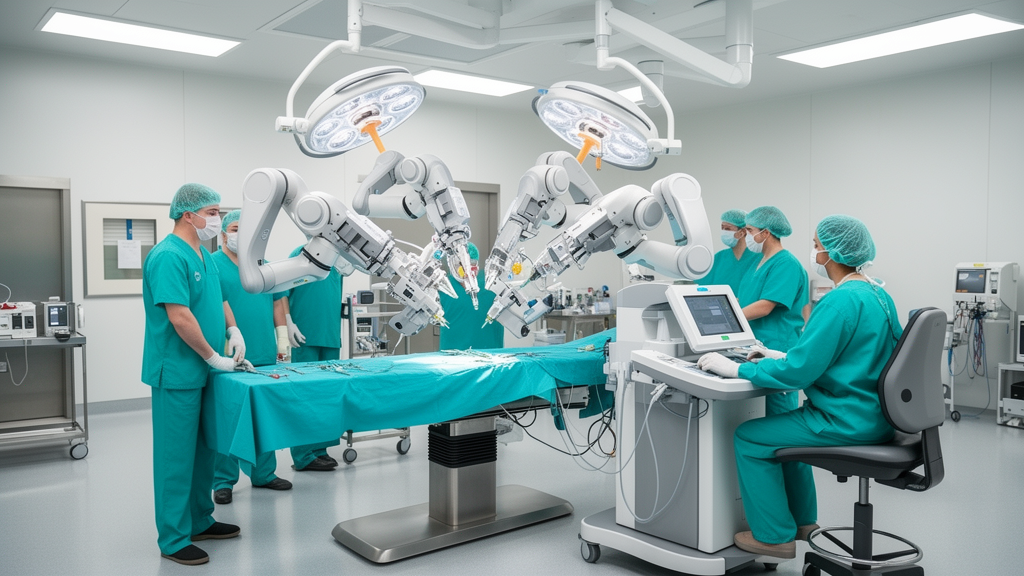
Manufactured by CMR Surgical in Cambridge, United Kingdom, the Versius robotic system differs structurally from legacy single-cart platforms by employing an open surgeon console paired with independent, transportable bedside units that can be configured flexibly around the operating table. In the tertiary center’s operating rooms, surgical setups were customized according to procedure type: pelvic interventions, including radical prostatectomy and radical cystectomy, utilized five transabdominal ports and four bedside units including the dedicated visualization unit, while upper urinary tract operations utilized three bedside units alongside one or two auxiliary bedside assistant access ports.
Conducted prospectively within the Urology Department of a tertiary university hospital between May 2023 and May 2024, the observational study enrolled forty-five consecutive adult patients presenting with suspected or confirmed urologic neoplasms who were deemed suitable candidates for minimally invasive robotic surgery. Patient recruitment adhered to strict ethical review board approval and documented informed consent, while individuals presenting with emergency surgical indications or absolute clinical contraindications to laparoscopic or robotic approaches were excluded from participation. The primary objective of the investigation focused on perioperative safety, quantified systematically by recording all intraoperative adverse events and classifying postoperative complications across the inpatient stay according to the internationally validated Clavien–Dindo system. Secondary clinical endpoints encompassed precise measurements of robotic docking duration, active console operating time, overall operative duration, intraoperative blood loss volume, perioperative transfusion requirements, unintended conversions to alternative surgical modalities, and total hospital length of stay.
Baseline demographic and pre-existing clinical health profiles demonstrated a diverse oncologic patient population managed under real-world clinical referral conditions rather than highly selected introductory trial criteria. The forty-five patients included thirty-nine male individuals, representing 86.7 percent of the cohort, and six female patients, with an overall mean cohort age of 58.9 ± 11.9 years spanning an age range from 21 to 76 years. The average body mass index of the cohort was calculated at 27.9 ± 5.1 kilograms per square meter, reflecting an overweight average baseline, while the mean Charlson Comorbidity Index was established at 4.2 ± 1.5. Major pre-existing chronic conditions documented across the participant population included systemic hypertension in twelve patients, diabetes mellitus in eleven individuals, and established cardiovascular disease in seven patients, illustrating substantial baseline medical complexity among candidates undergoing initial modular robotic oncologic resections during the platform’s maiden operational year.
The surgical volume undertaken during the twelve-month evaluation spanned a broad range of pelvic and retroperitoneal urologic oncologic procedures reflecting varied anatomical complexity and reconstructive demands. Radical prostatectomy represented the most frequently performed robotic intervention, accounting for twenty-six cases or 57.8 percent of the institutional caseload, followed by partial nephrectomy, which was completed in eight patients representing 17.8 percent of the series. More complex extirpative operations included five radical cystectomies, comprising 11.1 percent of procedures, three radical nephrectomies representing 6.7 percent, two nephroureterectomies accounting for 4.4 percent, and one robot-assisted adrenalectomy representing 2.2 percent of the institutional experience. Surgical techniques across all procedural categories followed standardized published operative methodologies, adapting established robotic steps to the modular bedside arm geometry while case selection during platform roll-out relied on multidisciplinary tumor board evaluation and operating surgeon discretion without rigid procedural exclusion criteria.
Evaluation of clinical safety parameters demonstrated an acceptable early complication profile consistent with published international implementation benchmarks for novel robotic hardware. Postoperative adverse events occurred in ten of the forty-five patients, yielding an overall complication rate of 22.2 percent, with the vast majority representing minor, low-grade deviations managed conservatively without invasive procedural re-intervention. Major postoperative complications, defined under the Clavien–Dindo classification as grade III or higher, were documented in three patients, representing 6.7 percent of the treated population. Blood transfusions were administered strictly according to standardized institutional transfusion triggers, initiated only when postoperative hemoglobin concentrations declined below 8 grams per deciliter or when hemodynamic instability developed intraoperatively. Routine physiological monitoring demonstrated that perioperative hemoglobin reductions and serum creatinine variations across all surgical subgroups remained within expected and clinically acceptable limits following extirpative and reconstructive maneuvers.
Intraoperative conversions from the robotic platform to conventional laparoscopic surgery or open abdominal exploration were documented in six of the forty-five procedures, representing an overall institutional conversion frequency of 13.3 percent. These conversion events clustered almost entirely during the earliest phases of platform adoption and reflected proactive decisions undertaken to preserve patient safety rather than catastrophic structural failure. Among the twenty-six patients undergoing radical prostatectomy, conversion to standard laparoscopy was required in three cases, representing 11.5 percent, due to hardware communication difficulties and repetitive console warning alarms, while conversion to open laparotomy occurred in one case, representing 3.8 percent, following an acute mesenteric vein laceration sustained during initial laparoscopic port insertion that required emergent surgical hemostasis. Within the partial nephrectomy series, one operation was converted to open surgery due to severe anatomical exposure limitations involving an upper-pole posterior renal tumor, and another case was converted to laparoscopy following console alerts.
Detailed operative metrics for the primary prostatectomy cohort highlighted tangible efficiency gains as surgical teams adapted to the nuances of independent bedside arm alignment and console maneuvering. Across all twenty-six radical prostatectomy procedures, the mean total operative time was recorded at 307.8 ± 84 minutes. To evaluate the learning curve, investigators conducted a temporal subgroup analysis comparing thirteen patients operated on during the initial six months against thirteen patients treated during the subsequent six months. Robotic docking time decreased significantly from an average of 21.2 minutes in the first half to 15.5 minutes in the second half, achieving statistical significance with a p-value of 0.046. Furthermore, active console time exhibited a notable downward trajectory from 302.4 minutes down to 237.6 minutes, approaching statistical significance at p equals 0.057, despite the second cohort presenting with comparable baseline body mass, prostate volume, and surgical complexity.
Surgical outcomes across upper urinary tract and adrenal interventions demonstrated acceptable technical feasibility and histopathological accuracy despite small individual cohort sizes. Among the eight patients who underwent robot-assisted partial nephrectomy, final histopathologic evaluation confirmed renal cell carcinoma in four patients, multilocular cystic renal neoplasms of low malignant potential in two individuals, and benign renal lesions in two patients, with a solitary positive surgical margin identified in 12.5 percent of cases. The single robot-assisted adrenalectomy was completed for a five-centimeter left adrenal mass with an operative duration of 135 minutes and an estimated intraoperative blood loss of 100 milliliters. This patient experienced a serious Clavien–Dindo grade IVa postoperative complication involving acute cardiac arrhythmia requiring transfer to the intensive care unit for specialized monitoring, followed by successful stabilization and discharge on postoperative day four, with final histopathology confirming a benign adrenocortical adenoma.
The authors framed these initial observations within the IDEAL stage 1/2a surgical innovation framework, emphasizing that technical alarms and initial conversion rates are recognized early challenges that resolve as surgical teams standardize modular workflows. Important study limitations include the single-center design, small sample size of forty-five patients, lack of a comparative control group, and absence of long-term oncologic follow-up. The researchers concluded that larger prospective multicenter investigations are necessary to confirm oncologic durability and define the long-term clinical role of modular robotic platforms across Africa.
Subject of Research: Early implementation and perioperative safety of the Versius robotic surgical platform in urologic oncology at an African tertiary center
Article Title: Early implementation of the versius robotic platform in urologic oncology: a prospective experience from an African tertiary center
Article References: Rady Saad, I., Assem, A., Hesham Agamy, M., Abdullah Ashmawy, A., & Mursi Hammoud, K. (2026). Early implementation of the versius robotic platform in urologic oncology: a prospective experience from an African tertiary center. African Journal of Urology, 32(1), Article 29. https://doi.org/10.1186/s12301-026-00581-7
Image Credits: AI Generated
DOI: 10.1186/s12301-026-00581-7
Keywords: Versius robotic platform, CMR Surgical, urologic oncology, radical prostatectomy, partial nephrectomy, radical cystectomy, radical nephrectomy, nephroureterectomy, adrenalectomy, Clavien-Dindo complications, docking time, console time, surgical conversion rate, IDEAL framework, modular surgical robots, African tertiary healthcare
News Source: Ophelia Keating. (November 11, 2026). African Tertiary Center Reports Initial Outcomes with Versius Robotic Urologic Surgery. Scienmag.