Aeroengine turbine blades endure severe thermal, mechanical, and environmental strain during operational service, accumulating damage that routinely demands repair or complete remanufacturing. A comprehensive literature synthesis published in Discover Materials evaluates current repair options, systematically examining established joining and coating technologies alongside laser-based additive repair and emerging repair materials. By evaluating published findings on damage mechanisms, processing parameters, microstructural evolution, defect formation, post-processing treatments, and claimed performance, the review highlights critical factors that govern superalloy restoration.
The literature analysis reveals that final repair outcomes depend directly on complex metallurgical interactions between the substrate alloy, the added repair material, and the operational heat input. Factors including material dilution, solidification behavior, and post-repair heat treatment fundamentally dictate microstructural development and defect generation within restored zones.
Crucially, repair strategies cannot rely on a single, universal process across diverse aeroengine components. Conventional joining techniques and additive methods each provide specific engineering benefits depending on the physical location of the damage, the complex geometry of the turbine blade, and the metallurgical compatibility of the materials involved.
To address demanding operating environments, researchers are investigating emerging repair materials including modified interlayers, composite additions, and high-entropy alloys. While these emerging materials offer promising potential, the review emphasizes that their suitability for service-representative turbine-blade repairs requires extensive additional evaluation. Furthermore, repairing single-crystal and directionally solidified superalloys introduces stringent technical demands, necessitating particular focus on preserving crystallographic continuity and avoiding adverse repair-induced microstructural alterations.
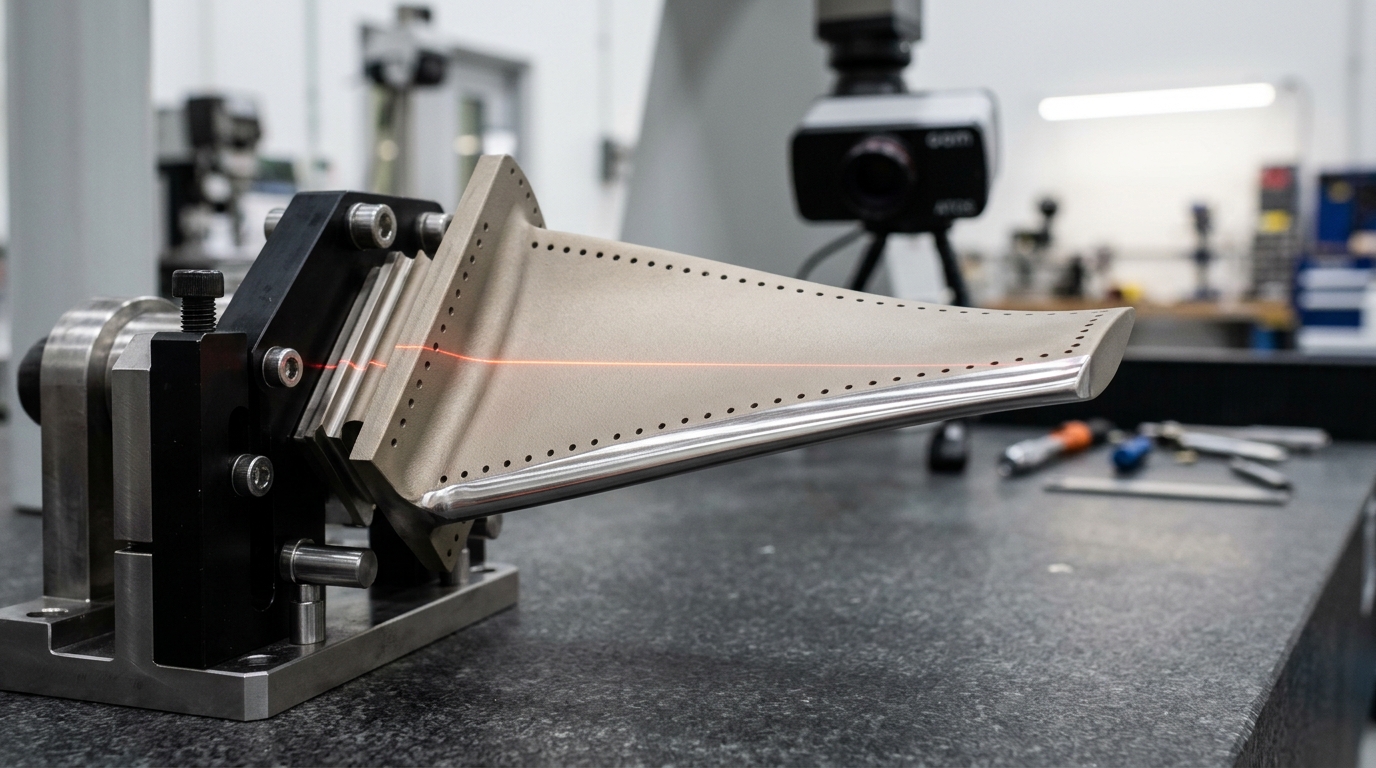
To bridge laboratory research and industrial practice, the authors propose a structured, component-based framework that integrates initial damage assessment and process selection with dimensional verification, non-destructive inspection, and component qualification. However, widespread technological comparison remains hindered by significant disparities in published literature. Experimental circumstances, specimen geometries, and reporting standards vary widely between individual studies, preventing researchers from conducting direct cross-study comparisons or drawing universal performance conclusions.
Critical evaluations of operational readiness are further constrained by a lack of long-term service data and restricted access to proprietary industry acceptance standards. Consequently, the authors caution that reported laboratory outcomes and research-stage performance targets should never be construed as universal acceptability thresholds or definitive evidence of airworthiness. Future research must prioritize rigorous, component-specific validation programs that systematically evaluate fatigue performance, creep life, environmental oxidation resistance, protective coating compatibility, dimensional correctness, and repeatable inspection capabilities.
Subject of Research: Repair and remanufacturing technologies for superalloy aeroengine turbine blades
Article Title: A critical review on repair and remanufacturing of superalloy aeroengine turbine blades covering microstructural evolution, defect mechanisms, and advanced joining technologies
Article References: S, A., & M, R. (2026). A critical review on repair and remanufacturing of superalloy aeroengine turbine blades covering microstructural evolution, defect mechanisms, and advanced joining technologies. Discover Materials. https://doi.org/10.1007/s43939-026-01070-y
Image Credits: AI Generated
DOI: 10.1007/s43939-026-01070-y
Keywords: superalloys, aeroengine turbine blades, remanufacturing, additive repair, laser-based repair, microstructural evolution, defect mechanisms, joining technologies, single crystal superalloys, directionally solidified superalloys, high-entropy alloys, crystallographic continuity, post-repair heat treatment, damage assessment, dimensional verification, airworthiness qualification, creep resistance, fatigue validation
News Source: Denise Maddox. (November 29, 2026). Aeroengine Turbine Blade Repair Requires Tailored Techniques and Component Specific Testing. Scienmag.