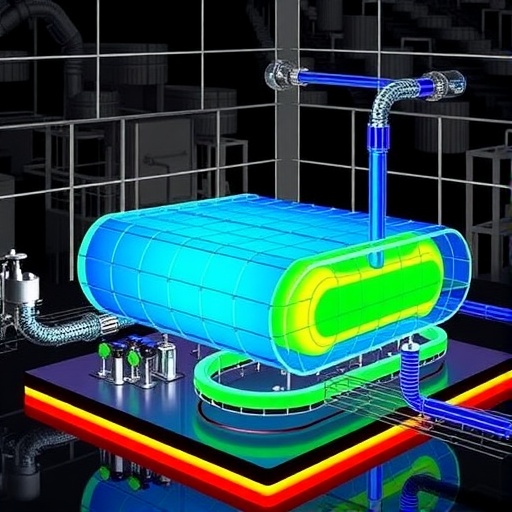
In the global pursuit to combat climate change, the conversion of carbon dioxide (CO₂) into valuable chemicals, such as methanol, stands as a beacon of sustainable innovation. Methanol synthesis, a reaction known for its highly exothermic nature, has traditionally relied on multi-tubular fixed-bed reactors cooled by shell-side heat exchangers to maintain safe operational temperatures. However, the expansion of production capacity brings forth new challenges: excessive heat losses, amplified cooling requirements, and soaring capital investments. To address these constraints, scientists are exploring autothermal reactor designs—reactors capable of using the heat generated by the reaction itself to preheat reactants or feed downstream processes. Although autothermal reactors have demonstrated success in strongly exothermic reactions, their adaptation to the relatively mild exotherm of CO₂-to-methanol hydrogenation remains an untapped frontier.
A pioneering review from researchers at Shanghai Jiao Tong University, recently published in Frontiers of Chemical Science and Engineering, sheds light on the intricacies of engineering autothermal reactors for CO₂ hydrogenation to methanol. This comprehensive analysis uncovers three significant scientific and engineering challenges: the complexities of multiscale modeling, intrinsic operational multi-stability, and formidable obstacles encountered during scale-up from laboratory to industrial scales.
The first challenge revolves around the intricate nature of multiscale modeling. Catalytic autothermal reactors involve phenomena unfolding simultaneously across varying length scales—from microscopic catalyst particles to the entire reactor system. Predicting local temperature fields and concentration gradients is critical because the CO₂-to-methanol process operates near chemical equilibrium with minimal single-pass conversion and only a weak exothermic footprint. Traditional modeling approaches leverage porous-media frameworks that facilitate computational efficiency; however, the accuracy of these models hinges on precise transport parameters. Obtaining such parameters often demands particle-resolved simulations that offer high accuracy but at an untenable computational expense when scaled to reactors of industrial dimensions. Currently, most studies tackle scale-bridging by coupling only two of three critical scales—particle, bed, and reactor—leaving comprehensive multiscale integration in its nascent stages.
The second challenge surfaces from the reactor’s operational multi-stability. The reaction heat generated during methanol synthesis exhibits strong nonlinearity with respect to temperature, governed by Arrhenius kinetics. Heat removal, conversely, increases approximately linearly with temperature. This mismatch creates multiple possible operating states: the reactor can be in an extinction state (where the reaction ceases), an unstable intermediate region prone to oscillations or uncontrolled temperature excursions, or a fully ignited state sustaining the desired reaction heat. This multi-stable behavior poses serious control challenges. Reactor startup and ongoing adjustments in flow rates or feed composition can abruptly shift the system between these states. Moreover, operational disturbances exacerbate the difficulty of maintaining the reactor within the safe, productive regime necessary for efficient methanol synthesis.
Scaling up from laboratory bench-top reactors to industrial-scale systems reveals the third formidable hurdle. Laboratory experiments commonly employ shorter reactor tubes exhibiting near-ideal temperature profiles fueled by steady heat removal predominantly through convective gas flow. However, real-life industrial reactors typically consist of longer tubes where significant radial and axial temperature gradients evolve. These gradients can stifle the ability of the reaction to sustain the required temperature, especially given the modest heat release inherent in CO₂ hydrogenation. Despite preheating efforts, certain sections of the reactor may sustain ignition, while others falter below critical thresholds, resulting in heterogeneous reaction zones and compromised overall performance.
Confronted with these complex hurdles, the Shanghai Jiao Tong team proposes a transformative melding of Virtual Twins and Digital Twins to chart a path forward. Virtual Twins enable detailed, multiscale simulation of reactor phenomena by integrating particle-scale catalytic kinetics, bed-scale transport dynamics, and reactor-scale thermal management into a cohesive digital model. These models can efficiently generate surrogate models that approximate reactor behavior with reduced computational demand, facilitating faster optimization and scenario testing.
Meanwhile, Digital Twins harness real-time operational data from sensors embedded within actual reactors, feeding this data back into the Virtual Twin’s simulations. This dynamic feedback loop updates the model parameters continuously, capturing deviations from idealized lab conditions such as catalyst deactivation, feed fluctuations, or thermal disturbances. This real-time integration empowers predictive analysis and robust control algorithms, safeguarding stable autothermal operation despite the inherent multi-stability.
Together, this dual approach—combining predictive computational frameworks with data-driven operational intelligence—holds immense promise. It paves a bridge from conceptual demonstrations to industrial-scale deployment of autothermal CO₂ hydrogenation reactors capable of efficient, self-sustaining methanol production. This integrated methodology not only addresses multiscale modeling gaps but also resolves operational uncertainties and scale-up complications that have long stymied progress.
Critically, this research underscores the unique challenges posed by weakly exothermic reactions which defy conventional scaling laws developed for strongly exothermic systems. The subtle interplay of thermal inertia, spatial gradients, and nonlinear reaction kinetics necessitates bespoke engineering solutions, departing from standard reactor design heuristics. Moreover, it elevates the role of advanced computational tools and big data analytics in chemical reactor design—a paradigm shift towards smarter, adaptive manufacturing processes.
Autothermal reactor concepts, when fully realized, offer significant environmental and economic advantages. By reusing reaction heat internally or deploying it productively, they promise substantial reductions in external heating energy requirements and cooling loads, translating into lower operational costs and smaller carbon footprints. This innovation can accelerate the global transition towards a methanol economy, where CO₂ emissions are recycled into versatile chemicals and fuels, closing the carbon loop.
In conclusion, the research from Shanghai Jiao Tong University represents a critical milestone in the quest to unlock autothermal technology for CO₂-to-methanol synthesis. Through a meticulous and multidisciplinary examination of multiscale modeling intricacies, kinetic and thermal operational dynamics, and scale-up realities, it reveals both the hurdles and the roadmap ahead. By harnessing the cutting-edge tools of Virtual and Digital Twins, the chemistry and engineering communities edge closer to scalable, efficient, and sustainable methanol production from carbon dioxide, positioning this technology at the forefront of climate change mitigation efforts.
Subject of Research: Not applicable
Article Title: Multiscale modeling, operational, and scale-up challenges in autothermal CO2 hydrogenation reactors
News Publication Date: 15-Mar-2026
Web References: 10.1007/s11705-026-2644-8
References: Information not provided
Image Credits: HIGHER EDUCATION PRESS
Keywords
CO₂ hydrogenation, methanol synthesis, autothermal reactors, multiscale modeling, operational stability, scale-up challenges, catalytic reactors, reaction kinetics, virtual twins, digital twins, chemical engineering, climate change mitigation
Tags: advances in autothermal reactor engineeringautothermal CO2-to-methanol reactorscapital investment reduction in chemical plantscatalytic reactor design for CO2 conversionCO2 hydrogenation process optimizationexothermic reaction heat managementheat integration in chemical reactorsmulti-stability in reactor operationmultiscale modeling in chemical reactorsoperational challenges in methanol synthesisscale-up challenges in chemical engineeringsustainable methanol production technologies