A comprehensive pharmaceutical review in Discover Pharmaceutical Sciences has evaluated modern delivery technologies designed to overcome the severe pharmacokinetic limitations of norepinephrine, an essential neurotransmitter governing cardiovascular stability and vascular tone. First isolated by Ulf von Euler in 1946 following Jokichi Takamine’s 1901 isolation of adrenaline, norepinephrine is synthesized from dopamine by dopamine beta-hydroxylase within adrenal medulla and sympathetic nerve endings. Following calcium-triggered exocytosis, the compound binds alpha-1, alpha-2, beta-1, beta-2, and beta-3 adrenergic receptors, stimulating peripheral vasoconstriction, elevated arterial blood pressure, cardiac inotropy, and metabolic glycogenolysis. When administered intravenously to manage fluid-refractory hypotension, norepinephrine reaches steady state within five minutes but undergoes rapid enzymatic breakdown by monoamine oxidase and catechol-O-methyltransferase into dihydroxymandelic acid and normetanephrine. This intense metabolism produces a circulation half-life of only two minutes, requiring continuous intravenous infusion and prompting intense development of stabilized formulations and intelligent infusion systems.
The commercial evolution of norepinephrine reflects persistent efforts to resolve chemical instability and operational hazards associated with bedside vial dilution. Hospira gained initial Food and Drug Administration approval in 1982 for Levophed, formulated as norepinephrine bitartrate equivalent to one milligram base per milliliter. This formulation required sodium chloride for isotonicity, sodium metabisulfite to prevent oxidative degradation, and an acidic pH between 3.0 and 4.5, offering twenty-four hours of stability at 20 to 25 degrees Celsius after dilution in five percent dextrose or saline. While patent expirations fostered widespread generic manufacturing through abbreviated applications by Meitheal, Hikma, Baxter, Mylan, Sandoz, and Fresenius Kabi, recent approvals introduced premixed infusion bags. These ready-to-use products include norepinephrine bitartrate in five percent dextrose at concentrations of 16, 32, and 64 micrograms per milliliter buffered to pH 3.5 to 3.9, and saline formulations stabilized with edetate disodium dihydrate to chelate catalytic metal ions at pH 3.4 to 4.5.
Rigorous clinical trials have evaluated norepinephrine against phenylephrine for preventing spinal-induced hypotension during cesarean deliveries, avoiding reflex bradycardia. A randomized, double-blinded trial by Mujahid and colleagues evaluated 95 parturients under spinal anesthesia, determining that norepinephrine achieved hemodynamic stability equivalent to phenylephrine while completely eliminating maternal bradycardia, which occurred in zero percent of norepinephrine patients compared to 19.15 percent receiving phenylephrine. Umbilical cord blood gas parameters demonstrated comparable neonatal safety between groups. Similarly, a randomized controlled trial by Ravichandrane and colleagues enrolled 130 women, comparing prophylactic norepinephrine infusions at 5 micrograms per minute against phenylephrine at 25 micrograms per minute. Hypotension incidence was comparable at 26.10 percent for norepinephrine versus 33.80 percent for phenylephrine, confirming non-inferiority. Further validating these outcomes, Vallejo and coworkers established hemodynamic parity across 85 parturients receiving fixed-rate infusions, while Ngan Kee and colleagues documented neonatal safety via non-inferior umbilical arterial pH across 668 obstetric deliveries.
Vascular route selection represents another crucial domain where clinical practice is actively evolving to balance delivery efficacy against catheter complications. While central venous catheters remain standard for administering concentrated vasopressors to protect small vessels from extravasation and ischemic necrosis, they introduce substantial hazards of microbial colonization, catheter-related bloodstream infections, and venous thrombosis. To address these burdens, Powell and colleagues investigated peripheral intravenous administration across 124 patients, demonstrating that dedicated peripheral access successfully avoided central catheterization in 36 out of 98 individuals. Expanding on this approach, Groetzinger and associates implemented a prospective peripheral protocol in a quaternary medical intensive care unit between 2019 and 2020. Among 87 patients receiving low-concentration peripheral infusions, 44 individuals (51 percent) never required central line placement throughout their stay. Adverse events occurred in only three patients (3 percent), and none were serious or required phentolamine antidote administration, illustrating peripheral feasibility under controlled monitoring protocols.
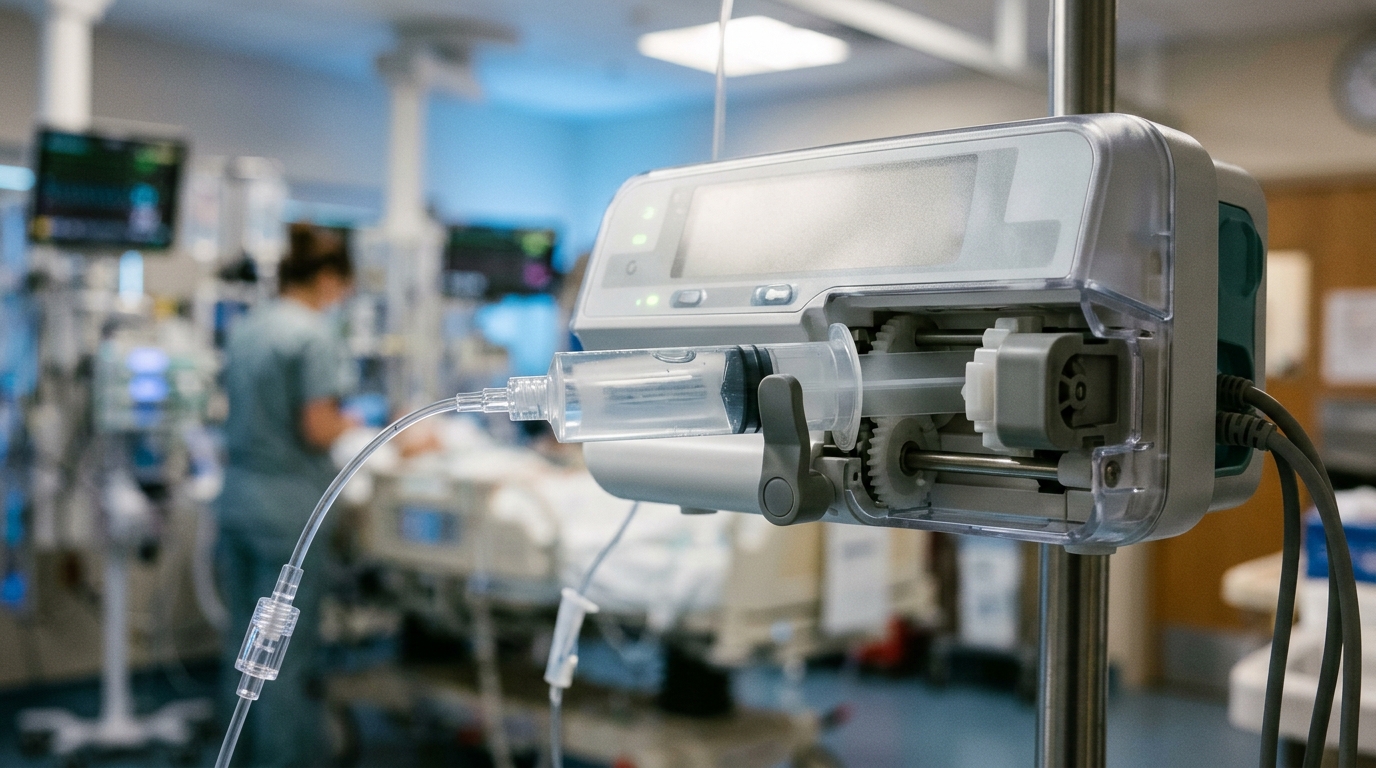
Beyond manual infusion adjustments, automated and closed-loop delivery architectures have refined hemodynamic stability and dosing accuracy. Sasaki and colleagues designed a computer-controlled closed-loop infusion system utilizing a proportional-integral-derivative controller to manage isoflurane-induced hypotension in six laboratory beagle dogs. Titrating intravenous norepinephrine every two seconds to target a mean arterial pressure of 60 mmHg, the system counteracted abrupt increases in isoflurane from 1.5 to 4 percent; arterial pressure recovered rapidly to 58 mmHg and remained within 55 to 65 mmHg for 96 percent of the final test period. In clinical environments, Desebbe and coworkers evaluated closed-loop vasopressor administration in 40 postcardiac surgery intensive care patients. Automated titration maintained target mean arterial pressure between 65 and 75 mmHg for 95 percent of the observation period, compared to 66 percent under standard care, while reducing hypotensive episodes from 12.5 to 1.4 percent. Baykuziyev’s team further confirmed surgical efficacy across abdominal operations, maintaining systolic pressure within 10 percent of target for over 90 percent of procedural time.
At the nanoscale, advanced formulation science is investigating engineered carriers to stabilize norepinephrine and achieve controlled delivery kinetics. At the quantum mechanical level, Faris and colleagues performed density functional theory calculations using B3LYP with LANL2DZ basis sets for zinc and 6-31G+(d,p) for other atoms on pristine, lithium-doped, and sodium-doped Zn12O12 nanocages. The gas-phase NE@Zn12O12 nanohybrid achieved an adsorption energy of -25.82 kcal/mol, with natural bond orbital and electron localization function analyses validating significant charge transfer. Nanotechnology has also enabled receptor-targeted chemotherapy; Karakus and coworkers engineered PLGA-PEG nanoparticles conjugated with benzylguanidine to exploit the norepinephrine transporter, resulting in 60 percent higher paclitaxel accumulation within murine neuroblastoma tumors compared to non-targeted particles. Concurrently, Ishida and coworkers established active catecholamine loading into phosphatidylcholine liposomes driven by transmembrane pH gradients from 0 to 5 units. At external pH 9, encapsulation efficiencies reached 88 percent for norepinephrine and 70 percent for epinephrine, producing internal drug concentrations 43-fold and 34-fold greater than external media.
Polymeric depot systems and biological encapsulation strategies offer further promise for sustained neurotransmitter delivery. Lu and colleagues fabricated microcapsules featuring polynorepinephrine shells via oil-in-water emulsion templating, demonstrating the chemical utility of catecholamine polymerization to achieve pH-responsive cargo release using Nile red. Expanding into tissue engineering, Martins and associates synthesized a thermoresponsive hydrogel based on poly(N-vinylcaprolactam) through free-radical polymerization. Exhibiting a glass transition temperature of 194 degrees Celsius and a lower critical solution temperature of 34 degrees Celsius, the polymer undergoes sol-to-gel transition at physiological body temperature. Proton nuclear magnetic resonance confirmed dipolar coupling between norepinephrine and the polymer backbone, which shielded the drug against degradation while releasing 80 percent of encapsulated payload within 24 hours and 87 percent within 72 hours, enhancing tubulogenesis in endothelial cell spheroids. In cell encapsulation, Jeon and colleagues enclosed human chromaffin cells in alginate-poly-L-lysine-alginate microcapsules. Intrathecal implantation in neuropathic pain rats sustained catecholamine release, significantly alleviating cold allodynia in acetone testing through naloxone-reversible pathways.
Prodrug engineering and alternative delivery pathways represent further frontiers intended to improve bioavailability and eliminate continuous intravenous lines. Yoosefian and coworkers utilized density functional theory with the WB97XD functional and 6-311G(d) basis sets alongside aqueous molecular dynamics simulations to evaluate carboxylated single-walled carbon nanotubes as carriers for Droxidopa, an established norepinephrine prodrug. The system demonstrated chemisorption with an adsorption energy of -0.714 electronvolts, suggesting improved nanotube dispersibility and bioavailability. In chronic ambulatory settings, implantable infusion pumps surgically placed under abdominal skin have delivered continuous infusions, as demonstrated by Oldenburg and colleagues in six patients with chronic orthostatic hypotension without complications. Non-invasive routes continue to encounter serious physiological hurdles. Subcutaneous administration risks severe local vasoconstriction and ischemic tissue necrosis, illustrated by a 2025 canine extravasation managed with subcutaneous phentolamine. Bolus intramuscular injections lack precise titratability for acute shock, while intranasal delivery remains constrained because hydrophilic norepinephrine exhibits poor mucosal permeability compared to lipophilic compounds.
Clinical deployment of norepinephrine demands rigorous vigilance due to severe toxicity risks arising from potent adrenergic stimulation. Local extravasation can trigger intense tissue ischemia leading to skin blanching, ulceration, and necrosis that requires rapid antidote intervention with phentolamine or topical nitroglycerin. Systemically, excessive titration risks hypertension, intracranial hemorrhage, cardiac tachyarrhythmias, and peripheral limb gangrene in compromised vascular beds. In comparative clinical trials for septic shock, Gordon and colleagues evaluated 409 patients across 205 individuals allocated to early vasopressin and 204 to norepinephrine (average age 66 years, 58.2 percent male). Early vasopressin failed to increase kidney failure-free days and yielded 22 major adverse events compared to 17 with norepinephrine. Sepsis guidelines therefore maintain norepinephrine as the primary first-line vasopressor. Dopamine is not recommended due to arrhythmogenic risks, epinephrine remains second-line due to cardiac and metabolic side effects, vasopressin serves as an adjunct to avoid dose escalation, selepressin and terlipressin are avoided due to digital ischemia, and angiotensin II remains unrecommended.
Accurate quantification and monitoring remain essential to evaluating novel formulations and guiding therapy. High-performance liquid chromatography coupled with electrochemical detection provides standard quantification by measuring current from catechol oxidation, while fluorescence detection requires derivatization to analyze norepinephrine alongside normetanephrine, vanillylmandelic acid, and homovanillic acid. Liquid chromatography-tandem mass spectrometry enables profiling at picogram-per-milliliter concentrations in plasma, urine, and cerebrospinal fluid, though sample complexity demands protein precipitation, extraction, and acidification to prevent rapid ex vivo oxidative breakdown. Complementing laboratory instrumentation, miniaturized electrochemical and optical biosensors are emerging for continuous point-of-care tracking. These analytical advances align with expanding clinical research, including telemedicine models documented across 27 studies and 21,006 heart failure patients by Fatrin and colleagues, and an active Phase III trial (NCT06059144) evaluating dilute peripheral norepinephrine for acute ischemic stroke with early neurological deterioration. Together with artificial intelligence algorithms and targeted prodrug matrices, these interdisciplinary developments continue to refine norepinephrine delivery, transforming acute critical care and autonomic medicine.
Subject of Research: Pharmaceutical formulations and closed-loop delivery technologies for norepinephrine administration
Article Title: Unlocking norepinephrine potential innovations in formulation and smart systems
Article References: Kumar, S., Sanap, S. N., Vasoya, M., Pandey, P., Khopade, A., & Sawant, K. K. (2025). Unlocking norepinephrine potential innovations in formulation and smart systems. Discover Pharmaceutical Sciences, 1(1), Article 23. https://doi.org/10.1007/s44395-025-00027-z
Image Credits: AI Generated
DOI: 10.1007/s44395-025-00027-z
Keywords: norepinephrine, vasopressors, closed-loop infusion, drug delivery, hemodynamics, intensive care, nanocarriers, hypotension, Unlocking, potential, innovations, formulation
News Source: Ophelia Keating. (November 8, 2026). Advanced Formulations and Smart Infusion Systems Transform Norepinephrine Delivery. Scienmag.