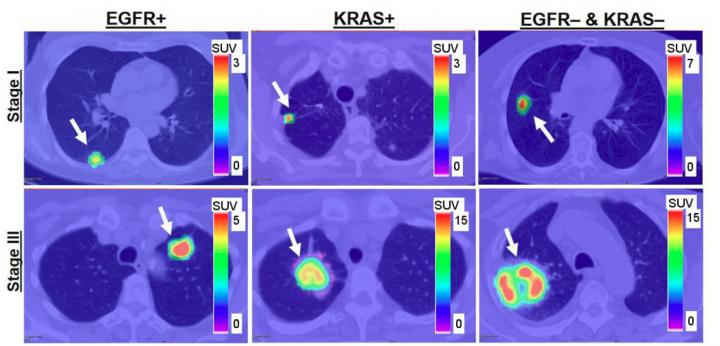
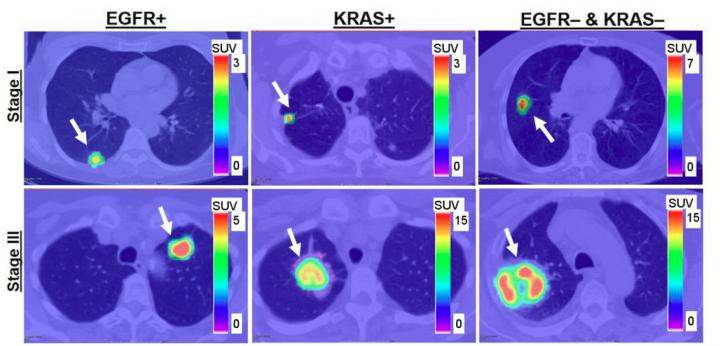
Credit: Stephen S.F. Yip, PhD, and Hugo Aerts, PhD, Dana-Farber Cancer Institute, Brigham and Women's Hospital, and Harvard Medical School, Boston Massachusetts; John Kim, MD, University of Michigan Health System, Ann…
Reston, Va. – Researchers have used positron emission tomography (PET) to successfully identify genetic cell mutations that can cause lung cancer. The research, published in the featured article of the April 2017 issue of "The Journal of Nuclear Medicine," shows that an advanced image analysis technique, radiomics, can non-invasively identify underlying cell mutations in patients with non-small cell lung cancer (NSCLC). More people in the United States die from lung cancer than from any other type of cancer, and NSCLC is the most common form.
The characteristics of metabolic tumors have been quantified by PET radiomics, but little is known about the relationship between these characteristics, or phenotypes, and the underlying mutations that cause them. This information is key to precision medicine–selecting the therapy that will work best for a particular patient.
"To our knowledge, this is the first study to investigate the relationship between somatic mutations and the metabolic phenotypes, which may provide valuable information for developing non-invasive imaging biomarkers for determining mutation status," explains Stephen Yip, PhD, Harvard Medical School, Boston, Massachusetts. "Identifying mutation status in NSCLC patients is an important component of selecting an optimal treatment plan for the patient. The current standard of care uses molecular testing based on biopsies of tumor tissue or surgical resection to identify mutation status. Molecular testing, however, can be limited by invasive procedures and long processing times. In addition, tissue samples are not always readily available."
For the study, 348 NSCLC patients underwent diagnostic F-18-fluorodoxyglucose PET (F-18-FDG PET) scans and were tested for genetic mutations. Of those patients, 13 percent (44/348) and 28 percent (96/348) were found to harbor an epidermal growth factor receptor (EGFR) or Kristen rat sarcoma viral (KRAS) mutations, respectively. The analysis evaluated 21 imaging features: 19 independent radiomic features quantifying phenotypic traits and 2 conventional features (metabolic tumor volume and maximum standard uptake value).
The results indicate that EGFR mutations may drive different metabolic tumor phenotypes that are captured in PET images, whereas KRAS-mutated tumors do not. This proof-of-concept study sheds light on genotype-phenotype interactions using radiomics to capture and describe the phenotype.
Yip notes, "This study may thus help develop an imaging biomarker that can non-invasively and accurately identify EGFR mutation status using PET imaging to complement, but not to replace, molecular testing."
###
The authors of "Associations between somatic mutations and metabolic imaging phenotypes in non-small cell lung cancer" include Stephen S.F. Yip, Thibaud P. Coroller, Chintan Parmar, Emmanuel Rios Velazquez, Elizabeth Huynh, Raymond H. Mak and Hugo J.W.L. Aerts, Dana-Farber Cancer Institute, Brigham and Women's Hospital, and Harvard Medical School, Boston, Massachusetts, and John Kim, University of Michigan Health System, Ann Arbor, Michigan.
This study was supported by the National Institute of Health (Award Number U01CA190234 and U24CA194354) and research seed funding grant from the American Association of Physicists in Medicine. The authors also thank the PROFILE team for help with somatic mutation testing.
Please visit the SNMMI Media Center to view the PDF of the study, including images, and more information about molecular imaging and personalized medicine. To schedule an interview with the researchers, please contact Laurie Callahan at (703) 652-6773 or [email protected]. Current and past issues of The Journal of Nuclear Medicine can be found online at http://jnm.snmjournals.org.
About the Society of Nuclear Medicine and Molecular Imaging
The Society of Nuclear Medicine and Molecular Imaging (SNMMI) is an international scientific and medical organization dedicated to raising public awareness about nuclear medicine and molecular imaging, a vital element of today's medical practice that adds an additional dimension to diagnosis, changing the way common and devastating diseases are understood and treated and helping provide patients with the best health care possible.
SNMMI's more than 17,000 members set the standard for molecular imaging and nuclear medicine practice by creating guidelines, sharing information through journals and meetings and leading advocacy on key issues that affect molecular imaging and therapy research and practice. For more information, visit http://www.snmmi.org.
Media Contact
Laurie Callahan
[email protected]
@SNM_MI
http://www.snm.org
############
Story Source: Materials provided by Scienmag