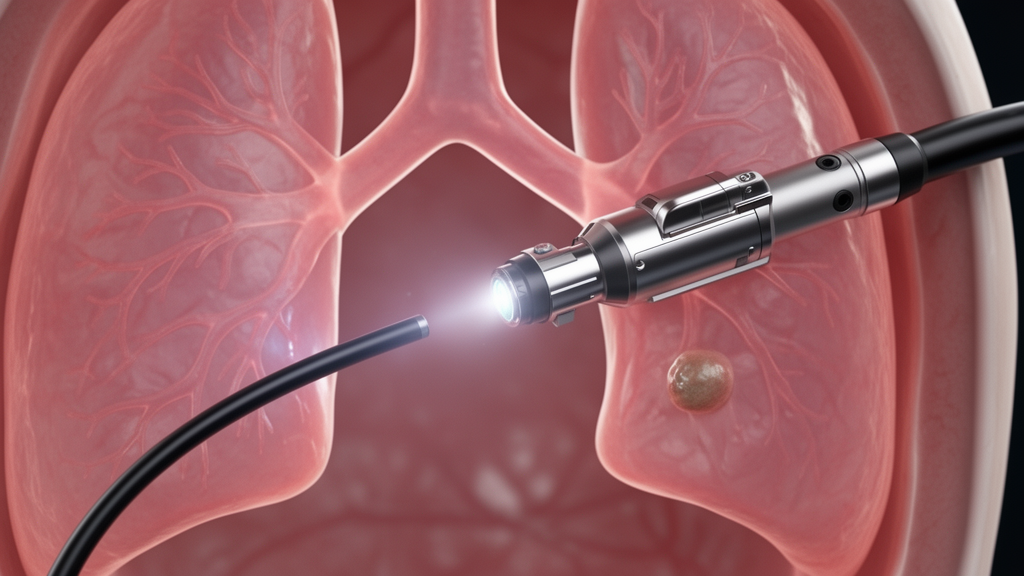
A comprehensive narrative review published in Pulmonary Therapy reveals that advanced guided bronchoscopy platforms have evolved to achieve tissue diagnostic yields comparable to conventional computed tomography-guided transthoracic needle biopsy for peripheral pulmonary lesions, while significantly lowering procedural complication rates. With targeted lung cancer screening programs utilizing low-dose computed tomography expanding globally, clinicians are encountering an unprecedented volume of incidental pulmonary nodules. Observational estimates indicate that incidental nodules appear in two to three percent of screened individuals, with over sixty percent situated in the outer third of the lung. Although the majority of these peripheral abnormalities possess benign etiology, approximately one point five percent represent early malignancies, presenting a persistent diagnostic challenge where standard non-invasive risk models still result in a twelve to fifteen percent rate of benign surgical resections.
Historically, interventional pulmonology focused predominantly on central airway visualization, leaving peripheral lesions beyond the mechanical reach of conventional flexible bronchoscopes. Conventional instruments typically navigate only to third- or fifth-generation bronchi, prompting widespread reliance on computed tomography-guided transthoracic needle biopsy as the primary non-surgical tissue sampling method. Transthoracic needle biopsy carries substantial procedural morbidity, including an estimated sixteen point eight percent incidence of pneumothorax and a five point two percent rate of clinically significant bleeding.
Among the primary technological developments examined in the review is radial probe endobronchial ultrasound, which adapts ultrasonographic imaging to peripheral lung exploration. Miniaturized radial ultrasound catheters measuring one point four to one point seven millimeters in diameter pass through working channels to deliver circumferential three-hundred-and-sixty-degree acoustic views of surrounding parenchymal tissue. Acoustic feedback differentiates solid lesions from aerated parenchyma, displaying characteristic concentric, eccentric, or adjacent orientations. Investigator trials demonstrate that probe position strongly governs diagnostic yield: placing the transducer directly within a target lesion achieves an eighty-four percent diagnostic yield, whereas adjacent positioning drops accuracy to forty-eight percent. Across pooled meta-analyses, radial probe endobronchial ultrasound achieves an average sensitivity of seventy-three percent, though its principal physical limitation remains the absence of continuous real-time guidance during active tissue excision.
Parallel advancements in instrument engineering produced ultrathin bronchoscopes designed with outer diameters of three millimeters or less and operating channels ranging from one point two to one point seven millimeters. Originating from early fiber-optic prototypes and pediatric adaptations, modern iterations allow direct visualization into ninth- through twelfth-generation airways. Prospective multicenter evaluations and randomized trials show superior diagnostic performance for ultrathin bronchoscopes compared to conventional scopes when sampling peripheral lesions measuring under twenty millimeters. A pooled meta-analysis reported an overall diagnostic yield of sixty-five percent, with success influenced heavily by lesion diameter, proximity to the lung hilum, and the presence of a computed tomography bronchus sign indicating an open airway leading directly into the lesion. However, navigating these fragile ultrathin instruments introduces mechanical difficulties, such as reduced suction capacity and peripheral airway collapse around the camera tip, which investigators mitigate using lateral or prone decubitus patient positioning and selective mechanical ventilation protocols to preserve bronchial lumen diameter during tissue acquisition.
Navigation bronchoscopy integrates pre-procedural imaging with intra-procedural spatial guidance to bridge anatomical gaps. Electromagnetic navigation bronchoscopy systems construct a three-dimensional virtual bronchial roadmap from high-resolution thoracic scans and track sensor-equipped instruments through an external electromagnetic field. Following the initial clearance of the superDimension platform in 2004, the prospective multicenter NAVIGATE trial of one thousand one hundred and fifty-seven procedures documented a seventy-three percent diagnostic yield in peripheral nodules with a median diameter of twenty millimeters located nine millimeters from the pleura. Randomized trials evaluating digital tomosynthesis-corrected navigation report diagnostic yields between seventy-five and seventy-nine percent, maintaining low complication rates with a three point one percent pneumothorax incidence and only one point six percent requiring tube thoracostomy drainage.
Virtual bronchoscopic navigation offers a cost-effective non-electromagnetic alternative by rendering three-dimensional endoluminal pathways directly from pre-existing computed tomography datasets without requiring specialized electromagnetic field generators. Commercial systems display reconstructive roadmaps alongside live endoscopic feeds, functioning in conjunction with standard flexible bronchoscopes, ultrathin devices, and radial ultrasound probes. Multiple randomized investigations report diagnostic yields between sixty-seven and eighty-four percent when virtual navigation is combined with radial ultrasound or fluoroscopy, demonstrating pronounced diagnostic advantages for nodules measuring smaller than twenty millimeters. For challenging targets lacking a direct bronchial pathway, specialized platforms integrate parenchymal vessel mapping to enable bronchoscopic trans-parenchymal nodule access. This advanced technique allows the operator to puncture bronchial walls and travel directly through intervening parenchymal tissue toward isolated nodules.
Robotic assisted bronchoscopy represents the most technologically advanced navigation modality currently integrated into clinical practice. Commercial platforms include the electromagnetic-guided Monarch and Galaxy systems and the Ion platform, which employs proprietary shape-sensing optical fiber technology that continuously calculates the physical deflection and precise three-dimensional coordinate position of the catheter tip. Robotic platforms provide stable remote control interfaces capable of executing sub-millimeter positional corrections and locking the catheter firmly in place within distant subsegmental bronchi. When paired with advanced imaging such as cone-beam computed tomography or fluoroscopic tomosynthesis, CT-to-body divergence is corrected intraoperatively. Multicenter prospective studies report catheter lesion reach rates reaching ninety-nine percent. In the multicenter prospective TARGET study, strict protocol criteria yielded a sixty-one point six percent diagnostic rate, while investigator-assessed yield reached eighty-three point two percent in lesions with a median size of twenty point nine millimeters. The subsequent CONFIRM study demonstrated an eighty-nine percent diagnostic yield using robotic bronchoscopy combined with cone-beam imaging for nodules averaging fourteen millimeters.
Once advanced platforms achieve stable navigation to peripheral targets, tissue sampling technique directly dictates pathological accuracy. Conventional forceps biopsies, fine-needle aspirations, and brushings are increasingly augmented by transbronchial lung cryobiopsy. Operating on the physical principles of the Joule-Thomson thermodynamic effect, cryobiopsy systems direct compressed carbon dioxide through miniaturized flexible probes measuring one point one to two point four millimeters, causing sudden gas expansion that generates temperatures of approximately minus eighty degrees Celsius. Instantaneous freezing adheres surrounding parenchymal tissue en bloc to the probe tip. Histological evaluation confirms that cryobiopsy specimens are substantially larger than forceps samples and remain free from mechanical crush artifacts, preserving cellular architecture for immunohistochemistry and comprehensive molecular genomic sequencing. Clinical meta-analyses indicate that combining robotic navigation with transbronchial cryobiopsy consistently yields diagnostic rates exceeding eighty percent.
Direct statistical comparisons consolidate the role of guided bronchoscopy relative to percutaneous alternatives. A comprehensive network meta-analysis incorporating three hundred and sixty-three studies demonstrated that robotic assisted bronchoscopy achieved a pooled diagnostic yield of eighty-four point eight percent, matching computed tomography-guided transthoracic needle biopsy at eighty-eight point nine percent. Virtual bronchoscopic navigation achieved seventy-five point one percent, electromagnetic navigation reached seventy-two point seven percent, and radial ultrasound reached seventy-two percent, with radial ultrasound alone being statistically inferior to transthoracic needle biopsy. Crucially, procedural safety favored bronchoscopy: percutaneous needle biopsy carried a sixteen point eight percent pneumothorax rate and five point two percent bleeding rate, whereas robotic platforms exhibited a two point two percent pneumothorax rate and zero point three percent bleeding rate. Recent randomized trials reinforce these findings; the multicenter VERITAS trial recorded non-inferior diagnostic accuracy for electromagnetic navigation compared to needle biopsy, while the RELIANT trial demonstrated comparable yields between robotic and electromagnetic platforms.
The therapeutic horizon of advanced bronchoscopy is expanding toward integrated single-session interventions and local tumor eradication. Emerging evidence highlights a combined diagnose-and-treat paradigm combining robotic localization, rapid on-site cytopathological evaluation, and thoracic surgery under a single general anesthetic administration. Clinical cohorts demonstrate that pre-resection robotic verification dropped benign surgical resection rates from twenty-one point nine percent to seven point six percent, while eliminating repeat intraoperative resections entirely. Furthermore, interventional trials are actively evaluating bronchoscopically delivered local ablative therapies, including radiofrequency ablation achieving eighty-two point six percent local control in early cohorts and microwave ablation attaining one hundred percent technical success at thirty days in nonsurgical candidates. Despite these promising developments, the review authors caution that current literature consists predominantly of non-comparative, single-center datasets frequently supported by commercial industry sponsorship. The authors emphasize that widespread adoption requires independent, randomized health-economic trials to balance capital platform expenditures against clinical outcomes before universal healthcare integration can occur.
Subject of Research: Comparative diagnostic performance and safety of advanced bronchoscopic modalities for peripheral pulmonary lesions
Article Title: Advanced Bronchoscopic Approaches to Peripheral Pulmonary Lesions: a Narrative Review of Current and Emerging Techniques
Article References: Westley, R., Fantin, A., Crisafulli, E., & Panchal, R. (2026). Advanced Bronchoscopic Approaches to Peripheral Pulmonary Lesions: a Narrative Review of Current and Emerging Techniques. Pulmonary Therapy, 12(3), 853-867. https://doi.org/10.1007/s41030-026-00377-8
Image Credits: AI Generated
DOI: 10.1007/s41030-026-00377-8
Keywords: peripheral pulmonary lesions, robotic assisted bronchoscopy, electromagnetic navigation bronchoscopy, radial probe endobronchial ultrasound, ultrathin bronchoscopy, virtual bronchoscopic navigation, transbronchial lung cryobiopsy, transthoracic needle biopsy, pulmonary nodules, interventional pulmonology, cone-beam computed tomography, digital tomosynthesis, pneumothorax complications, rapid on-site evaluation, shape-sensing technology, lung cancer screening
News Source: Ophelia Keating. (November 25, 2026). Advanced Bronchoscopic Systems Match Needle Biopsies for Peripheral Lung Lesions. Scienmag.