New Research Unveils How Body Weight Changes Affect Hypertension Differently Across Life Stages
A groundbreaking study published in the International Journal of Obesity has shed light on the complex relationship between changes in body fat and the development and resolution of hypertension at various stages of life. Conducted by a team of researchers led by Meng, Chen, and Qi, this comprehensive investigation focuses on the Chinese population and reveals how the timing and progression of excess adiposity—or body fat—can influence blood pressure dynamics in unique ways through the lifespan.
Hypertension, often dubbed the “silent killer,” affects millions globally and is a critical risk factor for cardiovascular diseases. Its connection with obesity is well-established, yet the intricate nuances behind how weight gain or loss impacts hypertension onset and remission have remained elusive. This study addresses that gap by examining adiposity transitions—shifts between normal weight, overweight, and obesity—and mapping their differential effects on hypertension and its subtypes from youth to older adulthood.
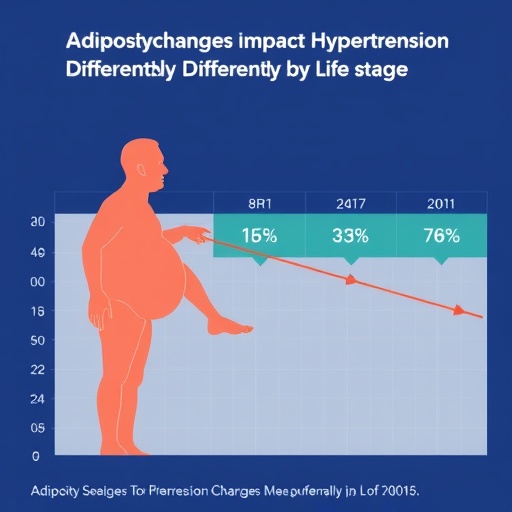
Leveraging longitudinal data and sophisticated statistical models, the researchers tracked a large cohort of individuals through multiple periods, capturing the nuances of weight change and corresponding blood pressure trajectories. Their findings reveal that the consequences of gaining or losing excess fat are far from uniform: the impact varies substantially based on the life stage during which these transitions occur. This insight challenges the prevailing one-size-fits-all approach to managing obesity-related hypertension.
In younger populations, particularly during early adulthood, moving from normal weight toward overweight or obesity was found to precipitate a pronounced increase in the risk of developing hypertension. Importantly, these early insults to vascular health appeared particularly durable, with obesity-related hypertension often persisting and resisting resolution later in life. This suggests that preventive interventions aimed at maintaining healthy weight in youth hold critical value to curb the onset of chronic high blood pressure.
Conversely, in middle-aged and older adults, the study uncovered a somewhat paradoxical pattern. While continued excess adiposity also increased hypertension risk, individuals who managed to reduce their body fat to healthier levels during these later stages showed significant improvements, including meaningful rates of hypertension resolution. This indicates a more plastic relationship between adiposity and blood pressure in later life, a hopeful message for clinical strategies targeting weight reduction among older populations.
Further dissecting hypertension subtypes revealed additional complexity. The impact of adiposity transitions differed between systolic, diastolic, and combined hypertension, underscoring the necessity of subtype-specific approaches when designing public health interventions. For example, the onset of isolated systolic hypertension—more common in older individuals—was less tightly linked with adiposity changes compared to other subtypes, suggesting that vascular aging and stiffening contribute uniquely to its pathogenesis, independent of weight.
The authors also emphasized the cultural and genetic context by studying a Chinese population, highlighting that ethnicity and region-specific factors play crucial roles in how adiposity and hypertension intersect. This geographic lens provides valuable insights given the rising prevalence of obesity and hypertension in Asia, where urbanization and lifestyle shifts have altered traditional health patterns dramatically.
This investigation is pioneering in its life-course perspective, framing adiposity not as a static risk factor but as a dynamic condition with fluctuating influences on hypertension. It calls for nuanced clinical guidelines that incorporate age, duration of obesity, and subtype of hypertension into personalized treatment plans. Moreover, it underscores the importance of early life interventions aimed at weight maintenance as a cornerstone of long-term cardiovascular health.
Beyond the clinical implications, the study ignites several intriguing research questions. For example, what biological mechanisms mediate the differential effects of adiposity based on life stage? Could epigenetic modifications or metabolic memory account for the observed persistence of early obesity effects on hypertension? Investigating these pathways could unlock novel therapeutic targets and preventative strategies.
The findings also highlight the importance of public health policies tailored to life stage-specific risks. Programs focusing on obesity prevention in children and young adults might yield more pronounced dividends by preventing irreversible vascular damage linked to early hypertension. Meanwhile, supportive infrastructures for weight management in older adults remain vital for promoting hypertension remission and reducing cardiovascular events.
In essence, this research unravels the intricacies of how timing and extent of weight gain or loss weave into the fabric of blood pressure regulation. It offers a compelling argument for integrating longitudinal tracking of adiposity into routine clinical practice, allowing practitioners to anticipate and tailor interventions more effectively.
As obesity rates continue to climb worldwide, understanding these life stage-specific interactions becomes more urgent. This study not only broadens the scientific understanding but also galvanizes efforts toward long-term, adaptive strategies to combat the global burdens of hypertension and cardiovascular disease.
The authors conclude with a call to action for the medical community: to embrace a life-course approach and consider hypertension and obesity as dynamic and interrelated phenomena that evolve with age. Such a paradigm shift promises to advance personalized medicine and improve population health outcomes in an era defined by chronic disease challenges.
In summary, this research represents a major advance in cardiovascular epidemiology, illuminating the variable impact of adiposity transitions on hypertension across life stages and providing a roadmap for future investigation and intervention refinement. It is a beacon pointing toward smarter, age-aware management of obesity-related hypertension, highlighting prevention, timely intervention, and sustained weight control as keystones of global cardiovascular health.
Subject of Research: Effects of excess adiposity transitions on the incidence and resolution of hypertension across different life stages in the Chinese population.
Article Title: Life stage-specific heterogeneity in the effects of adiposity transition on hypertension incidence and resolution.
Article References:
Meng, X., Chen, L., Qi, Q. et al. Life stage-specific heterogeneity in the effects of adiposity transition on hypertension incidence and resolution. Int J Obes (2026). https://doi.org/10.1038/s41366-026-02064-9
Image Credits: AI Generated
DOI: 01 April 2026
Tags: adiposity changes and hypertensionadiposity transitions and cardiovascular healthage-specific obesity effectsblood pressure dynamics in obesitybody fat impact on blood pressurebody weight changes across lifespanChinese population hypertension researchhypertension onset and remission factorslife stage differences in hypertensionlongitudinal study on obesity and hypertensionobesity and hypertension riskweight gain effects on hypertension