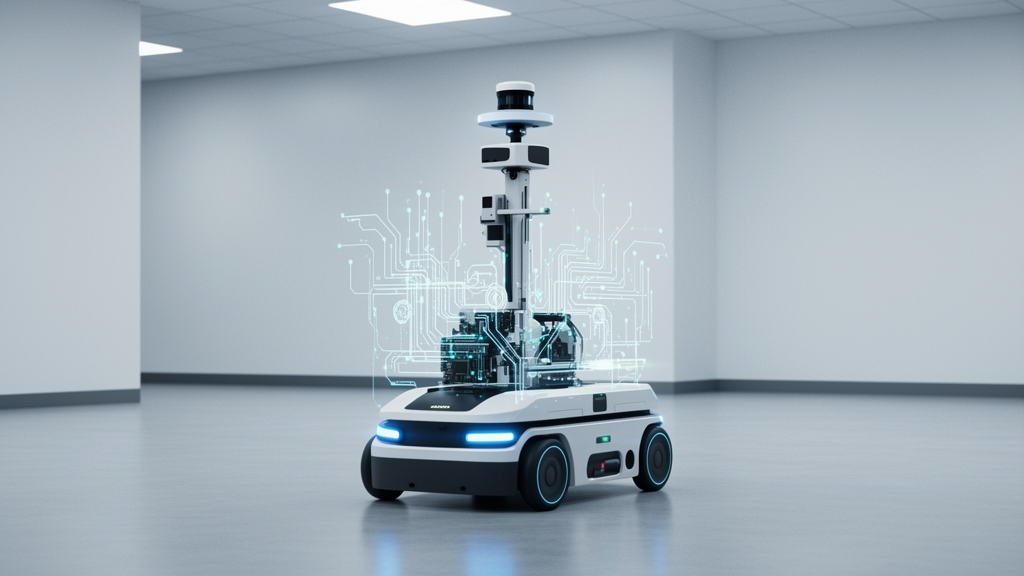
In autonomous robotics, engineers commonly assume that adding algorithmic layers to a mobile navigation pipeline steadily improves safety, but a simulation study from researchers at Chung Yuan Christian University shows that cumulative architectures fail to improve safety monotonically. Testing a five-level navigation stack across twenty-eight thousand six hundred fifty deterministic simulation trials, the research team found that introducing intermediate sensor and planning modules often degraded obstacle clearance or neutralized other safety mechanisms. The simulated differential-drive robot navigated four related apartment floor plans under identical random seeds, driving toward specified room goals amid dynamic obstacles. Rather than observing steady progress as reactive steering, obstacle tracking, and conservative braking were layered onto an initial geometric path planner, the researchers documented non-linear performance trade-offs. While the complete five-tier controller achieved the lowest overall contact duration, it failed to recover the wide physical clearances maintained by the simplest baseline planner.
The investigation evaluated a cumulative five-level navigation stack beginning with Level Zero, a basic geometric planner that executed pure-pursuit trajectory tracking along grid waypoints while ignoring dynamic obstacles. Level One introduced a semantic goal selector using a fixed room prior probability distribution, operating identically to the baseline under task-parity conditions where the prior selected the true target room. Level Two incorporated a reactive sensory bundle comprising LiDAR-based dynamic window steering across twenty-one candidate headings, clearance-scaled speed limits, and a hold command that stopped the base when forward clearance dropped below zero point nine meters. Level Three added obstacle perception with Gaussian noise, constant-velocity trajectory forecasting zero point seven seconds ahead, and a Bayesian room-belief estimator updated every forty steps. Finally, Level Four added distance-proportional preemptive braking and a stop-and-wait pause triggered whenever detected obstacles entered a forward half-plane within one point six meters.
Analyzing the primary task-parity ladder across four hundred trials per level revealed sharp departures from monotonic safety gains when stepping from the baseline to sensor-guided reactivity. While Level Two halved average obstacle contact time from two point eight four seconds to one point four six seconds per trial, it caused minimum surface clearance to plunge from zero point four eight six meters to zero point three six nine meters. The robot began swerving past moving entities at close range rather than plowing forward or yielding, shrinking safety margins by roughly twelve centimeters. Physical contact incidence barely moved across lower tiers, registering at thirty-three point two percent for the baseline and thirty-two point five percent for Level Two. Although Levels Three and Four recovered small amounts of clearance, Level Four still maintained an average clearance of only zero point four two one meters, remaining significantly closer to obstacles than the primitive baseline.
To uncover the causal mechanisms driving these unexpected dynamics, the authors performed a granular ablation testing twenty-one component configurations and forty-nine declared statistical contrasts. This decomposition revealed that reactive dynamic window steering was entirely responsible for the twelve-centimeter clearance loss and actively neutralized the protective hold rule bundled with it. When tested alone without steering, the hold rule stopped the robot before close obstacles, cutting contact incidence from thirty-three point two percent to eighteen percent and slashing contact time to zero point three six seconds while preserving clearance. However, when paired with dynamic window steering, the algorithm continuously selected clear lateral headings, driving into narrow gaps and preventing forward clearance from dropping below the hold activation threshold.
The higher tiers of the cumulative stack exhibited similar component redundancies and misattributed safety benefits. Level Three, which introduced obstacle prediction and Bayesian room belief, produced no statistically significant improvements across primary safety metrics in apartment trials, with mean contact time rebounding to two point four two seconds due to map-specific routing bottlenecks. At Level Four, overall contact incidence dropped sharply to thirteen percent and contact duration fell to zero point zero seven seconds, but the ablation proved this achievement stemmed entirely from the stop-and-wait pause rule. Once the pause was active to wait out crossing obstacles, the accompanying early braking component produced zero measurable change in primary contact metrics or spatial clearance.
These ablation findings led to exploratory post-hoc comparisons showing that simpler, unbundled configurations outperformed the standard engineering ladder. A straightforward combination of the baseline geometric controller and the isolated LiDAR hold rule completely surpassed Levels Two and Three across contact incidence, contact duration, clearance, and navigation transit time. Operating without steering, this simple stop configuration achieved an eighteen percent contact incidence, zero point three six seconds of contact time, and an average clearance of zero point four nine nine meters, while reaching the goal room two point eight seconds faster than Level Two. Similarly, pairing the baseline planner with early braking and the stop-and-wait pause while omitting LiDAR steering matched Level Four contact performance within zero point zero five seconds and provided superior clearance. Across all twenty-one tested configurations, intermediate Levels Two and Three were strictly dominated, showing that sequential layer accretion can trap navigation architectures in suboptimal compromises.
The real-world efficacy of these automated safeguards depended entirely on whether surrounding obstacles yielded or ignored the robot. In the primary apartment simulations, all safety gains achieved by Level Four came from eliminating collisions with the scripted person, who was programmed to halt or sidestep when encountering a blocked corridor. In contrast, contact with the roaming cat, which moved at up to one point three meters per second and ignored the machine, remained unchanged at roughly zero point zero seven seconds per trial across all five levels. When the researchers replaced the scripted person with a canonical social-force pedestrian model, the advanced stack failed under unyielding conditions. When pedestrian repulsion was set to minimal levels so that the human barely avoided collisions, every reactive tier from Level Two through Level Four suffered higher contact incidence and substantially lower clearance than the baseline, because the robot repeatedly steered into close-range conflicts with an unyielding agent.
To evaluate navigation behaviors against real human movement, the team replayed recorded pedestrian trajectories from two crowd scenes in the University of Cyprus dataset, designated ZARA1 and UNIV. Because these empirical pedestrian paths were fixed replays that could not perceive or react to the machine, overall collision rates became pervasive, exceeding seventy-eight percent in ZARA1 and ninety-five percent in dense UNIV trials across all configurations. However, total contact duration failed to decline, rising descriptively in ZARA1 from three point five seven seconds at the baseline to four point six four seconds under Level Four. Unyielding pedestrians walked directly into the stationary robot, demonstrating that passive stopping rules cannot eliminate collisions in crowded environments.
Beyond behavioral dynamics, the study exposed two pervasive methodological shortcuts in standard robotic safety evaluation protocols that routinely mislead engineers. First, the researchers demonstrated that applying a uniform zero point seven five meter center-to-center proximity gate to detect collisions produced severe directional measurement errors across different obstacle sizes. For the small cat obstacle, whose surface touched the robot at zero point six five meters, the gate counted non-contact near misses, representing seventy-four percent of all collision flags logged at Level Four. Conversely, for the human obstacle, whose touching distance was exactly zero point seven five meters, floating-point rounding during physical push-out caused the gate to miss twenty-seven to thirty percent of true physical contact frames.
In their conclusion, the authors noted key physical and environmental constraints that bound their simulation findings. The evaluation was conducted within a two-dimensional kinematic simulator using idealized unicycle motion models, rigid push-out contact physics, and four apartment maps derived from reflections of one architectural layout. Statistical mixed-effects modeling confirmed substantial variance clustering across random seeds and maps, with floor plans determining whether intermediate steering layers helped or harmed contact metrics. Furthermore, real human beings actively adapt their walking paths when encountering mobile robots, meaning unreactive trajectory replays overestimate the physical contact that a stationary robot would experience in populated environments. Nonetheless, by applying rigorous task parity, seed-level paired testing with Holm multiplicity corrections, and systematic component ablations, the study demonstrates that software accretion does not guarantee robotic safety, highlighting the necessity of assessing navigation systems through decoupled physical measurements rather than aggregated operational scores.
Subject of Research: Simulation evaluation of cumulative autonomous robot navigation layers and collision safety
Article Title: Adding navigation layers does not monotonically improve safety: a simulation ablation with scripted and recorded pedestrians
Article References: Chang, Y.-J., Cheng, W.-H., & Liu, H.-H. (2026). Adding navigation layers does not monotonically improve safety: a simulation ablation with scripted and recorded pedestrians. Frontiers in Robotics and AI, 13, Article 1973389. https://doi.org/10.3389/frobt.2026.1973389
Image Credits: AI Generated
DOI: 10.3389/frobt.2026.1973389
Keywords: mobile robot navigation, collision avoidance, simulation ablation, LiDAR steering, dynamic window approach, task parity, obstacle clearance, pedestrian interaction, social force model, recorded pedestrian trajectories, robot safety metrics, stop-and-wait pause, proximity gates, motion planning, indoor robotics, unicycle kinematics, multiplicity correction
News Source: Denise Maddox. (November 23, 2026). Adding Robot Navigation Layers Fails to Monotonically Improve Indoor Safety. Scienmag.