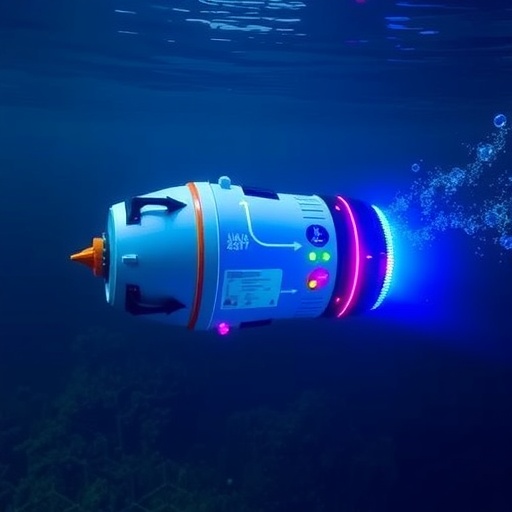
In the cutting-edge world of marine robotics, the exploration of underwater environments has taken a significant leap forward with the development of the Jaiabot, a micro autonomous underwater vehicle (AUV) that integrates advanced system identification and adaptive input estimation techniques. This innovative vehicle is not merely a tool; it represents a synergy of artificial intelligence, engineering, and environmental science that enables more effective data collection in the depths of our oceans. The research conducted by Faros and Tanner, published in the journal Autonomous Robots, delves into the sophisticated algorithms that power this remarkable technology.
One of the foremost challenges in underwater robotics is the unpredictable nature of the marine environment. Traditional methods of navigation and data collection often fall short due to volatility in current patterns, thermal layers, and varying salinity levels. The Jaiabot addresses these obstacles through its robust system identification processes that autonomously adjust to real-time environmental changes. By utilizing adaptive algorithms, the Jaiabot can effectively model its surroundings and stabilize its trajectory, enhancing both its navigational accuracy and data collection efficiency.
At the core of the Jaiabot’s design lies a sophisticated sensor suite equipped to monitor a myriad of underwater conditions. These sensors collect essential data, including pressure, temperature, and sonar readings, which are crucial for an accurate representation of any given underwater environment. The system identification framework implemented within the Jaiabot processes this data to create a dynamically updating model of the vehicle’s operational environment. This continuous feedback loop not only helps the vehicle innovate its navigation strategies but also paves the way for future advancements in underwater robotics as a whole.
Another significant aspect discussed by Faros and Tanner is the implementation of adaptive input estimation. This cutting-edge technique allows the Jaiabot to modify its control inputs based on the evolving conditions around it, enabling it to maintain optimal performance levels. For instance, if the AUV detects stronger currents, it can automatically adapt the thrust and maneuvering parameters, ensuring it remains on course and can effectively execute its mission, whether that entails scientific surveying or underwater inspections.
The implications of this research extend beyond technical advancements; they touch upon broader ecological and scientific imprints. As climate change continues to wreak havoc on marine ecosystems, tools like the Jaiabot are essential for monitoring changes in habitats, biodiversity, and oceanic conditions. The precision offered by the integration of system identification and adaptive algorithms propels scientists to gather data with unprecedented accuracy, allowing for informed decision-making in marine conservation efforts.
Moreover, the operational versatility of the Jaiabot positions it as a vital asset in various marine industry sectors. From oil and gas exploration to environmental monitoring and deep-sea research, the potential applications for this autonomous vehicle are vast. By enhancing the ability to navigate complex underwater terrains and collect valuable data autonomously, the Jaiabot could change the face of many industries reliant on marine exploration.
The researchers also emphasize that the adaptability of the Jaiabot’s algorithms is a major advantage. Unlike traditional vehicles that may require significant recalibration and manual intervention, the Jaiabot can self-optimize in real-time. This facet not only improves operational efficiency but translates to significant cost savings, reducing the need for extensive human oversight in potentially hazardous underwater missions.
As the investigation progresses, the research team plans to refine the vehicle’s sensing and control mechanisms further. Upcoming iterations of the Jaiabot are expected to leverage machine learning techniques, enhancing its capability to predict and react more intelligently to underwater dynamics. By building on the foundational work presented in this research, Faros and Tanner hope to foster a new generation of AUVs that are even more intuitive and capable in their exploration of our planet’s unexplored frontiers.
In terms of collaboration and knowledge dissemination, this research highlights the importance of interdisciplinary approaches in marine robotics. The blending of expertise from robotics, artificial intelligence, and marine sciences creates a holistic framework enabling the unveiling of new possibilities in ocean exploration. It is imperative that such research continues to foster partnerships that bridge the gap between academia, industry, and environmental stewardship.
Furthermore, the pursuit of profit-driven applications must be matched by a commitment to ethics and sustainability. As autonomous vehicles like the Jaiabot become commonplace in marine industries, it is critical that their deployment adheres to environmental regulations and develops responsibly. Research such as that by Faros and Tanner underscores the potential to align innovation with conservation, ensuring that while we explore, we also protect the marine ecosystems that sustain life on Earth.
In summary, the advancements in system identification and adaptive input estimation showcased by the Jaiabot signal a transformative moment in the field of underwater robotics. As we delve deeper into our oceans, we require more sophisticated tools that can adapt, learn, and operate autonomously within these unpredictable environments. The research conducted by Faros and Tanner not only paves the way for future innovations but also reminds us of our responsibility to protect the vast and mysterious worlds that lie beneath the waves.
In conclusion, the Jaiabot micro autonomous underwater vehicle emerges as a beacon of progress in marine technology, intertwining advanced engineering with ecological responsibility. The implications of this research stretch wide, inviting ongoing dialogue about the future of exploration and conservation in our ever-changing oceans. By embracing these advancements, society stands on the threshold of unlocking incredible knowledge and fostering a sustainable relationship with our planet’s final frontier – the ocean.
Subject of Research: System identification and adaptive input estimation in autonomous underwater vehicles.
Article Title: System identification and adaptive input estimation on the Jaiabot micro autonomous underwater vehicle.
Article References: Faros, I., Tanner, H.G. System identification and adaptive input estimation on the Jaiabot micro autonomous underwater vehicle. Auton Robot 49, 31 (2025). https://doi.org/10.1007/s10514-025-10220-9
Image Credits: AI Generated
DOI: 10.1007/s10514-025-10220-9
Keywords: Autonomous Underwater Vehicle, System Identification, Adaptive Input Estimation, Robotics, Marine Exploration.
Tags: adaptive system identificationadvanced navigation algorithmsartificial intelligence in marine vehicleschallenges in underwater explorationenvironmental science and roboticsJaiabot underwater vehiclemarine robotics technologymicro autonomous underwater vehiclereal-time environmental adaptationsensor technologies for AUVsunderwater data collection techniques