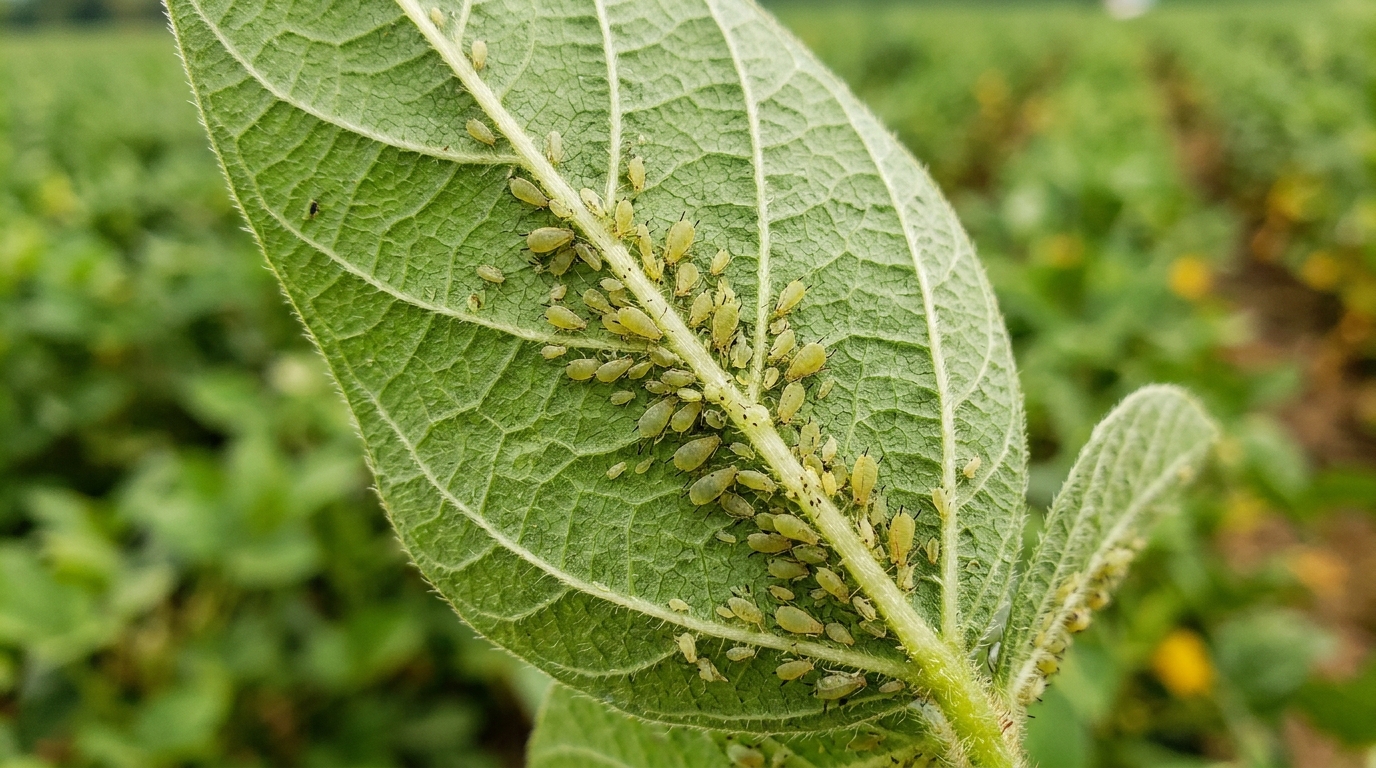
Researchers have developed a sequence of biologically grounded mathematical population models capable of capturing the multi-peak outbreak dynamics of the soybean aphid (Aphis glycines), an invasive agricultural pest causing severe yield loss across soybeans in the North Central United States. Throughout a single growing season, populations of the aphid frequently exhibit multiple peaks of unequal amplitude, an observed pattern that classical boom-bust population models cannot reproduce. To address this limitation, the research team designed novel modeling frameworks to simulate these complex fluctuations realistically while providing practical utility for agricultural pest management.
In their evaluation of model formulations, the researchers first examined a variable carrying capacity model, in which seasonally fluctuating host-plant quality determines a time-dependent carrying capacity. While this formulation succeeded in generating multiple population peaks, mathematical analysis revealed that it admits finite-time blow-up, or population explosion, which makes the model biologically unrealistic under conditions of high colonisations. To resolve this instability, the authors proposed an adaptive behavioural model incorporating a density-dependent switch, which successfully maintains the multi-peak population dynamics while mathematically guaranteeing bounded aphid populations. Incorporating empirical evidence showing that abiotic stressors like flooding alter host-plant fitness, the team also constructed a novel framework featuring time-dependent, data-fitted periodic plant fitness and aphid growth rates, proving that this system generates transient multi-peak oscillations without settling into a sustained periodic state.
To evaluate the practical management utility of the frameworks, the researchers assessed all simulated models against established agricultural benchmarks, specifically the Economic Threshold and the Economic Injury Level. In numerical simulations across all tested models, predicted aphid abundances exceeded both the Economic Threshold and the Economic Injury Level, indicating that active pest control interventions are necessary. Furthermore, the team performed a global Sobol sensitivity analysis, which successfully identified the key governing parameters that drive the frequency of aphid outbreaks. The authors concluded that their modeling sequence establishes a stable, data-informed, and biologically grounded foundation for predicting soybean aphid outbreaks and improving current pest management strategies in affected regions.
Subject of Research: Soybean aphid population dynamics and agricultural pest modeling
Article Title: An investigation of novel population models to control aphid outbreaks via a data driven “adaptive” framework
Article References: Banerjee, A., Verma, U., Srivastava, S. N., & Parshad, R. D. (2026). An investigation of novel population models to control aphid outbreaks via a data driven “adaptive” framework. PLOS Ecosystems, 1(3), e0000039. https://doi.org/10.1371/journal.pesy.0000039
Image Credits: AI Generated
DOI: 10.1371/journal.pesy.0000039
Keywords: soybean aphid, Aphis glycines, pest management, population models, multi-peak dynamics, Sobol sensitivity analysis, agricultural pests, ecological modeling, investigation, novel, population, models
News Source: Drew Townsend. (November 6, 2026). Adaptive Population Models Capture Multi-Peak Soybean Aphid Outbreak Dynamics. Scienmag.