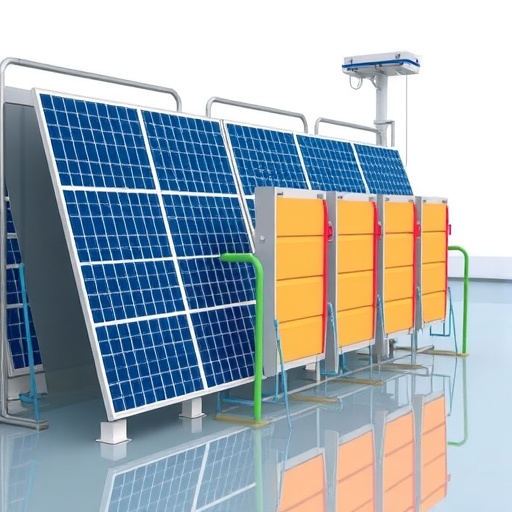
In an era increasingly defined by the urgent need to transition toward sustainable energy, the design and implementation of advanced energy storage systems have emerged as a pivotal challenge and opportunity. Recent developments spearheaded by researchers Guo, Wu, Ma, and their colleagues are making waves in this domain. Their innovative approach, outlined in their 2025 Nature Communications publication, introduces a scenario-adaptive hierarchical optimisation framework tailored to hybrid energy storage systems (HESS). This breakthrough promises to transform how we integrate and optimise diverse energy storage technologies, offering enhanced efficiency, flexibility, and resilience in power grids worldwide.
Hybrid energy storage systems represent a fusion of various storage technologies—such as batteries, supercapacitors, and flywheels—which complement each other’s strengths while compensating for individual limitations. For instance, while batteries offer high energy density, supercapacitors excel in power density and rapid charge-discharge capabilities. The primary challenge in designing HESS lies in precisely balancing these disparate components to meet varying demand profiles, grid conditions, and operational constraints, a multidimensional optimisation problem that defies traditional design methodologies.
What sets this new framework apart is its scenario-adaptive nature. Unlike fixed design paradigms that rely on static assumptions, this approach dynamically adapts to a wide array of plausible future scenarios, including fluctuating energy demands, renewable generation variability, and evolving regulatory standards. By embedding scenario analysis directly into the hierarchical optimisation process, the framework anticipates and mitigates performance bottlenecks before they manifest in real-world applications, thereby ensuring robustness and longevity in HESS design.
The hierarchical optimisation mechanism itself is inherently sophisticated. It decomposes the design problem into interconnected layers, spanning from component-level parameters to system-wide operational strategies. This decomposition allows for an iterative redesign process where localized adjustments propagate upwards, refining global system performance. Such a nested approach contrasts starkly with monolithic models that often overlook emergent properties arising from component interactions, thereby missing opportunities for optimization at the system level.
In practice, the framework leverages advanced algorithmic techniques, such as multi-objective evolutionary algorithms and machine learning-based predictive models. These computational tools enable rapid exploration of the vast design space, evaluating trade-offs between competing objectives such as cost, reliability, efficiency, and response time. The inclusion of machine learning models enhances predictive accuracy by capturing complex nonlinear relationships and temporal dependencies inherent in energy storage dynamics.
One remarkable outcome of this research is the demonstrated ability to tailor HESS design to specific application scenarios, ranging from grid frequency regulation and peak shaving to integration with intermittent renewables like wind and solar. This adaptability is crucial as energy systems evolve towards decentralization and increased participation of distributed energy resources. Whether stabilizing microgrids on remote islands or bolstering urban energy resilience, the adaptable framework provides a customized blueprint for optimal storage integration.
Moreover, the framework’s capacity to incorporate uncertainty quantification transforms conventional risk assessment paradigms. By systematically accounting for uncertainties in technology lifetimes, performance degradation, and future regulatory environments, it supports robust decision-making under ambiguity. This feature is especially beneficial for utilities and policymakers who navigate complex and often conflicting sustainability and reliability mandates.
The implications for economic viability are also profound. Through optimizing component selection and operational management simultaneously, the framework identifies pathways to reduce capital expenditures and operational expenses, thereby accelerating the commercial deployment of hybrid energy storage solutions. In addition, it offers insights into the lifecycle environmental impacts of different configurations, aligning technical innovation with broader sustainability goals.
Crucially, this research addresses scalability, a notorious bottleneck in energy systems design. By modularizing the optimisation process, it accommodates expansions and technology upgrades without necessitating complete redesigns. This forward-compatibility facilitates incremental innovation, allowing stakeholders to progressively enhance energy storage infrastructure as technologies mature and costs decline.
Beyond pure technical sophistication, the framework embodies a paradigm shift towards integrative and anticipatory design in energy storage. It challenges the prevailing siloed approach by fostering interdisciplinary collaboration among materials scientists, system engineers, data scientists, and policy analysts. By merging insights across scales and fields, it cultivates a holistic perspective that is indispensable for addressing the multifaceted challenges of modern energy systems.
The research team validated the framework through extensive simulations and pilot implementations across diverse climatic and grid contexts. These empirical assessments underscore its versatility and practical relevance, highlighting significant improvements in system lifespan, operational flexibility, and cost-effectiveness compared to conventional designs. Such evidence bolsters confidence in its applicability for both emerging and established energy markets.
Looking ahead, this framework lays the groundwork for integrating emerging storage technologies like solid-state batteries, flow batteries, and hydrogen storage into cohesive hybrid systems. Its extensible architecture anticipates future innovations, providing a robust platform to continuously refine design strategies as new materials and architectures come online.
Furthermore, as digitalization and smart grid technologies proliferate, this optimisation framework is primed to exploit real-time data streams and adaptive control techniques. By synchronizing design-time optimisation with runtime monitoring and control, it opens pathways to truly intelligent energy storage systems capable of self-optimizing and responding proactively to grid fluctuations.
In summary, the scenario-adaptive hierarchical optimisation framework devised by Guo, Wu, Ma, and colleagues represents a landmark advancement in the field of hybrid energy storage system design. Integrating robust computational techniques with scenario planning, it offers a versatile and powerful tool that addresses the complex trade-offs inherent in next-generation energy storage. As the global push towards clean energy solutions intensifies, such innovative frameworks will be instrumental in unlocking the full potential of hybrid storage, enabling more resilient, efficient, and economically viable energy systems around the world.
Subject of Research:
Hybrid energy storage system design and optimisation using scenario-adaptive hierarchical frameworks.
Article Title:
Scenario-adaptive hierarchical optimisation framework for design in hybrid energy storage systems.
Article References:
Guo, J., Wu, H., Ma, T. et al. Scenario-adaptive hierarchical optimisation framework for design in hybrid energy storage systems. Nat Commun (2025). https://doi.org/10.1038/s41467-025-67377-1
Image Credits: AI Generated
Tags: adaptive hierarchical optimizationadvanced energy storage designbalancing diverse energy storage componentsenergy storage system efficiencyenergy storage technologies integrationflexible power system designfuture energy demand profileshybrid energy storage systemsmultidimensional optimization in energy systemspower grid resiliencescenario-adaptive frameworkssustainable energy transition