A newly proposed deep learning model combining Adaptive Harris Hawks Optimization with a one-dimensional convolutional neural network can accurately predict the electromagnetic shielding effectiveness of ultra-high voltage protective garment materials, according to a study published in Discover Applied Sciences.
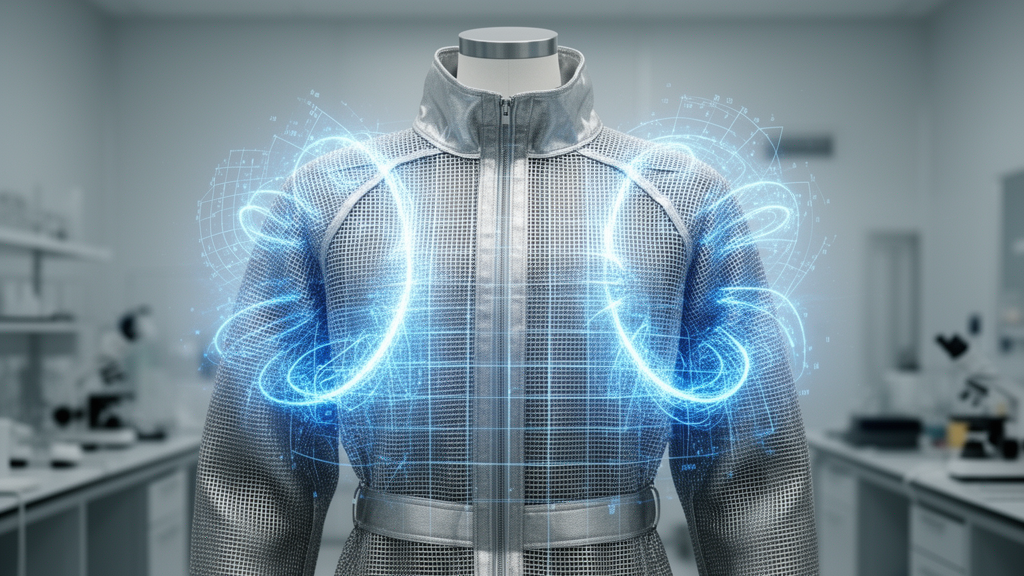
Electromagnetic shielding garments serve a critical safety function by protecting ultra-high voltage utility personnel from exposure to hazardous radiation during maintenance and operational work. The shielding effectiveness of these specialized garments depends on complex, nonlinear interactions involving electrical conductivity, material thickness, operating frequency, permittivity, and textile structure. Together, these interdependent material characteristics allow advanced composite fabrics to attenuate incident electromagnetic waves through combined mechanisms of reflection, absorption, and scattering for modern occupational safety applications.
The authors explain that existing deep learning models frequently suffer from noisy data and lack automated mechanisms for adaptive optimization. These shortcomings restrict model prediction accuracy and operational robustness, preventing earlier systems from reliably modeling the high-dimensional shielding parameters and intricate nonlinear dynamics that govern electromagnetic interference attenuation in protective fabrics.
To establish and evaluate their predictive architecture, the authors utilized the EMI Shielding Textile Dataset obtained from the Kaggle repository, consisting of 15,000 distinct samples. This dataset captures key variables across textile samples, including specific material properties, electrical conductivity, electromagnetic frequency, fabric thickness, and measured shielding parameters. Before feeding data into the predictive network, the researchers executed a multi-stage pre-processing pipeline to ensure data quality and model stability.
The pre-processing stage applied Robust Scaling to normalize the raw data values and suppress the influence of extreme outliers, alongside Savitzky–Golay filtering to smooth out unwanted noise while safeguarding underlying signal patterns. For feature extraction, the team deployed Kernel Principal Component Analysis to capture nonlinear relationships and reduce feature dimensionality. The resulting features were directed into the AHHO-1DCNN architecture, where Adaptive Harris Hawks Optimization dynamically tuned hyperparameters to improve convergence efficiency while the one-dimensional convolutional neural network learned complex nonlinear dependencies.
In Python-based experimental validation, the AHHO-1DCNN system demonstrated high predictive precision, yielding a mean absolute error of 0.0185, a mean absolute percentage error of 0.281, and a root mean squared error of 0.5142. The researchers concluded that their optimized framework provides a robust computational solution for predicting shielding performance, facilitating the intelligent design of next-generation protective garment materials for ultra-high voltage operations.
Subject of Research: Deep learning prediction of electromagnetic shielding effectiveness for ultra-high voltage protective garments
Article Title: Deep learning-driven prediction model for electromagnetic shielding effectiveness of ultra-high voltage shielding garment materials
Article References: Hu, H., Chen, H., Li, M., Xia, L., & Yang, Z. (2026). Deep learning-driven prediction model for electromagnetic shielding effectiveness of ultra-high voltage shielding garment materials. Discover Applied Sciences. https://doi.org/10.1007/s42452-026-09531-y
Image Credits: AI Generated
DOI: 10.1007/s42452-026-09531-y
Keywords: electromagnetic shielding, shielding effectiveness, ultra-high voltage garments, deep learning, 1D convolutional neural network, Adaptive Harris Hawks Optimization, AHHO-1DCNN, Kernel Principal Component Analysis, Savitzky-Golay filtering, Robust Scaling, EMI shielding textile dataset, radiation protection, permittivity, electrical conductivity, backpropagation neural network, Levenberg-Marquardt algorithm
News Source: Blake Davidson. (November 26, 2026). Adaptive Deep Learning Model Accurately Predicts Shielding Effectiveness for High-Voltage Garments. Scienmag.