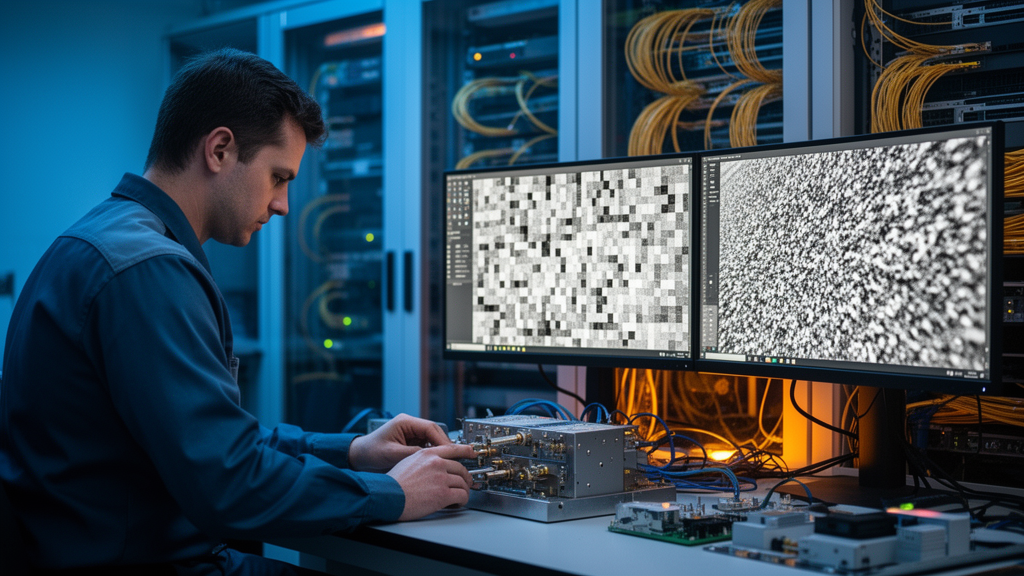
Narrowband communication systems occupy restricted frequency bands and provide low bit-rate transmission that is widely deployed across remote sensing platforms, industrial telemetry, telemedicine networks, and Internet of Things installations. In these resource-limited operating environments, carrying data-dense payloads such as high-resolution visual imagery presents a persistent engineering conflict between image reconstruction quality, transmission delay, and channel bandwidth expenditure. Conventional lossy codecs typically rely on fixed operating points or constant bit-rate encoding schemes that cannot dynamically accommodate fluctuations in channel capacity, often resulting in severe visual distortion or excessive transmission latency. To overcome these operational trade-offs, the researchers established an integrated architecture designated as the Rate-Distortion Auto-encoder enhanced Shrike Algorithm, which combines deep representation learning with runtime optimization to adaptively adjust compression factors without requiring network retraining.
The fundamental motivation behind the design stems from the physical limitations governing narrowband channels, where link-layer constraints restrict the total volume of data that can be delivered reliably within an allocated transmission window. Unlike high-throughput broadband channels that support continuous high-capacity data streams, narrowband networks prioritize extended physical range, link reliability, and low power consumption over rapid data transmission. When transmitting complex visual data, standard compression codecs lack the flexibility to negotiate dynamic shifts in network state, causing either degraded reconstruction fidelity or transmission bottlenecks that compromise time-critical remote monitoring tasks. To formally connect compression behavior directly to communication limits, the researchers developed an explicit throughput-based bit-budget formulation. Within this mathematical structure, bandwidth matching is defined as the automated calibration of compression parameters so that the total bit budget strictly adheres to the achievable channel throughput while systematically minimizing reconstruction errors during image decoding.
To guarantee consistent processing across diverse visual inputs, the framework begins with a standardized data preprocessing pipeline prior to feature extraction and compression. Raw images gathered from the training corpora undergo deterministic spatial resizing to equalized dimensions, ensuring uniform tensor geometries for subsequent neural network operations while stabilizing numerical convergence and minimizing computational variability. Following resizing, the pixel intensities are scaled through min-max normalization into a continuous numerical range between zero and one, an operation that equalizes luminance intensity ranges, stabilizes neural gradient updates, and prevents systematic bias toward extreme pixel values. Importantly, the three standard red, green, and blue color channels are preserved in full throughout the transformation without channel decimation or subsampling, producing a normalized input tensor that enables deep convolutional layers to capture both high-frequency spatial patterns and detailed chromatic information.
The feature extraction stage employs a convolutional neural network architecture specifically tailored to isolate hierarchical structural representations from the normalized image tensors. The network scans input imagery using small spatial filter kernels to compute spatial convolutions that delineate localized edges, fine structural transitions, and broad surface textures necessary for high-fidelity representation. Interspersed max pooling operations selectively extract dominant regional feature values across designated pooling windows, simultaneously reducing spatial dimensionality and suppressing local noise while lowering total computational overhead. Non-linear Rectified Linear Unit activation functions are applied to map intermediate feature representations into non-linear manifolds, allowing the network to capture complex structural patterns. The output of this convolutional pipeline is an activated hierarchical feature map that encapsulates local and global visual details, providing an information-dense representation ready for downstream latent vector encoding.
At the center of the framework is a learned Rate-Distortion Auto-encoder that converts the spatial feature maps into compact latent vectors while explicitly balancing reconstruction fidelity against transmitted bitrate. The autoencoder consists of a deep convolutional encoder, an intermediate quantization module, a learned parametric entropy model, and a symmetrical convolutional decoder. The encoder maps preprocessed visual data into continuous latent coordinates, which are subsequently quantized into discrete symbols to enable digital transmission. To estimate the operational bitrate without relying on coarse approximations, a parametric probability density model approximates the likelihood distribution of the quantized symbols, calculating expected bits from negative log-likelihood values. Arithmetic entropy coding is then executed on the quantized latent variables to generate the practical compressed bitstream. During decoding, the quantized latent representations pass through reconstructed convolutional layers to synthesize the final output image, driven by a joint optimization loss that balances mean squared error reconstruction distortion against the entropy-coded transmission footprint scaled by a Lagrange trade-off parameter.
To solve the challenge of selecting appropriate compression trade-offs on the fly without retraining neural weights, the authors integrated a nature-inspired metaheuristic designated as the Shrike Optimization Algorithm. While conventional learned image compression systems operate at fixed, pre-trained rate-distortion operating points, the lightweight Shrike optimizer executes dynamically at runtime on a per-image basis. The algorithm models candidate compression parameters as nests and parent solutions, iteratively generating candidate nestlings through randomized exploration and female-directed search steps designed to evade suboptimal local minima. Each candidate solution represents an explicit value for the Lagrange multiplier within defined upper and lower bounds, and is evaluated using a constrained rate-distortion fitness function that penalizes any configuration whose projected bitstream exceeds the permissible channel bit budget. With an analytical computational complexity scaling linearly with search iterations, population size, and problem dimensionality, the optimization runs with negligible execution overhead compared to deep neural inference, enabling dynamic per-image bandwidth matching tailored to immediate channel throughput feedback.
Experimental evaluation of the proposed framework was conducted using Python 3.9 and PyTorch running on an Intel Core i7-12700K system configured with 32 gigabytes of random-access memory and integrated graphics, evaluating model inference with a unit batch size under simulated narrowband channel constraints. The neural training regimen utilized the official MS COCO 2014 dataset, incorporating 82,783 images for model training alongside 40,504 validation images, while the Kodak photographic collection of 24 standardized images served as an independent benchmark corpus to prevent data partitioning bias. Model optimization was executed using the Adam optimizer with a fixed learning rate of 0.001 and a batch size of 32 across 30 training epochs, tracking validation losses to implement early stopping. Training and validation loss curves demonstrated rapid convergence within the initial ten epochs before leveling into stable plateaus, reaching final loss values of 0.08 on the training split and 0.12 on validation data, with balanced generalization achieved between epochs 15 and 20.
Performance assessments demonstrated substantial gains across objective reconstruction fidelity and operational efficiency metrics when compared to both traditional codecs and learning-based architectures under matched bitrate conditions. Across the evaluated rate-distortion operating range, the proposed model achieved a peak Peak Signal-to-Noise Ratio of 49.90 decibels, a Multi-Scale Structural Similarity Index of 0.90, and a Learned Perceptual Image Patch Similarity score of 0.23, outperforming established baseline codecs including JPEG, JPEG 2000, Better Portable Graphics, WebP, and the attention-based ETAM network. In matched-bitrate benchmark comparisons, the framework provided a 13.69 decibel improvement over a lightweight attention-convolution model, while direct statistical comparisons against an autoencoder baseline demonstrated a mean PSNR difference of 21.50 decibels (95% confidence interval: 19.85 to 23.15, p < 0.001, Cohen’s d = 1.82). Operational latency measurements under simulated narrowband conditions recorded an average compression time of 0.138 milliseconds, a transmission latency of 0.065 milliseconds, a total execution time of 0.142 milliseconds, and an effective throughput of 0.468 gigapixels per second.
To evaluate the statistical consistency and classification stability of the reconstructed imagery, the researchers implemented a five-fold cross-validation scheme alongside an auxiliary diagnostic quality discrimination task. The diagnostic task evaluated feature separability by categorizing reconstructed samples above a fidelity threshold as high-quality reconstructions, yielding an Area Under the Receiver Operating Characteristic Curve of 0.933. Across the five validation folds, the model exhibited consistent operational stability, recording mean classification accuracy of 97.2 percent, precision of 96.5 percent, recall of 95.8 percent, and an F1-score of 96.8 percent, paired with a root mean squared error of 0.0112 and an R-squared value of 0.9824. Component ablation studies conducted under an identical 0.15 bit-per-pixel constraint further revealed that while baseline convolutional layers and standalone rate-distortion learning provide incremental fidelity, the integrated coupling of the rate-distortion autoencoder with shrike optimization attained the highest visual reconstruction fidelity with negligible latency penalties.
Despite the observed experimental improvements, the authors noted several methodological boundaries and operational constraints that warrant further investigation. The reported peak fidelity of 49.90 decibels represents an individual operating optimum rather than a universal mean across diverse operational regimes, emphasizing that rate-distortion curves remain the definitive metric of comparative performance. Furthermore, while the MS COCO and Kodak corpora provide standardized evaluation environments, they do not fully replicate the erratic physical channel fading, packet loss, and severe interference encountered in unmanaged wireless deployments. The computational complexity of combined neural inference and runtime optimization also imposes heavier hardware burdens than legacy codecs, potentially constraining immediate deployment on ultra-low-power edge nodes. Future development efforts will aim to assess real-world entropy bitstream overheads, construct lightweight edge-executable architectures, incorporate multimodal sensor data, and test adaptive transmission over real-world cellular Internet of Things networks.
Subject of Research: Deep learning-based adaptive image compression and narrowband bandwidth matching
Article Title: Deep learning-based adaptive image compression and narrowband communication bandwidth matching optimization system
Article References: Yi, Z., Wang, F., Wang, S., & Gao, S. (2026). Deep learning-based adaptive image compression and narrowband communication bandwidth matching optimization system. Discover Internet of Things, 6(1), Article 165. https://doi.org/10.1007/s43926-026-00488-3
Image Credits: AI Generated
DOI: 10.1007/s43926-026-00488-3
Keywords: Adaptive image compression, Narrowband communication, Rate-distortion autoencoder, Shrike optimization algorithm, Internet of Things, Feature extraction, Peak signal-to-noise ratio, Structural similarity index, Learned perceptual image patch similarity, Throughput constraints, Bandwidth matching, Convolutional neural networks, MS COCO dataset, Kodak benchmark, Quantization, Arithmetic entropy coding, Remote sensing, Transmission latency
News Source: Denise Maddox. (November 13, 2026). Adaptive Deep Compression Balances Image Fidelity and Narrowband Channel Constraints. Scienmag.