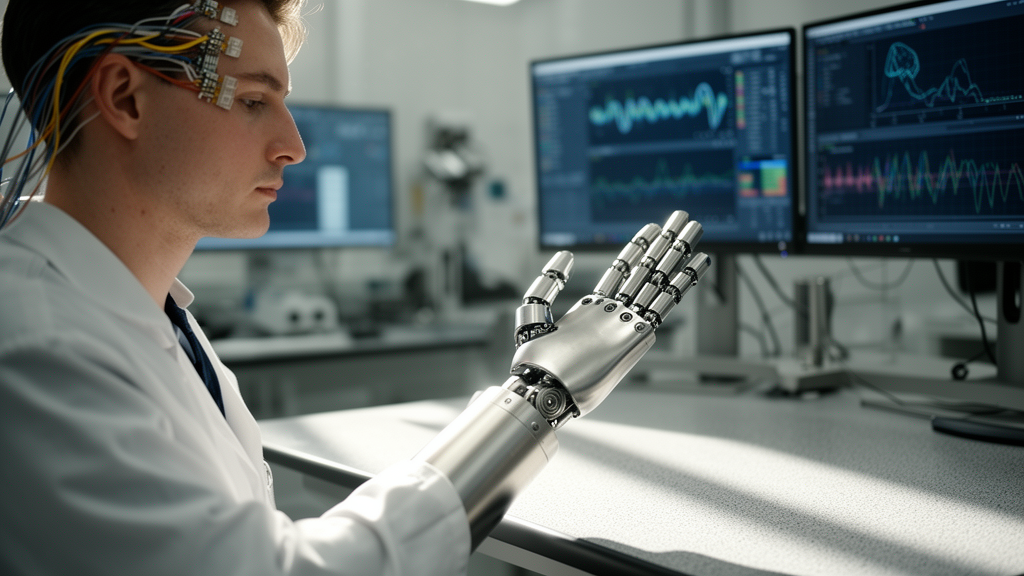
A comprehensive scientific review from the University of Washington highlights that bridging the persistent clinical divide in advanced neuroprosthetics requires treating machine learning decoders and human users as dynamic, mutually adapting partners. Despite impressive laboratory demonstrations of fluid prosthetic control, real-world deployment continues to falter, with upper-limb prosthetic abandonment rates lingering between twenty and forty percent after decades of development. This translational failure stems directly from domain shift, an ongoing phenomenon where the statistical distributions of biological signals recorded during daily life systematically deviate from initial calibration data. Rather than viewing signal variability as a mere engineering nuisance, the synthesis of fifty-five peer-reviewed studies demonstrates that non-stationarity reflects living neurophysiology, including muscle fatigue, physical sensor displacement, and persistent cortical reorganization. By moving away from static computational models toward closed-loop domain adaptation, researchers are discovering that coordinating decoder parameter adjustments with natural motor learning offers a viable pathway toward reliable, long-term assistive neurotechnologies.
The neurophysiological foundations of myoelectric interfaces reveal why bridging the gap between benchtop prototypes and real-world prostheses remains technically demanding. Surface electromyography detects electrical potentials generated during muscle contractions, acting as a non-invasive conduit to decipher user motor intention. While advanced techniques decompose surface recordings into individual motor neuron discharge timings following targeted muscle reinnervation, practical deployment faces severe physical constraints. Commercial myoelectric sockets typically incorporate up to eight bipolar channels relying on dry, mechanically fixed metal contacts embedded within a rigid socket liner, contrasting sharply with research environments that utilize dense grids of gel-based silver-silver chloride electrodes. Daily activities inevitably introduce skin-electrode motion artifacts, cable movements, sweat accumulation, and fluctuating contact impedance that degrade signal quality. In clinical cohorts, such as individuals with neuromuscular impairments, signal-to-noise ratios can plunge to roughly two decibels. Furthermore, routine physical activities cause millimeter-scale electrode shifts and limb posture variations that alter underlying spatial muscle activation patterns, drastically eroding downstream decoding accuracy.
Classical decoding architectures established foundational benchmarks for neuroprosthetic control but remain inherently vulnerable to shifting signal statistics. Early systems relied on static linear regression, Wiener filters, and population-vector algorithms that treated recorded biosignals as time-invariant inputs mapped directly to intended movement kinematics. State-space formulations, particularly the Kalman filter, introduced an explicit dynamical model where intended kinematic trajectories evolve as latent states observed through noisy neural or electromyographic features. Specialized extensions, such as non-linear recursive Bayesian filters and generalized linear models, refined torque estimation and captured non-Gaussian spike probabilities. Nevertheless, all classical formulations operate under the fundamental assumption that underlying statistical relationships remain stationary over time. When exposed to mechanical electrode displacement, shifting limb orientations, or metabolic fatigue, these fixed observers inevitably fail because their static observation matrices cannot accommodate altered signal distributions. Consequently, decoders that exhibit pristine accuracy during brief calibration routines experience steep performance degradation when users attempt continuous, unconstrained manipulation outside laboratory walls.
Modern machine learning techniques have substantially expanded decoding flexibility by discovering complex non-linear mappings directly from multichannel recordings without handcrafted feature engineering. Deep convolutional architectures exploit local spatial and temporal correlations, whereas recurrent networks capture sequential temporal dynamics, with hybrid networks successfully integrating both spatial and temporal hierarchies. Furthermore, continuous non-linear regression decoders bypass discrete gesture classification, granting simultaneous, proportional control across multiple mechanical degrees of freedom. Hybrid frameworks like KalmanNet combine physical state-space principles with neural networks that estimate Kalman gain values directly from data. Despite these representational strides, highly parameterized models often overfit session-specific artifacts such as electrode impedance, skin temperature, and postural bias. This vulnerability was empirically validated in the longitudinal DELTA benchmark, which tracked high-density electromyographic decoding across six sessions spanning several months. While offline-trained models suffered severe inter-session accuracy losses, incremental-learning strategies that continually ingested small streams of freshly recorded data sustained robust performance across the entire multi-month evaluation.
The underlying biological origins of domain shift present an even more profound challenge across both non-invasive and chronically implanted interfaces. In intracortical brain-machine interfaces, recording arrays experience microscopic physical displacement relative to individual target neurons, alongside progressive foreign-body responses that deposit insulating glial scar tissue around electrode shanks. Chronic recording studies demonstrate that neural signal amplitudes fluctuate dramatically, swinging between sixty-six percent and two hundred thirty-six percent of their baseline mean across single days, weeks, and months. Although multiunit thresholding can preserve usable signals when isolated single units vanish, disappearing channels and drifting neuronal tuning properties repeatedly degrade static decoders. Moreover, mechanical disturbances compound these biological instabilities across different operational timescales. In electromyographic control, an electrode shift of merely seven millimeters can trigger an accuracy reduction of fifteen to thirty percent, while a one-centimeter displacement produces up to a thirty-five percent drop in classification performance, illustrating how physical movement alters spatial correlation profiles.
Rather than treating neurophysiological evolution as an unwanted source of noise, the review emphasizes that neural plasticity constitutes a vital biological resource for sustaining motor proficiency. Cortical circuits actively reorganize as users interact with neuroprosthetic interfaces over days, weeks, and years, establishing stable motor memories that mirror natural motor skill consolidation. Chronic brain-machine interface experiments reveal that prolonged training produces resilient neural activation patterns distributed across both direct decoder-coupled units and indirect cortical ensembles. When closed-loop decoder adaptation is applied, it actively reshapes cortical representations, accelerating user competency. However, decoding stability requires delicate tuning; excessively aggressive algorithmic updates disrupt nascent cortical patterns, destabilizing user learning before durable motor memories can form. Studies pairing voluntary cortical activation with functional electrical stimulation and contingent sensory feedback further show that guided sensorimotor integration reinforces adaptive cortical remodeling. Reframing neural plasticity as an intrinsic engine of functional recovery demonstrates that successful translation depends on algorithms designed to harmonize with, rather than suppress, living neuroplastic reorganization.
To track evolving biological non-stationarities, computational researchers have engineered diverse algorithmic domain adaptation techniques that balance tracking responsiveness against closed-loop stability. Closed-loop decoder adaptation dynamically recalibrates parameters during live user interaction; methods like SmoothBatch execute updates every one to two minutes using sliding averages, while online adaptive Kalman filters continuously adjust observation parameters while maintaining constant kinematic state transitions to prevent erratic movements. In parallel, point-process adaptive filtering analyzes spike-train dynamics at millisecond resolution, with modern variants modeling functional population connectivity to track substantial tuning shifts. Dynamic ensemble models, exemplified by the DyEnsemble framework, maintain multiple candidate decoders trained across diverse historical conditions, using Bayesian inference to dynamically reweight each model according to its real-time compatibility with incoming data. Additionally, reinforcement learning models employing actor-critic architectures optimize decoding policies using evaluative reward signals rather than labeled kinematic targets. This reinforcement paradigm bypasses the need for explicit movement calibration in individuals experiencing severe paralysis, sustaining functional control even amidst sudden neural channel loss.
Cross-subject variability introduces distinct domain adaptation challenges because individual anatomical differences, subcutaneous adipose thickness, residual limb geometry, and idiosyncratic movement habits prevent algorithms from generalizing across different users. Benchmark evaluations on the NinaPro dataset, which contains electromyographic recordings from sixty-seven able-bodied participants and eleven amputees across fifty-two gestures, clearly document steep classification drops when decoders trained on one individual encounter a new subject. In amputees, motor features occupy largely non-overlapping topological regions compared to able-bodied distributions, precluding simplistic gain adjustments. To bridge these disparities without exhausting calibration sessions, transfer learning frameworks deploy Riemannian manifold geometry, using techniques like unsupervised Generic Recentering and supervised Personally Adjusted Recentering to align covariance structures directly onto Riemannian space. Concurrently, simulation-driven transfer learning utilizes computational digital twins to generate vast libraries of synthetic electromyographic data containing known motor unit activations. Pre-training deep decoders on synthetic data before fine-tuning on minimal patient recordings substantially reduces clinical calibration burdens while outperforming randomly initialized baselines.
The culmination of modern neuroprosthetic theory centers on closed-loop co-adaptation, where the biological user and machine decoder learn simultaneously as coupled agents. Long-term training studies demonstrate that human users actively refine their muscle excitation patterns, with classification errors decreasing exponentially to reach a stable plateau after four days in able-bodied individuals and six to nine days in amputees. Formalizing this interaction through game-theoretic frameworks models the human and decoder as independent learners whose joint gradient dynamics ideally converge to a stable Nash equilibrium. Crucially, empirical testing challenges the assumption that faster algorithmic adaptation is inherently superior; in experimental tracking tasks, decoders operating at a slower learning rate of 0.25 frequently outperformed those running at 0.75 by allowing human motor learning to stabilize. A recent structured taxonomy organizes these strategies into four distinct paradigms: on-demand recalibration, unsupervised streaming updates, predictor-dependent confidence gating, and environment-dependent adaptation that explicitly incorporates user feedback.
Significant translational hurdles must still be surmounted before these adaptive algorithms can reliably populate commercial neuroprostheses. Most published benchmarks rely exclusively on controlled laboratory experiments spanning brief multi-week periods rather than longitudinal, multi-year clinical deployments in community environments. Crucially, empirical evaluations across diverse clinical subgroups, including pediatric users, older adults, and patients with diabetic neuropathy, remain sparse. Highly complex deep ensembles and particle filters also face severe computational, thermal, and battery power constraints when deployed on self-contained wearable embedded hardware. Furthermore, moving beyond offline accuracy toward standardized control-theoretic metrics, such as Fitts’ law throughput and path efficiency, is essential to quantify true functional utility. By unifying closed-loop adaptation, transfer learning initialization, and co-adaptive human learning within power-efficient architectures, neuroengineers can ultimately mitigate chronic device abandonment, delivering dependable, intuitive assistive devices that restore lasting motor autonomy worldwide.
Subject of Research: Domain adaptation and co-adaptive decoding in neuroprosthetic control
Article Title: Co-adaptive learning and domain adaptation bridge the translational gap in neuroprosthetic control: a review
Article References: Kanakath, I. K. (2026). Co-adaptive learning and domain adaptation bridge the translational gap in neuroprosthetic control: a review. Frontiers in Neuroscience, 20, 1974861. https://doi.org/10.3389/fnins.2026.1974861
Image Credits: AI Generated
DOI: 10.3389/fnins.2026.1974861
Keywords: neuroprosthetics, domain adaptation, co-adaptive learning, myoelectric control, surface electromyography, brain-machine interfaces, neural plasticity, cross-session drift, electrode displacement, closed-loop decoder adaptation, Kalman filter, reinforcement learning, transfer learning, Riemannian geometry, prosthetic abandonment, motor unit action potentials, game-theoretic decoding
News Source: Cassandra Pierce. (November 13, 2026). Adaptive Decoders and Human Learning Help Bridge Clinical Neuroprosthetic Control Gaps. Scienmag.