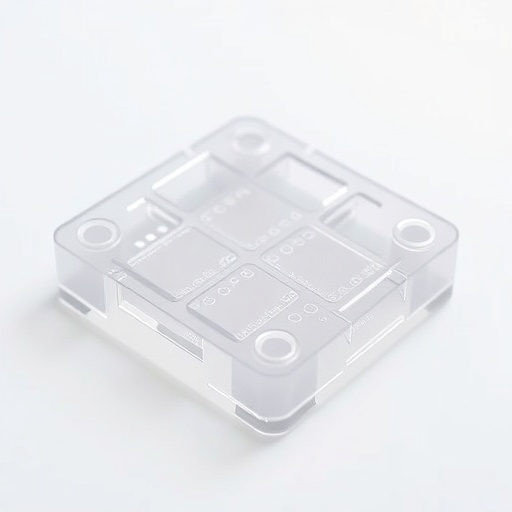
In a groundbreaking development that promises to revolutionize the field of wearable electronics and soft robotics, researchers led by Yang, Tang, and Xue have unveiled an innovative technique for adaptive 3D printing of moldable conductive polymer composites. Their work, published in the highly regarded journal npj Flexible Electronics in 2026, presents a transformative approach to fabricating highly sensitive soft sensors that boast an unprecedentedly broad working range. This novel technology seamlessly integrates material science with advanced additive manufacturing techniques, signaling a new era in sensor design and functionality.
At the heart of this innovation lies the development of a moldable conductive polymer composite optimized for the intricate demands of flexible, stretchable sensor applications. Traditional sensors, often rigid and brittle, fail to accommodate the dynamic mechanical deformations characteristic of soft robots or wearable devices. The polymer composite synthesized by Yang and colleagues addresses this limitation by combining mechanical compliance with electrical conductivity, enabling sensors to operate reliably under large strains without loss of sensitivity or performance.
The researchers utilized an adaptive 3D printing strategy that grants unparalleled control over the spatial arrangement and microstructure of the conductive polymer composite during fabrication. Unlike conventional printing approaches constrained by fixed parameters and geometries, this adaptive method dynamically modulates printing conditions, such as nozzle movement speed, extrusion rates, and environmental parameters, to tailor the sensor’s microarchitecture. This precision crafting results in sensors whose conductive pathways are optimized in real-time to enhance signal transduction despite substantial mechanical deformation.
One of the standout features of this technology is the moldability of the conductive polymer composite precursor, which can be shaped and printed into complex, free-form geometries that conform exquisitely to the user’s body or soft robotic surfaces. This level of customization paves the way for next-generation soft sensors that are not only more comfortable and ergonomic but also capable of detecting subtle physiological or mechanical signals with remarkable fidelity. Such sensors hold immense promise for medical diagnostics, human-machine interfaces, and responsive soft robotic systems.
The broad working range of the developed sensor is particularly noteworthy. Where prior soft sensors exhibited sensitivity only within narrow strain intervals, the sensors fabricated through this adaptive 3D printing pipeline demonstrate consistent performance across a wide range of mechanical deformations, encompassing small subtle movements to extreme stretches. This robustness is achieved through the composite’s unique microstructure, which features interconnected conductive networks embedded in an elastomeric matrix that can elongate and recover repeatedly, preserving electrical pathways.
Electromechanical characterization of the sensors showcased impressive gauge factors and minimal hysteresis, key parameters that define sensor accuracy and repeatability. The integration of conductive nanofillers within the polymer matrix creates a percolation network that responds linearly to strain while maintaining electrical stability. Moreover, the tunability of filler content and polymer cross-linking density allows fine adjustments of sensor sensitivity and mechanical properties, enabling bespoke designs tailored to specific applications or environmental conditions.
This advancement also addresses major challenges in manufacturing scalability and device integration. Due to the adaptive nature of the printing technique, complex multi-material sensors can be manufactured in a layer-by-layer fashion without the need for laborious post-processing steps. The ability to print directly onto flexible substrates or even living tissues opens new frontiers in bioelectronic interfaces and on-demand sensor fabrication. The inherently moldable ink formulation is compatible with existing additive manufacturing infrastructure, facilitating rapid translation from laboratory prototypes to commercial production.
In terms of biomedical applications, such adaptable soft sensors can revolutionize continuous health monitoring by providing real-time feedback on parameters such as pulse, respiration, joint movement, and muscle activity. The comfort afforded by the moldable design minimizes skin irritation and maximizes signal accuracy by maintaining intimate contact with the body. Additionally, in prosthetic devices, these sensors can enable intuitive control schemes by detecting subtle muscular contractions, greatly enhancing the user experience.
Soft robotics stands to gain immensely from this technology as well. The ability to print sensors that conform perfectly to deformable robot surfaces and maintain consistent electrical output under large strains enables feedback loops critical for motor control, balance, and environmental interaction. Such capabilities could accelerate the development of autonomous soft robots capable of complex locomotion and manipulation tasks in unstructured environments where rigidity and hardness are detrimental.
Beyond these immediate applications, the fundamental insights into the interplay between polymer chemistry, nanofiller distribution, and printing parameters provided by this study offer a valuable framework for future explorations in flexible electronics. The combination of adaptive manufacturing with materials design exemplifies a shift towards more intelligent fabrication methods that are responsive to desired device functions, potentially transforming various fields such as energy harvesting, tactile sensing, and electronic skin.
Looking ahead, the integration of this technology with wireless communication modules and low-power signal processing circuits could yield fully autonomous soft sensor systems capable of long-term deployment. Such systems would be invaluable not only in healthcare and robotics but also in environmental monitoring, sports performance analysis, and interactive consumer electronics. The scalability and adaptability of the process suggest a smooth pathway to widespread adoption.
Moreover, the environmentally benign nature of the polymer composites used in this study aligns with increasing demands for sustainable and recyclable electronics. The researchers’ use of biocompatible and non-toxic materials decreases the ecological footprint of sensor production and disposal, contributing to the growing movement towards green electronics. This ethical dimension enhances the societal impact and acceptability of the technology.
In conclusion, the adaptive 3D printing method developed by Yang, Tang, Xue, and their team epitomizes an exciting convergence of materials innovation and advanced manufacturing. By enabling the creation of highly sensitive, moldable soft sensors with expansive working ranges, they have opened pathways for new classes of intelligent devices that integrate seamlessly with the human body and soft robotic systems. Their work sets a compelling precedent for future research and commercialization in the domain of flexible, wearable, and bio-interfaced electronics.
As flexible electronics evolve from a niche innovation to a central technology platform, adaptive fabrication methods such as this will likely dominate the landscape. Continued research into optimizing material formulations, integrating multifunctionality, and developing comprehensive device ecosystems will unleash the full potential of soft sensors. The implications for healthcare, robotics, consumer electronics, and environmental sustainability are profound, promising a future where technology is both pervasive and unobtrusively integrated into everyday life.
This pioneering achievement underscores the power of interdisciplinary collaboration and the value of pushing the boundaries of both materials science and additive manufacturing. The journey from conceptual polymer composites to fully functional, adaptive 3D-printed sensors exemplifies the creative ingenuity driving modern science, heralding a future rich with responsive, intelligent, and adaptable electronic systems.
Subject of Research: Development of moldable conductive polymer composites for adaptive 3D printing and their application in highly sensitive soft sensors with a broad working range.
Article Title: Adaptive 3D printing of moldable conductive polymer composite for highly sensitive soft sensors with a broad working range.
Article References: Yang, Y., Tang, Y., Xue, K. et al. Adaptive 3D printing of moldable conductive polymer composite for highly sensitive soft sensors with a broad working range. npj Flex Electron (2026). https://doi.org/10.1038/s41528-025-00523-3
Image Credits: AI Generated
Tags: adaptive 3D printingadvanced additive manufacturing techniquesdynamic mechanical deformationselectrical conductivity in polymersflexible sensor designhigh-performance soft sensorsmechanical compliance in sensorsmoldable conductive polymer sensorsnpj Flexible Electronics researchsoft robotics technologytransformative sensor fabricationwearable electronics innovation