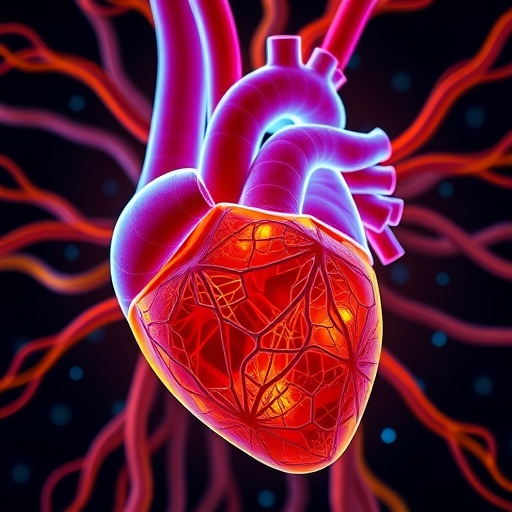
In a groundbreaking study published in Nature Communications, a team of researchers led by Leerberg, Avillion, and Priya has unveiled critical insights into how the spatial organization of actomyosin within developing cardiomyocytes directs the intricate cellular shape transformations necessary for the formation of heart chamber curvatures. This work advances our understanding of the biomechanical and molecular orchestration guiding cardiac morphogenesis, with important implications for congenital heart disease and regenerative medicine.
The heart’s remarkable architecture, characterized by its complex chambers and curved surfaces, does not arise from random cellular behaviors but from tightly controlled, region-specific cellular events. The study focuses on cardiomyocytes—the beating heart muscle cells—and reveals how the localized regulation of actomyosin cytoskeletal components influences their shape dynamics during the critical phases of chamber curvature development.
Actomyosin, a molecular motor complex composed of actin filaments and myosin-II motors, plays a pivotal role in generating contractile forces within cells. The researchers demonstrate that within cardiomyocytes, actomyosin organization is not uniform, but instead shows distinct regional patterns correlating with different mechanical and morphological demands. This regionalization enables cardiomyocytes to undergo precise shape changes required for the elaboration of chamber geometry.
The investigators employed cutting-edge live-cell imaging techniques combined with advanced quantitative microscopy to visualize actomyosin architecture in real time during heart development. High-resolution confocal imaging revealed that actomyosin fibers assemble preferentially along specific cellular axes and localize differentially at cell borders, establishing tension gradients that drive anisotropic cell shape remodeling.
Beyond visualization, the team utilized sophisticated biomechanical measurements to link actomyosin organization with force generation within cardiomyocytes. By applying laser ablation and atomic force microscopy, they quantified local mechanical stresses and demonstrated that areas exhibiting enriched actomyosin correspond with zones of heightened contractility, guiding cells toward curved morphologies.
A compelling aspect of this research is the identification of molecular signaling pathways that regulate actomyosin assembly and distribution within cardiomyocytes. The study highlights the roles of Rho GTPases, which orchestrate cytoskeletal dynamics, and upstream mechanotransductive cues derived from the extracellular matrix. These molecular circuits modulate the phosphorylation states of myosin regulatory light chains, fine-tuning contractile activity in a spatially restricted manner.
This region-specific regulation of actomyosin does not function in isolation but is integrated with alterations in cell-cell adhesion and extracellular matrix remodeling. The researchers found that intercellular junctions at sites of curvature formation undergo dynamic adjustments mediated by cadherins, enabling coordinated tissue-level morphogenesis via mechanical coupling of adjacent cardiomyocytes.
Importantly, the authors propose a biomechanical framework wherein localized actomyosin contractility generates asymmetric cortical tension, driving apical constriction and elongation of cardiomyocytes. These shape changes at the single-cell level cumulatively sculpt the macroscopic curves and folds of heart chambers, illuminating a fundamental principle of organ architecture establishment.
The implications of these findings extend beyond developmental biology. Aberrations in actomyosin signaling and organization could underlie congenital defects involving chamber malformations. Moreover, harnessing the knowledge of regionally regulated cytoskeletal dynamics may inform bioengineering strategies aiming to recreate functional cardiac tissues with correct morphology in vitro.
From a technical standpoint, the multidisciplinary approach employed sets a new standard for investigating cytoskeletal mechanisms in vivo. By integrating molecular genetics, live imaging, and physical force measurements, this study achieves a comprehensive understanding of how molecular and mechanical factors converge during cardiac morphogenesis.
Furthermore, the identification of regulatory nodes within the actomyosin pathway opens avenues for targeted therapeutic interventions. Modulating actomyosin contractility pharmacologically or through gene editing could potentially correct developmental defects or improve outcomes in cardiac repair therapies.
In summary, Leerberg and colleagues deliver a seminal contribution that elucidates how spatial regulation of actomyosin underpins the morphogenetic choreography of cardiomyocytes during heart chamber formation. Their insights reveal an elegant interplay between molecular patterning and biophysical forces that orchestrate the emergence of functional cardiac architecture.
This research not only enhances the fundamental understanding of heart development but also paves the way for innovations in congenital heart disease diagnosis, treatment, and tissue engineering. As cardiomyocytes precisely tune their cytoskeletal networks in space and time, the heart emerges as a dynamic symphony of cellular mechanics and molecular signaling, a marvel that science is now beginning to decode.
The intricate dance of actomyosin remodeling within cardiomyocytes stands as a testament to the sophistication of biological design, where regional control of cytoskeletal elements ensures the heart’s chambers take on their life-sustaining curved forms. Future research building on these findings promises to unveil further layers of complexity and biological elegance intrinsic to organogenesis.
As we deepen our grasp of the biomechanical and biochemical principles guiding cardiac tissue shaping, the potential to manipulate these processes for therapeutic ends grows ever more tangible. This study marks a pivotal step on that journey, offering a high-resolution blueprint of cytoskeletal regulation in one of biology’s most vital cellular transformations.
Subject of Research: Regionalized regulation of actomyosin cytoskeleton influencing cardiomyocyte shape changes during heart chamber curvature formation
Article Title: Regionalized regulation of actomyosin organization influences cardiomyocyte cell shape changes during chamber curvature formation
Article References:
Leerberg, D.M., Avillion, G.B., Priya, R. et al. Regionalized regulation of actomyosin organization influences cardiomyocyte cell shape changes during chamber curvature formation. Nat Commun (2026). https://doi.org/10.1038/s41467-026-70384-5
Image Credits: AI Generated
Tags: actomyosin cytoskeletal organizationactomyosin regulation in cardiomyocytesbiomechanical forces in heart developmentcardiac morphogenesis mechanismscardiomyocyte shape transformationcongenital heart disease researchcontractile forces in cardiomyocytesheart chamber curvature developmentlive-cell imaging of heart cellsmolecular motors in heart cellsregenerative medicine for heart repairspatial patterning of actomyosin